
Catalogue Search | MBRL


Are you sure you want to remove the book from the shelf?

{{itemTitle}}
127
result(s) for
"Altheide, David L"
Sort by:
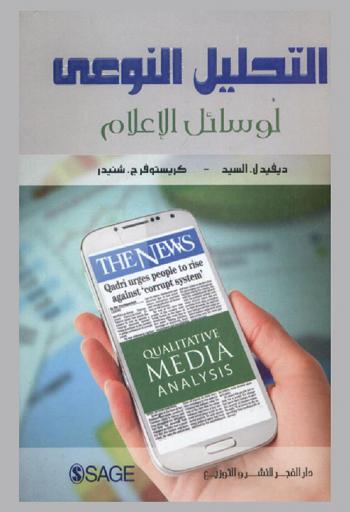
التحليل النوعي لوسائل الإعلام
يخاطب مؤلف هذا الكتاب الباحثين فى مجال البحث النوعى، وكثيرون ليسوا على دراية بالاختلافات بين البحث النوعى والبحث الكمى وهذا ما يتناوله الكتاب بالتوضيح والشرح التفصيلى، إن التحليل الكمى يفكر فى الأرقام وتحويلها إلى احصاءات قابلة للاستخدام، أما التحليل النوعى فإنه يفكر فى الكلمات ومعانيها وآثارها الاجتماعية ومن بين الكلمات التى يركز عليها هذا الكتاب الجريمة والمخدرات والعنف والارهاب والخوف كما جاءت فى وثائق وسائل الإعلام المقروءة والمسموعة، المرئية والإلكترونية وأيضا شبكات التواصل الاجتماعى الحديثة عبر الانترنت.
BOOK

Pandemic in the Time of Trump
This paper examines the power of a mediatized President to use reflexive propaganda—the rules and assumptions of digital media—to define a public health crisis. During the 2020 coronavirus pandemic, President Trump engaged in attention-based politics, or the use of media to draw attention of the largest audience to himself, at the expense of an efficient response to a major public health crisis. The repetitive tweets, with a common form—vulgar and combative language, usually against journalists—converted Donald Trump into a digital meme and enabled the President to dwell on his distorted accomplishments and TV ratings, to downplay health risks, and initially define the lethal virus as a benign hoax.
Journal Article

Policing and social media
This book investigates various public aspects of the management, use, and control of social media by police agencies in Canada.This book aims to illustrate the process by which new information technology--namely, social media--and related changes in communication formats have affected the public face of policing and police work.Schneider argues.
eBook
Consuming Terrorism
This article discusses a process that linked giving and spending to patriotism, domestic control, and a major foreign policy shift following the terrorist attacks on September 11, 2001. Analysis of news reports and advertisements suggests that popular culture and mass media depictions of fear, patriotism, consumption, and victimization contributed to the emergence of a national identity and collective action that transformed the meaning of terrorism from a strategy to a condition: terrorism world. Initial declarations about recovery and retaliation to promote patriotism became a “war on terrorism” with no end in sight. In this process, global policing that would justify a “first strike” against sovereign governments was socially constructed as commensurate with personal caring and national identity. These findings are organized around three points: (1) fear supported consumption as a meaningful way for audiences to sustain an identity of substance and character; (2) consumption and giving were joined symbolically as government and business propaganda emphasized common themes of spending and buying to “help the country get back on track”; (3) the absence of a clear target for reprisals contributed to the construction of broad symbolic enemies and goals.
Journal Article

\The News Media, the Problem Frame, and the Production of Fear\
The role of the news media in promoting a public discourse of fear is examined. A conceptual model is offered that is based on recent developments in communication formats and frames. The emphasis is on the impact of media forms and frames for guiding the selection and presentation of reports emphasizing fear (e.g., crime, drugs, violence). A \"problem frame\" compatible with format and entertainment needs is used by the news media as a secular version of a morality play. This promotes messages that resonate fear. The role of the problem frame is described as part of the process for promoting widespread messages stressing fear and danger. Materials from a qualitative content analysis approach, \"tracking discourse,\" of selected news media illustrate how the focus and content of \"fear\" shifts over a period of time. Conceptual and methodological implications of this approach are discussed.
Journal Article

The Triumph of Fear: Connecting the Dots about Whistleblowers and Surveillance
Edward Snowden was castigated by government officials and mainstream mass media as a traitor, spy, and international criminal when he released information about the National Security Agency (NSA) secret and massive surveillance of virtually all U.S. electronic communication. More than “wiretapping” is involved in the spin being put on Snowden's revelations. A lot of institutional duplicity has been revealed. The reaction of United States officials can be seen as a dramatic performance to demonstrate their moral resolve and complete power (even as Snowden challenged it) in order to dissuade other whistleblowers from following suite, as well as maintain authority and a discourse of fear about terrorism that justifies surveillance and other forms of social control.
Journal Article
War Programming: The Propaganda Project and the Iraq War
The invasion of Iraq was justified to the American people by a sophisticated propaganda campaign that reflected a think tank's vision for a new foreign policy. One objective of this article is to set forth a theoretical argument for analyzing modern propaganda campaigns as a feature of mass-mediated discourse crafted by think tanks and highly organized claims makers. We propose that the current structure of policy and critique is now institutionalized and formatted as War Programming, which connects criticism within a narrative sequence, including critiques and reflections about journalistic failings. The scope of the action is so immense that it precludes and preempts its critique. The second objective is to show how the rationale for the invasion was developed as a \"public conspiracy\" over a decade by the members of the Project for a New American Century (PNAC). The third aim of this article is to describe and clarify why the PNAC plans for Iraq and an imperialist foreign policy received very little news media coverage. Qualitative content analysis of news materials suggests that the news sources and media shared a logic and perspective about \"timely and entertaining news.\" The PNAC plan was not publicized by the major news media because it fell outside the focus of the Bush administration's propaganda campaign to demonize Iraq and its leader Saddam Hussein, who was held to be responsible for attacks on the United States. The implications of such a well-organized propaganda campaign for future news coverage of war are discussed.
Journal Article
Identity and the Definition of the Situation in a Mass-Mediated Context
The importance of identity and the definition of the situation for symbolic interactionist theory and research are discussed. These two concepts have been separated in much research since the 1970s, with identity being used in a variety of ways. This separation is partly attributed to paradigm shifts in social science, as well as to popular culture treatments of identity. Popular culture's emphasis on “collective” and “personal” identities is processed through entertainment formats that emphasize emotional and vicarious involvement, drama and action. Materials illustrate the presence of a mass-mediated generalized other, media communities, and the significance this has for realist and postrealist ethnography. Suggestions are offered for a reintegration of identity and the definition of the situation in ethnographic work.
Journal Article
Children and the Discourse of Fear
The news media, a dominant source of information about social issues, use entertainment formats to organize reports that audiences will understand. Part of this organized effort is the use of a discourse of fear, or the pervasive communication, symbolic awareness, and expectation that danger and risk are central features of everyday life. Reliant on formal agents of social control as news sources about fear, news reports tend to repeat certain words, themes, and perspectives that support more social control. Although associated with crime, the discourse of fear includes other topics and concerns as well. A qualitative content analysis approach, \"tracking discourse,\" permits a mapping of discourse over time and across various topics. Analysis of the use of fear in three major newspapers during 1987–1996 shows that it has increased; that a large part of the discourse of fear includes children and the spaces they occupy (e.g., schools and neighborhoods); and that it changed from a focus on specific events in the 1980s to a more generalized, pervasive perspective in the 1990s, peaking in about 1994. It is argued that this is important for making claims about \"necessary\" social action to protect children, as well as protect us from children.
Journal Article
