
Catalogue Search | MBRL


Are you sure you want to remove the book from the shelf?

{{itemTitle}}
279
result(s) for
"Martin Seligman"
Sort by:


Psychological Language on Twitter Predicts County-Level Heart Disease Mortality
Hostility and chronic stress are known risk factors for heart disease, but they are costly to assess on a large scale. We used language expressed on Twitter to characterize community-level psychological correlates of age-adjusted mortality from atherosclerotic heart disease (AHD). Language patterns reflecting negative social relationships, disengagement, and negative emotions—especially anger—emerged as risk factors; positive emotions and psychological engagement emerged as protective factors. Most correlations remained significant after controlling for income and education. A cross-sectional regression model based only on Twitter language predicted AHD mortality significantly better than did a model that combined 10 common demographic, socioeconomic, and health risk factors, including smoking, diabetes, hypertension, and obesity. Capturing community psychological characteristics through social media is feasible, and these characteristics are strong markers of cardiovascular mortality at the community level.
Journal Article

HBR's 10 must reads on mental toughness
Our professional lives are full of challenges and setbacks, but those who achieve elite performance are able to consistently rally their emotional strength in the pursuit of their goals--no matter what gets thrown at them. If you read nothing else on mental toughness, read these ten articles by experts in the field. We've combed through hundreds of articles in the Harvard Business Review archive and selected the most important ones to help you build your emotional strength and resilience--and to achieve high performance. This book will inspire you to: Thrive on pressure like an Olympic athlete Manage and overcome negative emotions by acknowledging them Plan short-term goals to achieve long-term aspirations Surround yourself with the people who will push you the hardest Use challenges to become a better leader Use creativity to move past trauma Understand the tools your mind uses to recover from setbacks-- Provided by publisher.
Book

Personality, Gender, and Age in the Language of Social Media: The Open-Vocabulary Approach
We analyzed 700 million words, phrases, and topic instances collected from the Facebook messages of 75,000 volunteers, who also took standard personality tests, and found striking variations in language with personality, gender, and age. In our open-vocabulary technique, the data itself drives a comprehensive exploration of language that distinguishes people, finding connections that are not captured with traditional closed-vocabulary word-category analyses. Our analyses shed new light on psychosocial processes yielding results that are face valid (e.g., subjects living in high elevations talk about the mountains), tie in with other research (e.g., neurotic people disproportionately use the phrase 'sick of' and the word 'depressed'), suggest new hypotheses (e.g., an active life implies emotional stability), and give detailed insights (males use the possessive 'my' when mentioning their 'wife' or 'girlfriend' more often than females use 'my' with 'husband' or 'boyfriend'). To date, this represents the largest study, by an order of magnitude, of language and personality.
Journal Article

Women are Warmer but No Less Assertive than Men: Gender and Language on Facebook
Using a large social media dataset and open-vocabulary methods from computational linguistics, we explored differences in language use across gender, affiliation, and assertiveness. In Study 1, we analyzed topics (groups of semantically similar words) across 10 million messages from over 52,000 Facebook users. Most language differed little across gender. However, topics most associated with self-identified female participants included friends, family, and social life, whereas topics most associated with self-identified male participants included swearing, anger, discussion of objects instead of people, and the use of argumentative language. In Study 2, we plotted male- and female-linked language topics along two interpersonal dimensions prevalent in gender research: affiliation and assertiveness. In a sample of over 15,000 Facebook users, we found substantial gender differences in the use of affiliative language and slight differences in assertive language. Language used more by self-identified females was interpersonally warmer, more compassionate, polite, and-contrary to previous findings-slightly more assertive in their language use, whereas language used more by self-identified males was colder, more hostile, and impersonal. Computational linguistic analysis combined with methods to automatically label topics offer means for testing psychological theories unobtrusively at large scale.
Journal Article


Navigating Into the Future or Driven by the Past
Prospection (Gilbert & Wilson, 2007), the representation of possible futures, is a ubiquitous feature of the human mind. Much psychological theory and practice, in contrast, has understood human action as determined by the past and viewed any such teleology (selection of action in light of goals) as a violation of natural law because the future cannot act on the present. Prospection involves no backward causation; rather, it is guidance not by the future itself but by present, evaluative representations of possible future states. These representations can be understood minimally as \"If X, then Y\" conditionals, and the process of prospection can be understood as the generation and evaluation of these conditionals. We review the history of the attempt to cast teleology out of science, culminating in the failures of behaviorism and psychoanalysis to account adequately for action without teleology. A wide range of evidence suggests that prospection is a central organizing feature of perception, cognition, affect, memory, motivation, and action. The authors speculate that prospection casts new light on why subjectivity is part of consciousness, what is \"free\" and \"willing\" in \"free will,\" and on mental disorders and their treatment. Viewing behavior as driven by the past was a powerful framework that helped create scientific psychology, but accumulating evidence in a wide range of areas of research suggests a shift in framework, in which navigation into the future is seen as a core organizing principle of animal and human behavior.
Journal Article
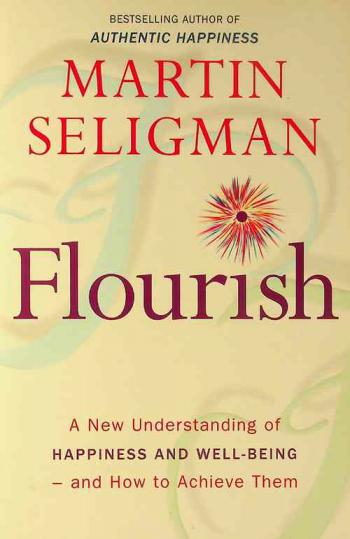
Flourish : a new understanding of happiness and well-being--and how to achieve them
'This book will help you flourish.' With this unprecedented promise, internationally esteemed psychologist Martin Seligman begins 'Flourish', the first to present his dynamic new concept of what well-being really is. Traditionally, the goal of psychology has been to relieve human suffering, but the goal of the Positive Psychology movement is different - it's about actually raisin the bar for the human condition. 'Flourish' builds on Dr Seligman's game-changing work on optimism, motivation and character to show how to get the most out of life, unveiling an electrifying new theory of what makes a good life - for individuals, for communities and for nations. In a fascinating evolution of thought and practice, 'Flourish' refines what Positive Psychology is all about. While certainly a part of high well-being, happiness - which swings with mood and is easily but unsustainably attained through pleasurable but pointless activity - doesn't give life meaning. Seligman now asks, what is it that enables you to cultivat eyour talents, to build deep, lasting relationships with others, to feel pleasure, and to contribute meaningfully to the world? In a word, what is it that allows you to flourish? \"Well-being\" takes the stage front and centre, and Happiness (or Positive Emotion) becomes one of the five pillars of Positive Psychology, along with Engagement, Relationships, Meaning and Accomplishment. Thought-provoking in its implications for education, economics, therapy, medicine and public policy - the very fabric of society - thsi book tells inspiring stories of Positive Psychology in action, including how the entire US Army is now trained in emotional resilience; how innovative schools can educate for fulfilment in life and not just for workplace success; and how corporations can improve performance at the same time as they raise employee well-being. 'Flourish' is a watershed in the understanding of well-being as well as a tool for getting the most out of life. On the cutting edge of a science that has changed millions of lives, Dr Seligman now creates the ultimate extension and capstone of his bestselling classic 'Authentic Happiness'.
Happiest People Revisited
In a past Psychological Science article, Diener and Seligman (2002) explored the characteristics of extremely happy individuals and found that strong social relationships characterized the entire group. The study was popular, perhaps because the authors focused on the very happiest people, not merely on correlations across the entire spectrum of subjective well-being. In the current study, we replicated and extended the earlier paper here by examining, in a world sample, the differences between the happiest individuals and unhappy and averagely happy people. We largely replicated earlier findings; basic need fulfillment and social resources were two ingredients for high subjective well-being. Replicating and extending the earlier findings, we found that, compared with the averagely happy people, the happiest people were more likely to come from societies high in subjective well-being and social capital. To achieve very high happiness, it is helpful not only to have desirable personal circumstances, but also to live in a prosperous happy society with strong social support. As in the original study, although a few characteristics seemed virtually necessary for subjective well-being (SWB), no characteristic guaranteed it. We also uncovered variables separating the groups that might be outcomes of SWB, for example, helping others, exercising, and not smoking.
Journal Article