
Catalogue Search | MBRL


Are you sure you want to remove the book from the shelf?

{{itemTitle}}
604
result(s) for
"Australia Colonization."
Sort by:

Settler society in the Australian colonies : self-government and imperial culture
Examines the rising numbers of free settlers from the 1820s to the 1860s, their dependence on Aboriginal, immigrant, and convict under-paid laborers, and the slow development of representative government.
Book

Bina
The incredible story of the resilience and recovery of Australia's First Nations languages Australia's language diversity is truly breathtaking.This continent lays claim to the world's longest continuous collection of cultures, including over 440 unique languages and many more dialects.
eBook

Decolonisation and the Pacific : indigenous globalisation and the ends of empire
\"This book charts the previously untold story of decolonisation in the oceanic world of the Pacific, Australia and New Zealand, presenting it both as an indigenous and an international phenomenon. Tracey Banivanua Mar reveals how the inherent limits of decolonisation were laid bare by the historical peculiarities of colonialism in the region, and demonstrates the way imperial powers conceived of decolonisation as a new form of imperialism. She shows how Indigenous peoples responded to these limits by developing rich intellectual, political and cultural networks transcending colonial and national borders, with localised traditions of protest and dialogue connected to the global ferment of the twentieth century. The individual stories told here shed new light on the forces that shaped twentieth-century global history, and reconfigure the history of decolonisation, presenting it not as an historic event, but as a fragile, contingent and ongoing process continuing well into the postcolonial era\"-- Provided by publisher.
Book

Indigenous communities and settler colonialism : land holding, loss and survival in an interconnected world
The new world created through Anglophone emigration in the 19th century has been much studied. But there have been few accounts of what this meant for the Indigenous populations. This book shows that Indigenous communities tenaciously held land in the midst of dispossession, whilst becoming interconnected through their struggles to do so.
eBook


Decolonizing Nature
British imperialism was almost unparalleled in its historical and geographical reach, leaving a legacy of entrenched social transformation in nations and cultures in every part of the globe. Colonial annexation and government were based on an all-encompassing system that integrated and controlled political, economic, social and ethnic relations, and required a similar annexation and control of natural resources and nature itself. Colonial ideologies were expressed not only in the progressive exploitation of nature but also in the emerging discourses of conservation.
At the start of the 21st century, the conservation of nature is of undiminished importance in post-colonial societies, yet the legacy of colonial thinking endures. What should conservation look like today, and what (indeed, whose) ideas should it be based upon?
Decolonizing Nature explores the influence of the colonial legacy on contemporary conservation and on ideas about the relationships between people, polities and nature in countries and cultures that were once part of the British Empire. It locates the historical development of the theory and practice of conservation - at both the periphery and the centre - firmly within the context of this legacy, and considers its significance today. It highlights the present and future challenges to conservationists of contemporary global neo-colonialism
The contributors to this volume include both academics and conservation practitioners. They provide wide-ranging and insightful perspectives on the need for, and practical ways to achieve new forms of informed ethical engagement between people and nature.
eBook

Timeline of the colonial world
Chronicles the important events, people, and locations during the Colonial era, including the age of exploration, the settling of North America, the American Revolution, and the colonization of Australia and Africa.
Book

Loss and renewal : Australian languages since colonisation
Felicity Meakins was awarded the Kenneth L. Hale Award 2021 by the Linguistic Society of America (LSA) for outstanding work on the documentation of endangered languages Australia is known for its linguistic diversity and extensive contact between languages. This edited volume is the first dedicated to language contact in Australia since colonisation, marking a new era of linguistic work, and contributing new data to theoretical discussions on contact languages and language contact processes. It provides explanations for contemporary contact processes in Australia and much-needed descriptions of contact languages, including pidgins, creoles, mixed languages, contact varieties of English, and restructured Indigenous languages. Analyses of complex and dynamic processes are informed by rich sociolinguistic description.
eBook

Memory, place and Aboriginal-settler history : understanding Australians' consciousness of the colonial past
\"Taking the absence of Aboriginal people in rural South Australian settler descendants' historical consciousness as a starting point, Memory, Place and Aboriginal-Settler History combines the methodologies and theories of historical enquiry, anthropology and memory studies to investigate how and why the colonial past is known, represented and understood by current generations. The author draws on archival research, interviews, oral histories, fieldwork, site visits and personal experience to closely examine the diverse but interconnected processes through which the past is understood and narrated. Concluding that the colonial era is primarily and most powerfully known through lived experience--through dwelling in place, material objects, family stories and everyday social interaction--this deep history demonstrates how, by unsettling taken-for-granted assumptions, a process of settler-Aboriginal reconciliation can be facilitated\"-- Provided by publisher.
Book
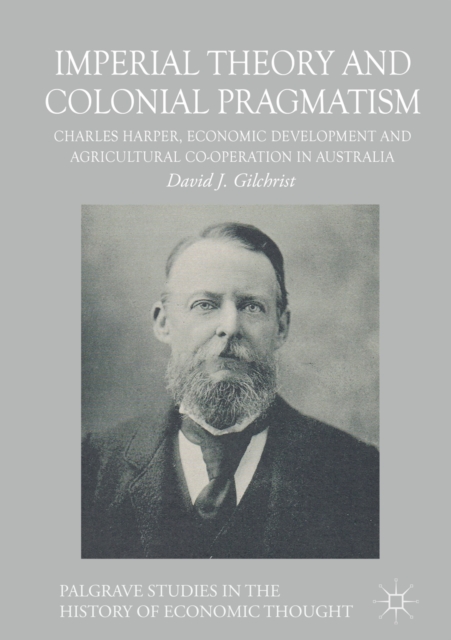
Imperial theory and colonial pragmatism : Charles Harper, economic development and agricultural co-operation in Australia
This book considers the role played by co-operative agriculture as a critical economic model which, in Australia, helped build public capital, drive economic development and impact political arrangements. In the case of colonial Western Australia, the story of agricultural co-operation is inseparable from that of the story of Charles Harper. Harper was a self-starting, pioneering frontiersman who became a political, commercial and agricultural leader in the British Empire's most isolated colony during the second half of the Victorian era. He was convinced of the successful economic future of Western Australia but also pragmatic enough to appreciate that the unique challenges facing the colony were only going to be resolved by the application of unorthodox thinking. Using Harper's life as a foil, this book examines Imperial economic thinking in relation to the co-operative form of economic organisation, the development of public capital, and socialism. It uses this discussion to demonstrate the transfer of socialistic ideas from the centre of the Empire to the farthest reaches of the Antipodes where they were used to provide a rhetorical crutch in support of purely pragmatic co-operative establishments.
eBook