
Catalogue Search | MBRL


Are you sure you want to remove the book from the shelf?

{{itemTitle}}
2,274
result(s) for
"Buildings Defects."
Sort by:


Factors affecting the number of building defects and the approaches to reduce their negative impacts in Malaysian public universities’ buildings
Purpose
The largest share of a building maintenance budget goes towards preventing or repairing building defects. Also, building defects shorten a building’s lifetime, impact the user’s safety and health, prevent the buildings from performing their functions well and repairing building defects generates waste. Therefore, this study aims to specify the factors that affecting the number of building defects and how to reduce their negative impacts.
Design/methodology/approach
A case study was used as a research strategy and convergent parallel mixed methods were used as research design. Quantitative and qualitative data were collected concurrently, followed by independent analyses of the quantitative and qualitative data, and then merged the two sets of results according to the procedure of using the convergent parallel design. Descriptive statistics analysed quantitative data, whilst qualitative data was analysed by the content analysis technique.
Findings
The findings of this study explored the factors that affect the number of defects in buildings, the significant factors were related to the building’s life cycle in terms of design, construction, operation and maintenance phase; relevant attributes were construction teams, building users and maintenance teams. The study also addressed the approaches to minimise the negative impacts of those factors. Their negative impacts mainly contributed to increased building defects that increase maintenance costs, affect users’ safety and health, reduce buildings’ lifespan and cause environmental impact due to resource extraction.
Originality/value
The existing studies have not adequately addressed the significant factors that affect the number of building defects. Also, emerging technologies and environmental sustainability considerations related to building defects have not been linked in previous related work. Therefore, the present study has contributed to filling this gap.
Journal Article
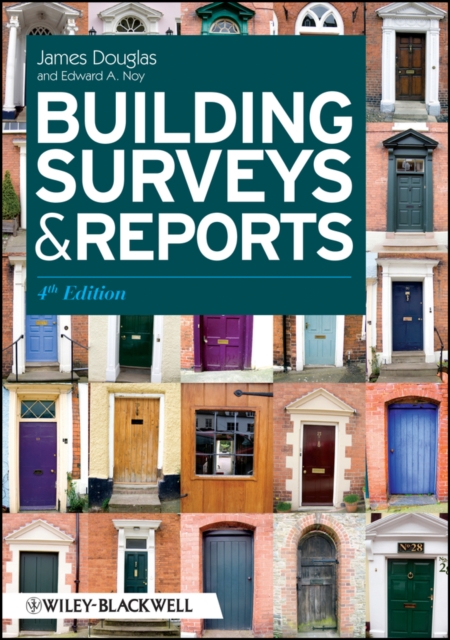
Building Surveys and Reports
This book provides guidance on building survey work for typical residential, commercial and industrial buildings, with advice on how to diagnose a wide range of defects. It considers both modern and older construction methods, together with new and traditional materials. The particular problems of alteration and renovation work are discussed, with guidance on how to carry out measured surveys. A separate chapter covers survey problems after flood and fire damage, and the legal section takes account of recent developments in case law relating to inspections and surveys of properties. This new edition continues to provide a thorough treatment of all the key issues relating to surveying buildings, dealing with the problems that surveyors are likely to encounter when inspecting buildings. Changes for the new edition include: * Examples and references have been updated * Evaluation of condition rating systems for domestic and commercial buildings * A new section on the home condition reports * More information on slate defects * Bibliography revised and expanded, to make it more comprehensive * Additional appendix showing the home condition report format
eBook

Modelling customers' perception of the quality of services provided by builders: A case of Victoria, Australia
Consumer satisfaction is essential for quality assurance, business survival and economic prosperity. It can also be used as an indicator of the occurrence of defects in the houses delivered by builders. The objective of this study is to compare the quality of services provided by volume and small builders, and to develop a model for predicting the chance of occurrence of structural defects in houses. A list of home builders was obtained from Australia's Housing Industry Association media release 2019. Thereafter, customer reviews of 10 volume builders and 107 small builders were obtained from publicly available data. Overall, 2336 reviews for volume-builders and 2037 reviews for small builders were analysed quantitatively. Further, using the scores provided by customers, the probability-based regression model for the structural integrity of residential buildings was developed. Generally, the research found that for volume-builders, customers have the highest satisfaction level for 'customer service' and the lowest satisfaction level for 'plumbing and waterproofing' work. However, for small builders, customers have the highest confidence in the 'structural integrity' of their buildings and the least confidence in projects 'timeliness'. Clients can use the stochastic-based model to predict the probability that a builder could deliver a house with low structural defects. The model showed that if a customer service score for a particular builder is less than 3.3, then there is a higher chance of having structural defects. This research contributes to the body of knowledge by developing and validating the logistic regression model that can be used as a tool to assess the quality of services provided by home builders. Moreover, the research provides useful information which can assist builders to improve the quality of services they provide.
Journal Article

Practical guide to diagnosing structural movement in buildings
\"What's the Crack?\" When cracking is observed in a building the most common reaction is that it must be the foundations and that it must be serious. Many surveyors are nervous about diagnosing cracks. This is understandable, as the interpretation of cracks can be difficult to teach, with university courses providing little or no time for field experience. Yet by understanding one straightforward principle the majority of cracks can be diagnosed in just a few minutes. Linking this with a good knowledge of construction techniques, the factors that distort cracking patterns and the key features of common causes of cracking, almost all cracks can be diagnosed quickly and with confidence. Practical Guide to Diagnosing Structural Movement in Buildings provides a methodology by which cracks and movement in buildings can be diagnosed. Written in four parts, part one describes the key principles of movement and cracking. Parts two and three describe the main features of common forms of movement and the associated crack patterns. Part two covers causes other than ground or foundation movement and part three covers movement caused by ground or foundation problems. Part four briefly describes the techniques used to arrest further movement or repair damage cause by movement. Primarily intended for the relatively inexperienced surveyor or engineer and undergraduate students of surveying as a practical guide for use on site, it focuses on identification and diagnosis. It will not only help in correctly diagnosing the problem but it will also demonstrate a methodical approach to show and record how the diagnosis was reached - critical when giving advice to third parties. \"What's the crack?\" - In the vast majority of cases it's not foundation related and in most cases it's not indicating a serious defect.
eBook

Deep Learning for Detecting Building Defects Using Convolutional Neural Networks
Clients are increasingly looking for fast and effective means to quickly and frequently survey and communicate the condition of their buildings so that essential repairs and maintenance work can be done in a proactive and timely manner before it becomes too dangerous and expensive. Traditional methods for this type of work commonly comprise of engaging building surveyors to undertake a condition assessment which involves a lengthy site inspection to produce a systematic recording of the physical condition of the building elements, including cost estimates of immediate and projected long-term costs of renewal, repair and maintenance of the building. Current asset condition assessment procedures are extensively time consuming, laborious, and expensive and pose health and safety threats to surveyors, particularly at height and roof levels which are difficult to access. This paper aims at evaluating the application of convolutional neural networks (CNN) towards an automated detection and localisation of key building defects, e.g., mould, deterioration, and stain, from images. The proposed model is based on pre-trained CNN classifier of VGG-16 (later compaired with ResNet-50, and Inception models), with class activation mapping (CAM) for object localisation. The challenges and limitations of the model in real-life applications have been identified. The proposed model has proven to be robust and able to accurately detect and localise building defects. The approach is being developed with the potential to scale-up and further advance to support automated detection of defects and deterioration of buildings in real-time using mobile devices and drones.
Journal Article

The Technology of Building Defects
The Technology of Building Defects has been developed to provide a unique review of the subject. Defects are considered as part of the whole building rather than in isolation. General educational objectives are set out which offer the reader the opportunity of self-assessment. Each section is generously illustrated with photographs and diagrams, forming an accessible self contained review covering the following: objectives; core information; exercises; revision notes; further reading. Taken together these sections build up to offer the reader an understanding of a range of technical topics concerned with building defects. This core text can be used for direct lecture material, seminar and tutorial information, assignment work and revision notes. It is a convenient one stop resource which dispenses with the need to consult a mass of different information sources.
Materials. Defects with materials. Failure mechanisms in cementitious materials. Failure mechanisms in ceramic materials. Failure mechanisms in timber. Failure mechanisms in metals. Components. Defects in components: general mechanisms. Defects in external joinery. Elements. Defects in elements: soil and foundation related problems. Walls. Movement and distortion problems in walls generally. Defects in floors. Problems with internal finishes. Defects in roofs. Radon in buildings. Distortion in buildings. Wind around buildings. Measuring movement. Index.
John Hinks is Reader in Facilities Management in the Department of Building Engineering and Surveying at Heriot-Watt University, Edinburgh, UK Geoff Cook is Senior Lecturer in the Department of Construction Management and Engineering at the University of Reading, UK
eBook

Application of the DEMATEL approach to analyse the root causes of building defects
Building defects are a common phenomenon in the construction industry. The negative consequences of building defects are not limited to waste generation or low resource efficiency. This challenge can have several direct and indirect implications such as cost overruns, unforeseen delays in project completion time, building occupants’ dissatisfaction and health and safety risks. Despite the increase in the number of studies investigating building defects in recent years, little is known about the prioritisation of their causes by considering the interaction among the causes of defects. Therefore, this study employed the decision-making trial and evaluation laboratory (DEMATEL) method to bridge this gap. Experts' opinion was sought using a questionnaire developed in the form of a matrix and semi-structured interview questions. Thereafter, the interactions among the causes of building defects were analysed and the most prominent causes are identified. The study showed that materials, workmanship and design are the major causes of building defects. Despite being specific context, the findings can be the basis for further research in this area with a focus on a range of different building typologies. Furthermore, the recommendations provided will act as a facilitator to minimise the occurrence of building defects. Lastly, the research findings can be considered in the planning stage of any construction project, to ensure the construction quality, reduce potential waste and enhance the circular economy and resource efficiency in the built environment sector.
Journal Article
Contrivance interrelated building components and defects factors: qualitative survey approach on government buildings
Purpose
The purpose of this paper is to identify the key aspects of building defects performance cases in relation to the building components focusing on the government-owned buildings and to enhance government’s role to curb the building defects to reoccur.
Design/methodology/approach
The qualitative research method approach was adopted with a total of 5,243 specific building defects identified and accumulated from actual building projects and provided feedback on the defects associated with the Government of Malaysia’s owned buildings.
Findings
This paper statistically validates that building defects are a staid delinquent matter fronting the construction industry in Malaysia. This matter needs to be tacked by all the parties involved in the industry. This paper proposes a factual statistical statement that is proved to be a practical and suitable measurement in correcting building defects and preventing them from reoccurring.
Research limitations/implications
Future research could focus on developing a defect performance measurement on real projects now focusing on private buildings as well.
Practical implications
The defects performance statistical measurement is anticipated to prove the problematic rate of defects occurrence on government-owned structures, as the key elements on the national defect preventive strategy which have to be taken into account.
Originality/value
The outcome of this paper is significant in its own right and serves as a platform for future research in this area.
Journal Article

Earthquake Safety Assessment of Buildings through Rapid Visual Screening
Earthquake is among the most devastating natural disasters causing severe economical, environmental, and social destruction. Earthquake safety assessment and building hazard monitoring can highly contribute to urban sustainability through identification and insight into optimum materials and structures. While the vulnerability of structures mainly depends on the structural resistance, the safety assessment of buildings can be highly challenging. In this paper, we consider the Rapid Visual Screening (RVS) method, which is a qualitative procedure for estimating structural scores for buildings suitable for medium- to high-seismic cases. This paper presents an overview of the common RVS methods, i.e., FEMA P-154, IITK-GGSDMA, and EMPI. To examine the accuracy and validation, a practical comparison is performed between their assessment and observed damage of reinforced concrete buildings from a street survey in the Bingöl region, Turkey, after the 1 May 2003 earthquake. The results demonstrate that the application of RVS methods for preliminary damage estimation is a vital tool. Furthermore, the comparative analysis showed that FEMA P-154 creates an assessment that overestimates damage states and is not economically viable, while EMPI and IITK-GGSDMA provide more accurate and practical estimation, respectively.
Journal Article