
Catalogue Search | MBRL


Are you sure you want to remove the book from the shelf?

{{itemTitle}}
3,182
result(s) for
"Civil war Prevention."
Sort by:

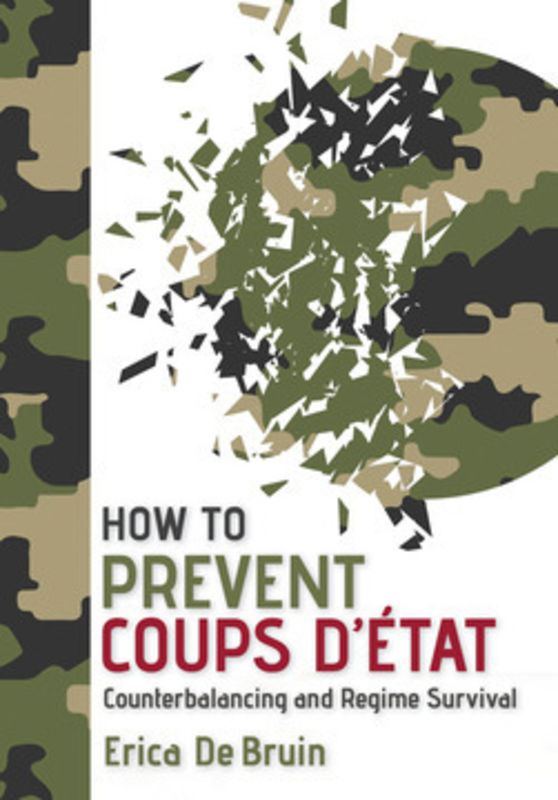
How to Prevent Coups d'État
In this lively and provocative book, Erica De Bruin looks at the
threats that rulers face from their own armed forces. Can they make
their regimes impervious to coups?
How to Prevent Coups d'État shows that how leaders
organize their coercive institutions has a profound effect on the
survival of their regimes. When rulers use presidential guards,
militarized police, and militia to counterbalance the regular
military, efforts to oust them from power via coups d'état are less
likely to succeed. Even as counterbalancing helps to prevent
successful interventions, however, the resentment that it generates
within the regular military can provoke new coup attempts. And
because counterbalancing changes how soldiers and police perceive
the costs and benefits of a successful overthrow, it can create
incentives for protracted fighting that result in the escalation of
a coup into full-blown civil war.
Drawing on an original dataset of state security forces in 110
countries over a span of fifty years, as well as case studies of
coup attempts in Asia, Africa, Latin America, and the Middle East,
De Bruin sheds light on how counterbalancing affects regime
survival. Understanding the dynamics of counterbalancing, she
shows, can help analysts predict when coups will occur, whether
they will succeed, and how violent they are likely to be. The
arguments and evidence in this book suggest that while
counterbalancing may prevent successful coups, it is a risky
strategy to pursue-and one that may weaken regimes in the long
term.
eBook


Military Integration after Civil Wars
This book examines the role of multiethnic armies in post-conflict reconstruction, and demonstrates how they can promote peacebuilding efforts.
The author challenges the assumption that multiethnic composition leads to weakness of the military, and shows how a multiethnic army is frequently the impetus for peacemaking in multiethnic societies. Three case studies (Nigeria, Lebanon and Bosnia-Herzegovina) determine that rather than external factors, it is the internal structures that make or break the military institution in a socially challenging environment. The book finds that where the political will is present, the multiethnic military can become a symbol of reconciliation and coexistence. Furthermore, it shows that the military as a professional identity can supersede ethnic considerations and thus facilitates cooperation within the armed forces despite a hostile post-conflict setting. In this, the book challenges widespread theories about ethnic identities and puts professional identities on an equal footing with them.
The book will be of great interest to students of military studies, ethnic conflict, conflict studies and peacebuilding, and IR in general
Florence Gaub is a Researcher and Lecturer at the NATO Defence College in Rome. She holds a PhD in International Politics from Humboldt University, Berlin.
Introduction 1. The Armed Forces as a Social Agent 2. Case Study Nigerian Army: From Colonial to Political 3. Case Study Lebanese Armed Forces: From Powerlessness to Integration? 4. Case Study Armies of Bosnia-Herzegovina: A State in Transit 5. Military Integration after Civil War: An Assessment. Conclusion
Florence Gaub is a Researcher and Lecturer at the NATO Defence College in Rome. She holds a PhD in International Politics from Humboldt University, Berlin.
eBook


World Development Report 2011
The 2011 World development report looks across disciplines and experiences drawn from around the world to offer some ideas and practical recommendations on how to move beyond conflict and fragility and secure development. The key messages are important for all countries-low, middle, and high income-as well as for regional and global institutions: first, institutional legitimacy is the key to stability. When state institutions do not adequately protect citizens, guard against corruption, or provide access to justice; when markets do not provide job opportunities; or when communities have lost social cohesion-the likelihood of violent conflict increases. Second, investing in citizen security, justice, and jobs is essential to reducing violence. But there are major structural gaps in our collective capabilities to support these areas. Third, confronting this challenge effectively means that institutions need to change. International agencies and partners from other countries must adapt procedures so they can respond with agility and speed, a longer-term perspective, and greater staying power. Fourth, need to adopt a layered approach. Some problems can be addressed at the country level, but others need to be addressed at a regional level, such as developing markets that integrate insecure areas and pooling resources for building capacity Fifth, in adopting these approaches, need to be aware that the global landscape is changing. Regional institutions and middle income countries are playing a larger role. This means should pay more attention to south-south and south-north exchanges, and to the recent transition experiences of middle income countries.
eBook

A war like no other : the Constitution in a time of terror
\"Owen Fiss has been a leading legal scholar for over thirty years, yet before 2001 it would have seemed unlikely for him to write about national security and the laws of war; his focus was civil procedure and equal protection, but when the War on Terror began to shroud legal proceedings in secrecy, he realized that the bulwarks of procedure that shield the individual from the awesome power of the state were dissolving, perhaps irreparably, and that it was time for him to speak up. The ten chapters in this volume cover the major legal battlefronts of the War on Terror from Guantánamo to drones, with a focus on the constitutional implications of those new tools. The underlying theme is Fiss's concern for the offense done to the U.S. Constitution by the administrative and legislative branches of government in the name of public safety and the refusal of the judiciary to hold the government accountable. A War Like No Other will be an essential intellectual foundation for all concerned about constitutional rights and the law in a new age. \"-- Provided by publisher.
Book

External Rebel Sponsorship and Civilian Abuse: A Principal-Agent Analysis of Wartime Atrocities
Although some rebel groups work hard to foster collaborative ties with civilians, others engage in egregious abuses and war crimes. We argue that foreign state funding for rebel organizations greatly reduces incentives to “win the hearts and minds” of civilians because it diminishes the need to collect resources from the population. However, unlike other lucrative resources, foreign funding of rebel groups must be understood in principal-agent terms. Some external principals—namely, democracies and states with strong human rights lobbies—are more concerned with atrocities in the conflict zone than others. Multiple state principals also lead to abuse because no single state can effectively restrain the organization. We test these conjectures with new data on foreign support for rebel groups and data on one-sided violence against civilians. Most notably, we find strong evidence that principal characteristics help influence agent actions.
Journal Article


Ex Parte Milligan Reconsidered
At the very end of the Civil War, a military court convicted
Lambdin P. Milligan and his coconspirators in Indiana of fomenting
a general insurrection and sentenced them to hang. On appeal, in
Ex parte Milligan the US Supreme Court sided with the
conspirators, ruling that it was unconstitutional to try American
citizens in military tribunals when civilian courts were open and
functioning-as they were in Indiana. Far from being a relic of the
Civil War, the landmark 1866 decision has surprising relevance in
our day, as this volume makes clear. Cited in four Supreme Court
decisions arising from the wars in Afghanistan and Iraq, Ex
parte Milligan speaks to constitutional questions raised by
the war on terror; but more than that, the authors of Ex parte
Milligan Reconsidered contend, the case affords an
opportunity to reevaluate the history of wartime civil liberties
from the Civil War era to our own. After the Civil War, critics of
Reconstruction pointed to Milligan as an example of the
Republican Party's abuse of federal power; even historians
sympathetic to Lincoln have found it necessary to apologize for his
administration's record on civil liberties during the Civil War.
However, the authors of this volume argue that this distorts the
nineteenth-century understanding of the Bill of Rights, neglects
international law entirely, and, equally striking, ignores the
experience of African Americans. In reviving Milligan , the
Supreme Court has implicitly cast Reconstruction as a \"war on
terror\" in which terrorist insurgencies threatened and eventually
halted the assertion of black freedom by the Republican Party, the
Union Army, and African Americans themselves. Returning African
Americans to the center of the story, and recognizing that Lincoln
and Republicans were often forced to restrict white civil liberties
in order to establish black civil rights and liberties, Ex parte
Milligan Reconsidered suggests an entirely different
account of wartime civil liberties, one with profound implications
for US racial history and constitutional law in today's war on
terror.
eBook