
Catalogue Search | MBRL


Are you sure you want to remove the book from the shelf?

{{itemTitle}}
9
result(s) for
"Fractions Juvenile literature."
Sort by:

Fraction frenzy : fractions and decimals
\"Introduces the reader to fractions and decimals.\"-- Provided by publisher.
Book

Delinquency and Crime Prevention: Overview of Research Comparing Treatment Foster Care and Group Care
Background
Evidence of treatment foster care (TFC) and group care’s (GC) potential to prevent delinquency and crime has been developing.
Objectives
We clarified the state of comparative knowledge with a historical overview. Then we explored the hypothesis that smaller, probably better resourced group homes with smaller staff/resident ratios have greater impacts than larger homes with a meta-analytic update.
Methods
Research literatures were searched to 2015. Five systematic reviews were selected that included seven independent studies that compared delinquency or crime outcomes among youths ages 10–18. A similar search augmented by author and bibliographic searches identified six additional studies with an updated meta-analysis. Discrete effects were analyzed with sample-weighted preventive fractions (PF) and 95 % confidence intervals (CI).
Results
Compared with GC, TFC was estimated to prevent nearly half of delinquent or criminal acts over 1–3 years (PF = 0.56, 95 % CI 0.50, 0.64). Two pooled study outcomes tentatively suggested that GC in homes with less than ten youths may prevent delinquency and crime better than TFC,
p
= 0.08. Study designs were non-equivalent or randomized trials that were typically too small to ensure controlled comparisons.
Conclusions
These synthetic findings are best thought of as preliminary hypotheses. Confident knowledge will require their testing with large, perhaps multisite, controlled trials. Such a research agenda will undoubtedly be quite expensive, but it holds the promise of knowledge dividends that could prevention much suffering among youths, their families and society.
Journal Article

Piece=part=portion : fractions=decimals=percents
Explains how in the language of mathematics, fractions, decimals and percents are three different ways of describing the same parts of things.
Book

Ready for fractions and decimals
\"Learn the basic fundamentals of adding, subtracting, multiplying and dividing using fractions and decimals\"--Provided by publisher.
Book


Pizza counting
Decorated pizzas are used to introduce counting and fractions. Includes facts about pizza.
Book
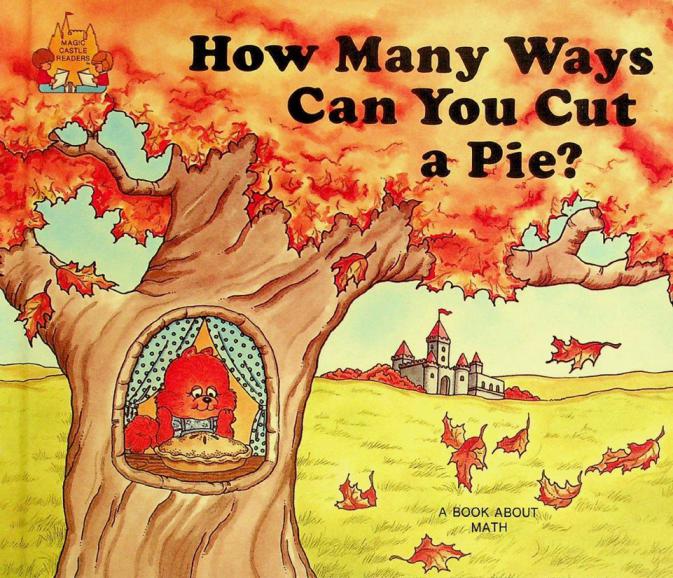
How many ways can you cut a pie ?
Squirrel promises to divide her pie into sections for her animal friends if she wins the pie contest.

Infinity : figuring out forever
\"Defining infinity is difficult. But there is one thing people do every day that leads to infinity counting. No matter what large number you name, there is always a larger number. By reading this book, kids can begin to think about this and other powerful ideas involving infinity, including how infinity relates to rocket science. Featuring clear text and beautiful photographs, this is an excellent choice for kids who want to delve deeper into math and science and for those ready to look at the world in a new way\"-- Publisher's website.
Book