
Catalogue Search | MBRL


Are you sure you want to remove the book from the shelf?

{{itemTitle}}
1,954
result(s) for
"GAMES Reference."
Sort by:

The little book of mahjong : learn how to play, score, and win
\"Disconnect from a device-oriented world and rediscover the classic Chinese game of mahjong--while improving focus, creativity and stimulating memory--with this comprehensive yet gifty guide that includes all the basics of the game, tips and techniques on how to play, and strategies to win both international mahjong and American mahjong. The classic game of mahjong was created over 2,000 years ago during the Qing Dynasty in China, but recently, it's experiencing a renaissance. No longer reserved for older players, mahjong is being rediscovered by millennials and is recognized for its ability to improve brain function, and reduce symptoms of cognitive diseases like dementia. Learning any new game can be difficult, especially one as complex as mahjong, which includes over dozens of tiles with different meanings. But whether you are a complete novice or a casual player looking to brush up on mahjong skills and techniques, The Little Book of Mahjong can help you get ahead in this classic game, whether you are playing international mahjong or American mahjong. With a comprehensive breakdown on all of the various tiles involved in the different versions of the game, explanations of what each tile means, detailed information on scoring, tips on how to improve your skills, and strategies for winning, this guide is perfect for mahjong players both new and old. Including a brief history of the game and its significance as well as full-color photos of game pieces and game objectives, you'll become a mahjong master in no time\"-- Provided by publisher.
Book

The Aesthetic of Play
The impulse toward play is very ancient, not only pre-cultural but pre-human; zoologists have identified play behaviors in turtles and in chimpanzees. Games have existed since antiquity; 5,000-year-old board games have been recovered from Egyptian tombs. And yet we still lack a critical language for thinking about play. Game designers are better at answering small questions (\"Why is this battle boring?\") than big ones (\"What does this game mean?\"). In this book, the game designer Brian Upton analyzes the experience of play -- how playful activities unfold from moment to moment and how the rules we adopt constrain that unfolding. Drawing on games that range from Monopoly to Dungeons & Dragons to Guitar Hero, Upton develops a framework for understanding play, introducing a set of critical tools that can help us analyze games and game designs and identify ways in which they succeed or fail.Upton also examines the broader epistemological implications of such a framework, exploring the role of play in the construction of meaning and what the existence of play says about the relationship between our thoughts and external reality. He considers the making of meaning in play and in every aspect of human culture, and he draws on findings in pragmatic epistemology, neuroscience, and semiotics to describe how meaning emerges from playful engagement. Upton argues that play can also explain particular aspects of narrative; a play-based interpretive stance, he proposes, can help us understand the structure of books, of music, of theater, of art, and even of the process of critical engagement itself.
eBook

The little book of bridge : learn how to play, score, and win
\"A comprehensive guide to the classic card game of bridge, including an overview of the basics, tips and techniques how to play--and strategies to win; perfect for new bridge players and experienced pros alike. Bridge is all about memory, bidding, and skill. It is one of the most popular card games in the world, and is played by millions of people worldwide in tournaments, clubs, and cruises, as well as online. New to the world of bridge? No problem! Learning any new game can be challenging, especially one as complicated as bridge. But mastering a complex game can be very rewarding. Whether you are a complete novice or a casual player looking to brush up on your skills and techniques, The Little Book of Bridge can help you play your cards right and get ahead in this classic game. With a comprehensive breakdown of all the cards involved in the game, detailed information on scoring, tips on how to improve your skills, strategies for winning, and a tear-away cheat sheet, this guide will have even the newest bridge enthusiast winning in no time flat\"-- Provided by publisher.
Book

Serious Games
Serious Games provides a thorough exploration of the claim that playing games can provide learning that is deep, sustained and transferable to the real world. \"Serious games\" is defined herein as any form of interactive computer-based game software for one or multiple players to be used on any platform and that has been developed to provide more than entertainment to players. With this volume, the editors address the gap in exisiting scholarship on gaming, providing an academic overview on the mechanisms and effects of serious games. Contributors investigate the psychological mechanisms that take place not only during gaming, but also in game selection, persistent play, and gaming impact.
The work in this collection focuses on the desirable outcomes of digital game play. The editors distinguish between three possible effects -- learning, development, and change -- covering a broad range of serious games’ potential impact. Contributions from internationally recognized scholars focus on five objectives:
Define the area of serious games
Elaborate on the underlying theories that explain suggested psychological mechanisms elicited through serious game play, addressing cognitive, affective and social processes
Summarize the empirical evidence on the effectiveness of serious games,
Introduce innovative research methods as a response to methodological challenges imposed through interactive media
Discuss the possibilities and limitations of selected applications for educational purposes.
Anchored primarily in social science research, the reader will be introduced to approaches that focus on the gaming process and the users’ experiences. Additional perspectives will be provided in the concluding chapters, written from non-social science approaches by experts in academic game design and representatives of the gaming industry. The editors acknowledge the necessity for a broader interdisciplinary study of the phenomena and work to overcome the methodological divide in games research to look ahead to a more integrated and interdisciplinary study of digital games.
This timely and singular volume will appeal to scholars, researchers, and graduate students working in media entertainment and game studies in the areas of education, media, communication, and psychology.
Ute Ritterfeld , Professor for Media Psychology, received her education in the Health Sciences (Academy of Rehabilitation in Heidelberg) and in Psychology (University of Heidelberg), completed her Ph.D. in Psychology (Technical University in Berlin), and habilitated at the University of Magdeburg, Germany. She was Assistant Professor at the University of Magdeburg, Adjunct Professor at the Universities of Berlin (Humboldt) and Hannover, and Associate Professor at the University of Southern California (USC) in Los Angeles, Annenberg School for Communication. At USC, Ritterfeld directed an interdisciplinary research team devoted to the studies of digital games and hosted the inaugural academic conference on serious games. In 2007, Ritterfeld joined the faculty of Psychology and Education at the VU University Amsterdam and co-founded the Center for Advanced Media Research Amsterdam (CAMeRA@VU) where she serves as director of interdisciplinary research. Ritterfeld co-edits the Journal of Media Psychology published by Hogrefe.
Michael Cody is Professor of Communication at the University of Southern California Annenberg School for Communication. He earned his Ph.D. in Communication at Michigan State University in 1978, where he focused on research methods and face to face social influence processes. He has authored or edited books in persuasion, interpersonal communication and entertainment education. He is the editor of the Journal of Communication (2009-2012).
Peter Vorderer (Ph.D., Technical University of Berlin), is Scientific Director of the Center for Advanced Media Research Amsterdam (CAMeRA) and head of the Department of Communication Science, VU University Amsterdam, The Netherlands. He specializes in media use and media effects research with a special focus on media entertainment and digital games. Together with Dolf Zillmann and Jennings Bryant, he has edited three well-recognized volumes on media entertainment and video games.
eBook

Master-mind : over 100 games, tests, and puzzles to unleash your inner genuis
An introduction to the human brain uses quizzes, trivia, and puzzles to explore the different functions of the brain, how to improve brain power, and why each brain is unique.
Book
Multiple Perspectives on Language Play
Interest in language play and linguistic creativity has increased in recent years, and the topic has been taken up from a variety of perspectives. In this book, disparate approaches to the topic are brought together, demonstrating that a number of phenomena whose similarities might not have been immediately recognized, have an academic home under the umbrella of language play and linguistic creativity. The contributions to this collection illustrate the variety of questions that can be asked regarding the social, cognitive, emotional, political, and cultural mechanisms and significance of innovative linguistic practices and point to new directions of inquiry. Furthermore, the work exemplifies a variety of ways in which this research can be carried out, as well as the range of contexts in which it might be investigated, including second language classrooms, online settings, and workplaces. Taken together, the chapters serve to illustrate the range of work that we will be accepting in the Language Play and Creativity series; viewed individually, each makes a unique contribution to some aspect of our understanding of creative language use.
eBook

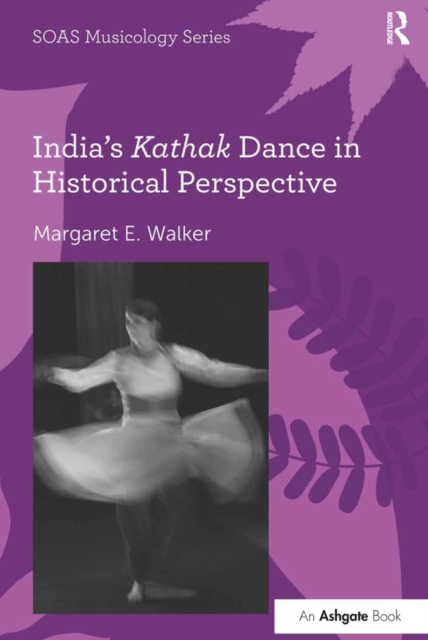
India's Kathak Dance in Historical Perspective
Kathak, the classical dance of North India, combines virtuosic footwork and dazzling spins with subtle pantomime and soft gestures. As a global practice and one of India's cultural markers, kathak dance is often presented as heir to an ancient Hindu devotional tradition in which men called Kathakas danced and told stories in temples. The dance's repertoire and movement vocabulary, however, tell a different story of syncretic origins and hybrid history - it is a dance that is both Muslim and Hindu, both devotional and entertaining, and both male and female. Kathak's multiple roots can be found in rural theatre, embodied rhythmic repertoire, and courtesan performance practice, and its history is inextricable from the history of empire, colonialism, and independence in India. Through an analysis both broad and deep of primary and secondary sources, ethnography, iconography and current performance practice, Margaret Walker undertakes a critical approach to the history of kathak dance and presents new data about hereditary performing artists, gendered contexts and practices, and postcolonial cultural reclamation. The account that emerges places kathak and the Kathaks firmly into the living context of North Indian performing arts.
eBook

Backstage Economies
Backstage Economies: Labour and Masculinities in Contemporary European Dance investigates gender politics and labour practices in contemporary European dance. By focusing on masculinities and job careers in professional dance, this study looks at the cultural, historical, and material conditions that shape the dancers' experience of 'the everyday' as they travel to work; struggle to secure funding; nurse injuries; and negotiate their gender and work identities. The emphasis on the dancers' everyday experience is designed to critically explore and to challenge the established methodological boundaries of dance studies: the focus shifts away from the scholarly attentions that are more regularly paid to the phenomenology and perception of performance, towards the material conditions of dance production. In general, this book revisits the debates in dance education related to gender politics and the well-being of dancers; and it also traces and discusses some significant shortcomings of the current European dance policies and employment practices.
eBook

Polka Heartland
Polka Heartland\"\" captures the beat that pulses in the heart of Midwestern culture--the polka--and offers up the fascinating history of how \"\"oompah-pah\"\" came to be the sound of middle America. From the crowded dance tent at Pulaski Polka Days to an off-the-grid Mexican polka dance in small-town Wisconsin, \"\"Polka Heartland\"\" explores the people, places, and history behind the Midwest's favorite music.From polka's surprising origin story as a cutting-edge European fad to an exploration of the modern-day polka scene, author Rick March and photographer Dick Blau take readers on a joyful romp through this beloved, unique, and richly storied genre. \"\"Polka Heartland\"\" describes the artists, venues, instruments, and music-makers who have been pivotal to polka's popularity across the Midwest and offers six full-color photo galleries to immerse readers in today's vibrant polka scene.
eBook