
Catalogue Search | MBRL


Are you sure you want to remove the book from the shelf?

{{itemTitle}}
113
result(s) for
"Hand weaving."
Sort by:

The weaving explorer : ingenious techniques, accessible tools & creative projects with yarn, paper, wire & more
\"The Weaving Explorer takes inspiration from the world of folk weaving traditions, adding a contemporary spin by introducing an unexpected range of materials and home dec projects\"-- Provided by publisher.
Book
Weaving and Dyeing in Highland Ecuador
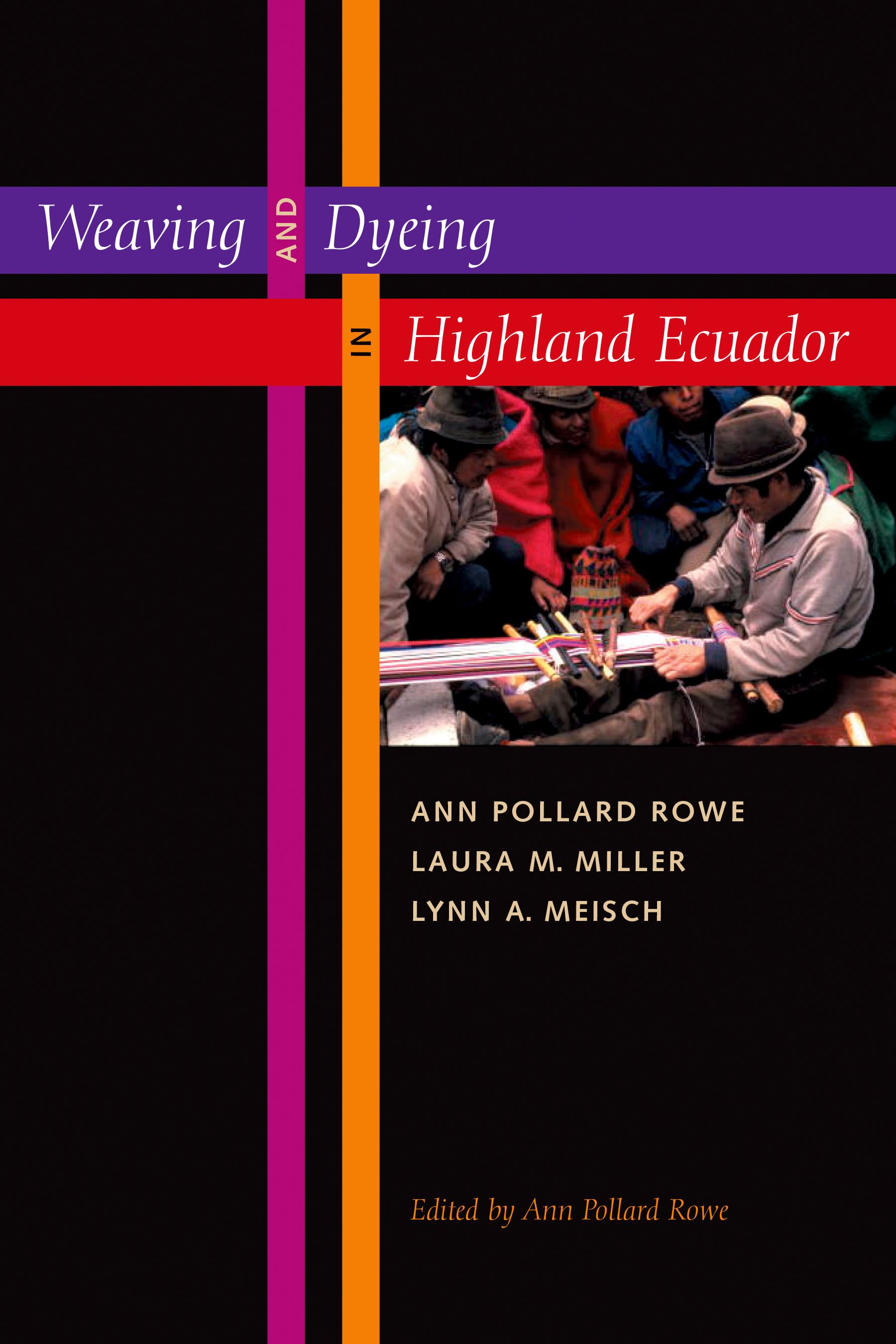
Although less well known than its much-admired counterparts in Peru and Bolivia, highland Ecuadorian weaving is an Andean tradition that has relationships with these more southern areas. A world away from the industrialized textile manufacturing of Euro-American society, these handmade pieces reflect the history and artistry of an ancient culture. This comprehensive study, edited by Ann Pollard Rowe, is unrivaled in its detail and includes not only descriptions of the indigenous weaving and dyeing technology, but also an interpretation of its historical significance, as well as hundreds of photographs, drawings, and maps that inform the understanding of the process. The principal focus is on backstrap-loom weaving, a major pre-Hispanic technology. Ecuadorian backstrap looms, which differ in various ways from those found elsewhere in the Andes, have previously only been treated in general terms. Here, the basic operation of this style of loom is covered, as are a variety of patterning techniques including warp-resist (ikat) dyeing, weaving belts with twill, and supplementary- and complementary-warp patterning. Spanish colonial treadle-loom weaving is also covered. The weaving techniques are explained in detail, so the reader can replicate them if desired. Textiles have been an important art form among Andean peoples from remote prehistory up to the present. A greater understanding of their creation process can yield a more meaningful appreciation of the art itself.
eBook

Contemporary weaving : bold colour, texture & design on the frame loom
\"Dive into eye-catching contemporary weaving, perfect for anyone that loves color, textiles, and learning something new. Both beginners and advanced weavers will learn to craft their own designs and make a variety of fine art projects, like wall hangings, pillows, and coasters, that bring home decor to the next level\"-- Provided by publisher.
BOOK

Salish Blankets
Salish Blanketspresents a new perspective on Salish weaving through technical and anthropological lenses. Worn as ceremonial robes, the blankets are complex objects said to preexist in the supernatural realm and made manifest in the natural world through ancestral guidance. The blankets are protective garments that at times of great life changes-birth, marriage, death-offer emotional strength and mental focus. A blanket can help establish the owner's standing in the community and demonstrate a weaver's technical expertise and artistic vision. The object, the maker, the wearer, and the community are bound and transformed through the creation and use of the blanket.Drawing on first-person accounts of Salish community members, object analysis, and earlier ethnographic sources, the authors offer a wide-ranging material culture study of Coast Salish lifeways.Salish Blanketsexplores the design, color/pigmentation, meaning, materials, and process of weaving and examines its historical and cultural contexts.
eBook

Made weave love : 20+ contemporary handwoven projects to craft at home
\"Phoebe Jones is on a mission to make weaving accessible to all. In her debut book 'Made Weave Love' Phoebe shows you the joys of weaving and how this gentle and intuitive craft can spark joy and creativity into your life. Covering the very basics from the essential tools and how to build your own loom, to selecting the perfect yarn and finding color and design inspiration, Phoebe carefully guides you through everything you need to get started. Packed with beautiful photography and step-by-step tutorials throughout, this go-to guide--featuring projects for both beginners and advanced crafters alike--will give you the skills you need to confidently weave stunning masterpieces that spread style and color throughout your home\" -- Back cover.
BOOK

Weaving a Future
The people of Taquile Island on the Peruvian side of beautiful Lake Titicaca, the highest navigable lake in the Americas, are renowned for the hand-woven textiles that they both wear and sell to outsiders. One thousand seven hundred Quechua-speaking peasant farmers, who depend on potatoes and the fish from the lake, host the forty thousand tourists who visit their island each year. Yet only twenty-five years ago, few tourists had even heard of Taquile. InWeaving a Future: Tourism, Cloth, and Culture on an Andean Island, Elayne Zorn documents the remarkable transformation of the isolated rocky island into a community-controlled enterprise that now provides a model for indigenous communities worldwide.
Over the course of three decades and nearly two years living on Taquile Island, Zorn, who is trained in both the arts and anthropology, learned to weave from Taquilean women. She also learned how gender structures both the traditional lifestyles and the changes that tourism and transnationalism have brought. In her comprehensive and accessible study, she reveals how Taquileans used their isolation, landownership, and communal organizations to negotiate the pitfalls of globalization and modernization and even to benefit from tourism. This multi-sited ethnography set in Peru, Washington, D.C., and New York City shows why and how cloth remains central to Andean society and how the marketing of textiles provided the experience and money for Taquilean initiatives in controlling tourism.
The first book about tourism in South America that centers on traditional arts as well as community control,Weaving a Futurewill be of great interest to anthropologists and scholars and practitioners of tourism, grassroots development, and the fiber arts.
eBook

Maguey Journey
The name maguey refers to various forms of the agave and furcraea genus, also sometimes called the century plant. The fibers extracted from the leaves of these plants are spun into fine cordage and worked with a variety of tools and techniques to create textiles, from net bags and hammocks to equestrian gear.In this fascinating book, Kathryn Rousso, an accomplished textile artist, takes a detailed look at the state of maguey culture, use, and trade in Guatemala. She has spent years traveling in Guatemala, highlighting maguey workers' interactions in many locations and blending historical and current facts to describe their environments. Along the way, Rousso has learned the process of turning a raw leaf into beautiful and useful textile products and how globalization and modernization are transforming the maguey trade in Guatemala.Featuring a section of full-color illustrations that follow the process from plant to weaving to product, Maguey Journey presents the story of this fiber over recent decades through the travels of an impassioned artist. Useful to cultural anthropologists, ethnobotanists, fiber artists, and interested travelers alike, this book offers a snapshot of how the industry stands now and seeks to honor those who keep the art alive in Guatemala.
eBook

Easy, beautiful handmade rag rugs : 12 step-by-step techniques with patterns and projects, including latch hook, braiding, and punch needle
Do you have a closet full of clothes that you no longer wear? Do you have a pile of scrap fabric from previous crafts lying in a corner? Don't contribute to the landfill when you can learn how to make beautiful rag rugs from your throw-away fabrics! Rag rug making is approachable and fun for crafters of all ages! With no loom and no machines required, rag rug making is a timeless homesteading tradition that emphasizes upcycling scrap materials and fabrics, making the craft low cost, easy for beginners, sustainable, and eco-conscious. After all, why buy new rugs when you can be self-sufficient and make your own? This engaging and accessible project guide will show you step-by-step how to make beautiful rag rug crafts completely by hand from start to finish! The book begins with a stunning gallery of rag rugs made by leading fabric artists from around the world, where they share their inspiration and which techniques they used. You'll then find complete overviews on the tools you'll need, and learn how to design, size, and transfer your own pattern, choose a color palette, use ready-made, recycled, or non-traditional materials, choose a rug backing, and create your own colors with fabric dyeing. Then, the techniques and projects will take you through creating rag rugs with methods including rug hooking, traditional and miniature punch needle, proddy, braiding, latch hooking, and quillie.
BOOK

Weaving and dyeing in highland Ecuador
Although less well known than its much-admired counterparts in Peru and Bolivia, highland Ecuadorian weaving is an Andean tradition that has relationships with these more southern areas. A world away from the industrialized textile manufacturing of Euro-American society, these handmade pieces reflect the history and artistry of an ancient culture.
This comprehensive study, edited by Ann Pollard Rowe, is unrivaled in its detail and includes not only descriptions of the indigenous weaving and dyeing technology, but also an interpretation of its historical significance, as well as hundreds of photographs, drawings, and maps that inform the understanding of the process.
The principal focus is on backstrap-loom weaving, a major pre-Hispanic technology. Ecuadorian backstrap looms, which differ in various ways from those found elsewhere in the Andes, have previously only been treated in general terms. Here, the basic operation of this style of loom is covered, as are a variety of patterning techniques including warp-resist (ikat) dyeing, weaving belts with twill, and supplementary- and complementary-warp patterning. Spanish colonial treadle-loom weaving is also covered. The weaving techniques are explained in detail, so the reader can replicate them if desired.
Textiles have been an important art form among Andean peoples from remote prehistory up to the present. A greater understanding of their creation process can yield a more meaningful appreciation of the art itself.
eBook