
Catalogue Search | MBRL


Are you sure you want to remove the book from the shelf?

{{itemTitle}}
26
result(s) for
"Islamic architecture Turkey"
Sort by:


Rum Seljuq Architecture, 1170-1220
This lavishly illustrated volume presents the major surviving monuments of the early period of the Rum Seljuqs, the first major Muslim dynasty to rule Anatolia. A much-needed overview of the political history of the dynasty provides the context for the study of the built environment which follows. The book addresses the most significant monuments from across the region: a palace, a minaret and a hospital are studied in detail, along with an overview of the decorative portals attached to a wide array of different building types. The case studies are used to demonstrate the key themes and processes of architectural synthesis and development that were under way at the time, and how they reflect the broader society.
eBook


Synagogues in the Islamic World
This beautifully illustrated volume looks at the spaces created by and for Jews in areas under the political or religious control of Muslims in regions such as Central Asia, the Middle East, North Africa and Spain.
eBook

Constantinopolis/Istanbul : cultural encounter, imperial vision, and the construction of the Ottoman capital
\"Studies the reconstruction of Byzantine Constantinople as the capital city of the Ottoman empire following its capture in 1453, delineating the complex interplay of socio-political, architectural, visual, and literary processes that underlay the city's transformation\"--Provided by publisher.
Book

Architecture and Landscape in Medieval Anatolia, 1100-1500
Anatolia was home to a large number of polities in the medieval period. Given its location at the geographical and chronological juncture between Byzantines and the Ottomans, its story tends to be read through the Seljuk experience. This obscures the multiple experiences and spaces of Anatolia under the Byzantine empire, Turko-Muslim dynasties contemporary to the Seljuks, the Mongol Ilkhanids, and the various beyliks of eastern and western Anatolia. This book looks beyond political structures and towards a reconsideration of the interactions between the rural and the urban; an analysis of the relationships between architecture, culture and power; and an examination of the region's multiple geographies. In order to expand historiographical perspectives it draws on a wide variety of sources (architectural, artistic, documentary and literary), including texts composed in several languages (Arabic, Armenian, Byzantine Greek, Persian and Turkish). Original in its coverage of this period from the perspective of multiple polities, religions and languages, this volume is also the first to truly embrace the cultural complexity that was inherent in the reality of daily life in medieval Anatolia and surrounding regions.
eBook
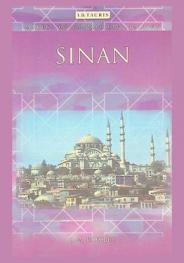
Sinan
\"The buildings of Sinan (c. 1490-1588) are ranked with the finest of Renaissance Europe. He was born in Cappadocia, probably into a Greek Christian family. Drafted into the Janissaries during his adolescence, he rapidly gained promotion and distinction as a military engineer. He was appointed Court Architect in 1538 and held that post for the most productive, brilliant half-century in Ottoman architecture. His palaces, mosques, fountains, hospitals and tombs completely changed the face of the Ottoman capitals, Istanbul and Edirne.\" \"Though little is known of Sinan's personal life, J.M. Rogers has reconstructed his professional biography from his practice and that of the Court Architects after him. The detailed building accounts of Suleymaniye in Istanbul - one of Sinan's greatest mosques - demonstrate his masterly coordination of planning, quantity surveying, work force management, and design and implementation of waterworks, that enabled this vast project to be completed in just seven years.\"--Jacket.
Book
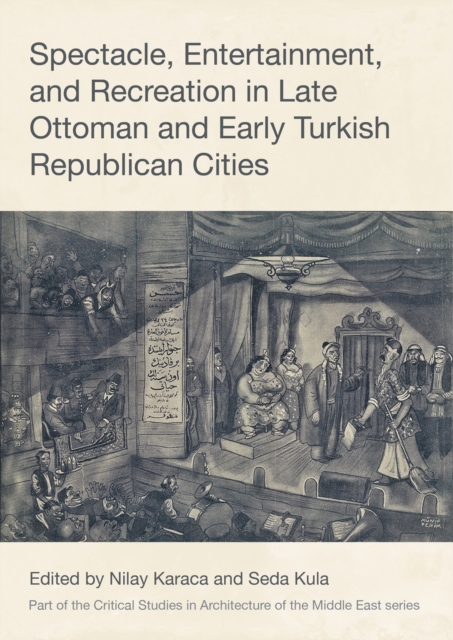
Spectacle, entertainment, and recreation in late Ottoman and early Turkish republican cities
An analysis of entertainment, spectacle and recreation activities and spaces of late Ottoman and early Turkish cities, discussing their evolution, and significance for the urban life as well as their interaction with society's modernization processes, through contributions of numerous authors portraying diverse urban environments. 91 b/w illus. Free sample: Introduction by Seda Kula.
eBook