
Catalogue Search | MBRL


Are you sure you want to remove the book from the shelf?

{{itemTitle}}
22
result(s) for
"Jacobins France."
Sort by:


Imperial city
In 1798, the armies of the French Revolution tried to transform Rome from the capital of the Papal States to a Jacobin Republic. For the next two decades, Rome was the subject of power struggles between the forces of the Empire and the Papacy, while Romans endured the unsuccessful efforts of Napoleon’s best and brightest to pull the ancient city into the modern world. Against this historical backdrop, Nicassio weaves together an absorbing social, cultural, and political history of Rome and its people. Based on primary sources and incorporating two centuries of Italian, French, and international research, her work reveals what life was like for Romans in the age of Napoleon.
eBook

Melancholy politics : loss, mourning, and memory in late modern France
\"A study of the cultural politics of loss and mourning in France from 1978 to the present. Focuses on national identity, secularism, Jacobin republicanism, and political-cultural exceptionalism\"--Provided by publisher.
Book

Scandal
Are sex scandals simply trivial distractions from serious issues or can they help democratize politics? In 1820, George IV's \"royal gambols\" with his mistresses endangered the Old Oak of the constitution. When he tried to divorce Queen Caroline for adultery, the resulting scandal enabled activists to overcome state censorship and revitalize reform. Looking at six major British scandals between 1763 and 1820, this book demonstrates that scandals brought people into politics because they evoked familiar stories of sex and betrayal. In vibrant prose woven with vivid character sketches and illustrations, Anna Clark explains that activists used these stories to illustrate constitutional issues concerning the Crown, Parliament, and public opinion.
Clark argues that sex scandals grew out of the tension between aristocratic patronage and efficiency in government. For instance, in 1809 Mary Ann Clarke testified that she took bribes to persuade her royal lover, the army's commander-in-chief, to promote officers, buy government offices, and sway votes. Could women overcome scandals to participate in politics?
This book also explains the real reason why the glamorous Georgiana, Duchess of Devonshire, became so controversial for campaigning in a 1784 election. Sex scandal also discredited Mary Wollstonecraft, one of the first feminists, after her death.
Why do some scandals change politics while others fizzle? Edmund Burke tried to stir up scandal about the British empire in India, but his lurid, sexual language led many to think he was insane.
A unique blend of the history of sexuality and women's history with political and constitutional history,Scandalopens a revealing new window onto some of the greatest sex scandals of the past. In doing so, it allows us to more fully appreciate the sometimes shocking ways democracy has become what it is today.
eBook

The trouble with history : morality, revolution, and counterrevolution
\"Renowned Eastern European author Adam Michnik was jailed for more than six years by the communist regime in Poland for his dissident activities. He was an outspoken voice for democracy in the world divided by the Iron Curtain and has remained so to the present day. In this thoughtful and provocative work, the man the Financial Times named \"one of the 20 most influential journalists in the world\" strips fundamentalism of its religious component and examines it purely as a secular political phenomenon. Comparing modern-day Poland with postrevolutionary France, Michnik offers a stinging critique of the ideological \"virus of fundamentalism\" often shared by emerging democracies: the belief that, by using techniques of intimidating public opinion, a state governed by \"sinless individuals\" armed with a doctrine of the only correct means of organizing human relations can build a world without sin. Michnik employs deep historical analysis and keen political observation in his insightful five-point philosophical meditation on morality in public life, ingeniously expounding on history, religion, moral thought, and the present political climate in his native country and throughout Europe\"-- Provided by publisher.
Book

Utopia's Garden
The royal Parisian botanical garden, the Jardin du Roi, was a jewel in the crown of the French Old Regime, praised by both rulers and scientific practitioners. Yet unlike many such institutions, the Jardin not only survived the French Revolution but by 1800 had become the world's leading public establishment of natural history: the Muséum d'Histoire Naturelle. E. C. Spary traces the scientific, administrative, and political strategies that enabled the foundation of the Muséum, arguing that agriculture and animal breeding rank alongside classification and collections in explaining why natural history was important for French rulers. But the Muséum's success was also a consequence of its employees' Revolutionary rhetoric: by displaying the natural order, they suggested, the institution could assist in fashioning a self-educating, self-policing Republican people. Natural history was presented as an indispensable source of national prosperity and individual virtue. Spary's fascinating account opens a new chapter in the history of France, science, and the Enlightenment.
eBook

Terror and terroir
This work traces the history of post-war France by tracking the Comite Regional d'Action Viticole (CRAV), a militant collective of winegrowers who have used protest and violence to push back against attempts to modernise the French economy and state and the wider impacts of globalisation.
eBook
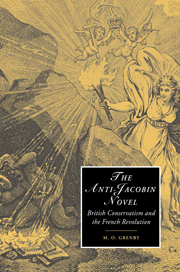
The Anti-Jacobin Novel
The French Revolution sparked an ideological debate which also brought Britain to the brink of revolution in the 1790s. Just as radicals wrote 'Jacobin' fiction, so the fear of rebellion prompted conservatives to respond with novels of their own; indeed, these soon outnumbered the Jacobin novels. This was the first survey of the full range of conservative novels produced in Britain during the 1790s and early 1800s. M. O. Grenby examines the strategies used by conservatives in their fiction, thus shedding new light on how the anti-Jacobin campaign was understood and organised in Britain. Chapters cover the representation of revolution and rebellion, the attack on the 'new philosophy' of radicals such as Godwin and Wollstonecraft, and the way in which hierarchy is defended in these novels. Grenby's book offers an insight into the society which produced and consumed anti-Jacobin novels, and presents a case for reexamining these neglected texts.
eBook

The Age of the Democratic Revolution
For the Western world, the period from 1760 to 1800 was the great revolutionary era in which the outlines of the modern democratic state came into being. Here for the first time in one volume is R. R. Palmer's magisterial account of this incendiary age. Palmer argues that the American, French, and Polish revolutions—and the movements for political change in Britain, Ireland, Holland, and elsewhere—were manifestations of similar political ideas, needs, and conflicts. Palmer traces the clash between an older form of society, marked by legalized social rank and hereditary or self-perpetuating elites, and a new form of society that placed a greater value on social mobility and legal equality.
Featuring a new foreword by David Armitage, this Princeton Classics edition of The Age of the Democratic Revolution introduces a new generation of readers to this enduring work of political history.
eBook

The Jews and the nation
This book is the first systematic comparison of the civic integration of Jews in the United States and France--specifically, from the two countries' revolutions through the American republic and the Napoleonic era (1775-1815). Frederic Jaher develops a vehicle for a broader and uniquely rich analysis of French and American nation-building and political culture. He returns grand theory to historical scholarship by examining the Jewish encounter with state formation and Jewish acquisition of civic equality from the perspective of the \"paradigm of liberal inclusiveness\" as formulated by Alexis de Tocqueville and Louis Hartz.
eBook