
Catalogue Search | MBRL


Are you sure you want to remove the book from the shelf?

{{itemTitle}}
227,372
result(s) for
"LABORATORY ANIMALS"
Sort by:


laboratory rabbit, guinea pig, hamster, and other rodents
The Laboratory Rabbit, Guinea Pig, Hamster, and Other Rodents is a single volume, comprehensive book sanctioned by the American College of Laboratory Animal Medicine (ACLAM), covering the rabbit, guinea pig, hamster, gerbil and other rodents often used in research.
eBook


Pathology of laboratory rodents and rabbits
Now in its fourth edition, Pathology of Laboratory Rodents and Rabbits has become a standard text for veterinary pathologists, laboratory animal veterinarians, students, and others interested in these species. - The standard reference on the pathogenesis and cardinal diagnostic features of diseases of mice, rats, hamsters, gerbils, guinea pigs, and rabbits - Expanded coverage of rabbit disease, normal anatomic features, and biology - Over 450 color photographs illustrating gross and microscopic pathology - Companion website offering images from the text in PowerPoint
eBook


Animal-centric Care and Management
The concept of the 3Rs (Refinement, Reduction and Replacement) has been used as a framework for improving the welfare of laboratory animals for the last half century. By establishing an animal-centric view on housing and management, this book takes Russell and Burch's definition of Refinement as \"elimination of inhumanities\" and goes further. Rather than fitting animals into experimental conditions, it encourages readers to adjust conditions to better meet the behavioral, emotional, physical, and physiological needs and preferences of the animals. The team of expert authors, from the fields of laboratory animal science, ethology, biology as well as animal training, provide ideas for creating housing conditions and handling procedures that induce, to the best of current abilities and knowledge, a long-term positive state of mind in the animals under our care.
This book is written for animal caretakers, animal health technicians, researchers, animal facility managers, laboratory animal veterinarians, or anyone who engages in work with living experimental animals or is interested in the continuous improvement of laboratory animal welfare. This interdisciplinary guide will act as a catalyst, resulting in multiple viewpoints and fields collaborating to optimize laboratory animal welfare.
eBook

Animal ethos : the morality of human-animal encounters in experimental lab science
\"What are the moral challenges and consequences of animal research in academic laboratory settings? Animal Ethos considers how the inescapable needs of lab research necessitate interspecies encounters that, in turn, engender unexpected moral responses among a range of associated personnel. Whereas much has been written about codified, bioethical rules and regulations that inform proper lab behavior and decorum, Animal Ethos, as an in-depth, ethnographic project, probes the equally rich--yet poorly understood--realm of ordinary or everyday morality, where serendipitous, creative, and unorthodox thought and action evidence concerted efforts to transform animal laboratories into moral, scientific worlds. The work is grounded in efforts to integrate theory within medical anthropology (and, more particularly, on suffering and moral worth), animal studies, and science and technology studies (STS). Contrary to established scholarship that focuses exclusively on single professions (such as the researcher or technician), Animal Ethos tracks across the spectrum of the lab labor hierarchy by considering the experiences of researchers, animal technicians, and lab veterinarians. In turn, it offers comparative insights on animal activists. When taken together, this range of parties illuminates the moral complexities of experimental lab research. The affective qualities of interspecies intimacy, animal death, and species preference are of special analytical concern, as reflected in the themes of 'Intimacy,' 'Sacrifice,' and 'Exceptionalism' that anchor this work\"--Provided by publisher.
Book
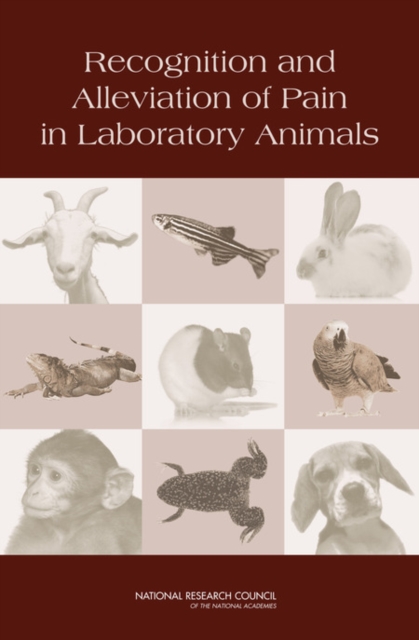
Recognition and alleviation of pain in laboratory animals
The use of animals in research adheres to scientific and ethical principles that promote humane care and practice. Scientific advances in our understanding of animal physiology and behavior often require theories to be revised and standards of practice to be updated to improve laboratory animal welfare.
Recognition and Alleviation of Pain in Laboratory Animals , the second of two reports revising the 1992 publication Recognition and Alleviation of Pain and Distress in Laboratory Animals from the Institute for Laboratory Animal Research (ILAR), focuses on pain experienced by animals used in research. This book aims to educate laboratory animal veterinarians; students, researchers and investigators; Institutional Animal Care and Use Committee members; and animal care staff and animal welfare officers on the current scientific and ethical issues associated with pain in laboratory animals. It evaluates pertinent scientific literature to generate practical and pragmatic guidelines for recognizing and alleviating pain in laboratory animals, focusing specifically on the following areas: physiology of pain in commonly used laboratory species; pharmacologic and non-pharmacologic principles to control pain; identification of humane endpoints; and principles for minimizing pain associated with experimental procedures. Finally, the report identifies areas in which further scientific investigation is needed to improve laboratory animal welfare.
eBook


Biotech Animals in Research
This book explores central aspects of genetic modification of animals for scientific purposes in the context of technological possibilities, regulatory issues in different regions, animal welfare implications and wider ethical issues exemplified through current theories and frameworks.
This discussion of lab animals produced through modern biotechnologies becomes increasingly pressing as CRISPR-Cas9 technology advances rapidly, challenging legal and ethical frameworks all over the world. Such animals are now affordable and readily available to almost every branch of scientific research. This not only raises enormous potential for creating 'tailored' models for human diseases but also rubs up against the traditional guiding principles (the 3Rs) for the humane use of animals for scientific experiments and raises wider ethical issues around death, integrity and naturalness. In this book, expert authors from diverse backgrounds in laboratory animal care, animal research, technology and animal rights explore a range of topics, from the science behind biotech research animals and the regulation of their use, to utilitarian, animal rights, virtue ethics and ethics of care, and critical animal studiers' perspectives on the use of these technologies.
Whatever your background or role in animal research, this book will challenge and stimulate deeper consideration of the benefits, disadvantages and ethical consequences of the use of biotechnology in the animal laboratory.
eBook