
Catalogue Search | MBRL


Are you sure you want to remove the book from the shelf?

{{itemTitle}}
22,199
result(s) for
"Library architecture."
Sort by:


Philanthropy and Light
Walter Gropius associated standardisation with promoting civilisation in 1935, yet Andrew Carnegie's influence on the proliferation of pattern book public library plans internationally predated these observations by 50 years. Through the first twenty years of his programme, he supported the erection of almost three thousand public buildings across Britain and America. Though better acknowledged in the US than the UK, this philanthropic contribution radically extended the scope of public provision and remains incomparable in its scale and scope in both nations. Frequently engraved with the self-deifying slogan Let there be Light�, open access to navigate these new interior public spaces after work coincided with the first provision of electric light. Towards the end of the nineteenth century, professional groups had sought to specify minimum standards of natural light and air for schools and hospitals. However, the commercial quantification of electricity accelerated the development of a readily comparable vocabulary to prescribe adequate quantities of light for all tasks regardless of their location or orientation. Seeking to gauge the extent of universal values, this book concentrates on the design and performance of a handful of early Carnegie library buildings in Britain and America, identifying their response to contemporary design theory, but also by contrast to their respective local environmental contexts. It examines whether their standards of provision were equitable and if these privately financed public buildings were the first roots of generically standardised public environments to be shared transatlantically. The book also argues that the public library building type can provide a datum for acknowledging the twentieth century legacy of shared international environmental standards for public spaces more broadly.
eBook
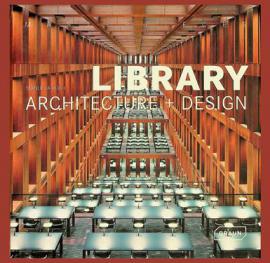
Library architecture + design
This volume from the 'Masterpieces' series presents outstanding examples of revolutions in library design and renovation, an architectural challenge to strike the finest balance between functionality and aesthetics.
Book
The space in the library. A methodological reflection
The space in the library is realized through the contribution of various figures, among which the main actors are librarians and architects. A relationship of skills that is always dialectical, finds its roots in history, and has designed better solutions the stronger the level of collaboration has been. In this context the library building also becomes an essential component of Library Science, and takes on new significance in the context of the digital canon.
Journal Article

The space in the library. A methodological reflection
The space in the library is realized through the contribution of various figures, among which the main actors are librarians and architects. A relationship of skills that is always dialectical, finds its roots in history, and has designed better solutions the stronger the level of collaboration has been. In this context the library building also becomes an essential component of Library Science, and takes on new significance in the context of the digital canon.
Journal Article
The space in the library. A methodological reflection
The space in the library is realized through the contribution of various figures, among which the main actors are librarians and architects. A relationship of skills that is always dialectical, finds its roots in history, and has designed better solutions the stronger the level of collaboration has been. In this context the library building also becomes an essential component of Library Science, and takes on new significance in the context of the digital canon.
Journal Article


The representation of the library : civil space in the Renaissance civilization
The discovery of the Vitruvian code constituted a revolution for architecture by promoting the meeting of architects-artists with learned humanists. The civil life of the lively Renaissance city had given impetus to the ethical and political ideals of humanists, while the meeting and exchange had determined the formation of public space. In this context, the humanistic library is created, a space designed according to the Renaissance ideal to host a collection of codes created according to the new bibliographic canon. The correspondence between the library aspects and the architectural aspects becomes the humanistic library in the Renaissance representation in a reference model. [Publisher's text]
Journal Article