
Catalogue Search | MBRL


Are you sure you want to remove the book from the shelf?

{{itemTitle}}
78,783
result(s) for
"Murals"
Sort by:

Access Granted: Some Thoughts for the Future
Stainton talks about William Scott's Praise Frisco: Peace and Love in the City, a landmark commission from the San Francisco Museum of Modern Art. Composed of colorfully montaged illustrations, the wall-length mural enmeshes Scott's personal history with cultural iconography. Praise Frisco is nostalgic yet futuristic, with a redesign of city infrastructure set amongst smiling portraits of some of the people who shape Scott's world. These include Diana Ross, church women praise dancing, and youthful depictions of himself and his mother.
Journal Article


The Dictator Stays in the Picture: The Forgotten History of a Controversial Mural
Italian-Canadian painter Guido Nincheri painted over two hundred church murals and church-paintings during his lifetime. The Canadian Encyclopedia notes how “Nincheri’s frescos are also now winning more attention.” Yet one of Nincheri’s frescos will always cause him controversy. On the cupola of the Church of the Madonna della Difesa in Montreal, Nincheri was commissioned to paint a mural celebrating The Lateran Treaty, for which Mussolini recognized the Vatican as a separate state. As a result, Mussolini features prominently in this mural, as a man on horseback no less (though as his grandson notes, appearing more befuddled than grand: “Look at the expression of Il Duce. It’s as if he’s saying, ‘What am I doing here?’”) Nevertheless, Nincheri’s fresco did briefly cause him to be placed in an internment camp during World War II. Having convinced Canadian authorities he was pressured to paint in Il Duce, he was released and would then go onto a career painting numerous religious paintings throughout churches in North America. Curiously, his fresco depicting Mussolini would survive—a contrast with another mural that featured a controversial leader in Diego Rivera’s Man at the Crossroads, initially commissioned to hang at New York City’s Rockefeller Center. But when the Mexican painter refused to take out the image of Lenin in this mural, his work was destroyed. Why was Nincheri’s controversial political leader allowed to remain, and not Rivera’s? More importantly, do art works depicting controversial historical figures, have a right to remain in their original creations, as their artists intended? Is posthumous censorship or destruction of such works, more harmful and even dangerous, than allowing such controversial works to be exhibited without alteration that might have valid justifiable reasons?
Journal Article
To the Wall : London's Murals and 'The Left', 1975-1986
This thesis examines the relationship between Left-wing politics and a body of exterior murals made in London between 1975 and 1986. Across this period approximately three hundred murals were made on the walls of London’s streets. Funded by a complex amalgam of predominantly state patronage, many of these murals gave form to the politics of the radical and oppositional Left. While murals featured briefly in art critical debates of the late 1970s and have since been included within broader histories of community and public art, this is the first extended study centred upon this remarkable moment of cultural production. Applying diverse methodologies of the social history of art and Marxist art history to an analysis of seven case studies this thesis seeks to redress the murals’ neglect within art historical accounts. The first chapter examines murals by Greenwich Mural Workshop and Brian Barnes, in Greenwich, Charlton and Battersea, focussing analysis on the emergent techniques by which the murals related to localised campaigns and struggles for democratic control of resources, between 1975 and 1978. The second chapter analyses two murals made in Tower Hamlets— by Ray Walker and David Binnington, Paul Butler, Desmond Rochfort and Ray Walker— focussing on the murals’ diverse modes of response and resistance to the rise of the Far and New Right between 1978 and 1983. The final chapter examines a Brixton mural by Brian Barnes and one in Hackney by Ray Walker, Anna Walker and Mike Jones, in relation to the deepening threat of nuclear apocalypse and hopes of the contemporary peace movement; analysing the murals’ place within Cold War iconography the chapter argues that the murals established a metonymic relation to wider-ranging resistances to Thatcherism’s ascent across the first half of the 1980s. Throughout, a focus on technique incorporates localised research, visual and iconographic analysis and a body of Marxist urban geography and theory to argue that the murals’ radical and innovative presence as sites of contestation across a period of profound urban, economic, social and cultural transition, constitutes a significant episode in the histories of British art and international muralism.
Dissertation
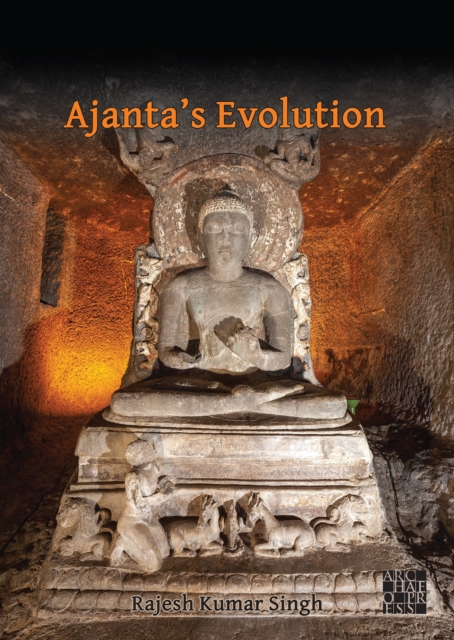
Ajanta's Evolution
Ajanta's Evolution: From Sāvakayāna to Bodhisatvayāna amid
Hunnic Turmoil offers a new scholarly exploration of the
rock-cut caves, their sculpture and paintings, meticulously tracing
the rise, transformation, and legacy of these architectural
marvels.
The book takes an interdisciplinary approach, combining elements
of historical, archaeological, artistic and Buddhist studies. Part
I treats the grand epoch of Śrāvakayāna, discussing archaeological
contexts, cave classification methodologies, and the emergence of
rock-cut monasteries under the influence of King Hari Ṣeṇa. Against
the backdrop of Hunnic upheaval and societal transformations, Part
II delves into the Bodhisatvayāna era, chronicling the impact of
Alchon or Alkhan Hun raids, migrations, and the evolution of the
rock-cut monuments.
The principle aim is to contextualize the site of Ajanta within
a new historical setting. It seeks to address the paradox of how
the Early Alchon or Alkhan Hunnic invasions, despite causing
significant challenges to the development of the fifth-century cave
temples, also provided opportunities for innovation. Another
noteworthy aspect is the introduction of a novel taxonomical
approach to the monuments. A revised chart for the taxonomy and
typological classification of Buddhist rock-cut monuments is
presented, mapping the evolutionary trajectory of architectural
development over time.
eBook


Heaven, Hell, and Everything in Between
Examining the vivid, often apocalyptic church murals of Peru from the early colonial period through the nineteenth century, Heaven, Hell, and Everything in Between explores the sociopolitical situation represented by the artists who generated these murals for rural parishes. Arguing that the murals were embedded in complex networks of trade, commerce, and the exchange of ideas between the Andes and Europe, Ananda Cohen Suarez also considers the ways in which artists and viewers worked through difficult questions of envisioning sacredness.This study brings to light the fact that, unlike the murals of New Spain, the murals of the Andes possess few direct visual connections to a pre-Columbian painting tradition; the Incas' preference for abstracted motifs created a problem for visually translating Catholic doctrine to indigenous congregations, as the Spaniards were unable to read Inca visual culture. Nevertheless, as Cohen Suarez demonstrates, colonial murals of the Andes can be seen as a reformulation of a long-standing artistic practice of adorning architectural spaces with images that command power and contemplation. Drawing on extensive secondary and archival sources, including account books from the churches, as well as on colonial Spanish texts, Cohen Suarez urges us to see the murals not merely as decoration or as tools of missionaries but as visual archives of the complex negotiations among empire, communities, and individuals.
eBook

Application of a modified Inception-v3 model in the dynasty-based classification of ancient murals
It is difficult to identify the historical period in which some ancient murals were created because of damage due to artificial and/or natural factors; similarities in content, style, and color among murals; low image resolution; and other reasons. This study proposed a transfer learning-fused Inception-v3 model for dynasty-based classification. First, the model adopted Inception-v3 with frozen fully connected and softmax layers for pretraining over ImageNet. Second, the model fused Inception-v3 with transfer learning for parameter readjustment over small datasets. Third, the corresponding bottleneck files of the mural images were generated, and the deep-level features of the images were extracted. Fourth, the cross-entropy loss function was employed to calculate the loss value at each step of the training, and an algorithm for the adaptive learning rate on the stochastic gradient descent was applied to unify the learning rate. Finally, the updated softmax classifier was utilized for the dynasty-based classification of the images. On the constructed small datasets, the accuracy rate, recall rate, and F1 value of the proposed model were 88.4%, 88.36%, and 88.32%, respectively, which exhibited noticeable increases compared with those of typical deep learning models and modified convolutional neural networks. Comparisons of the classification outcomes for the mural dataset with those for other painting datasets and natural image datasets showed that the proposed model achieved stable classification outcomes with a powerful generalization capacity. The training time of the proposed model was only 0.7 s, and overfitting seldom occurred.
Journal Article


The Power and the Glorification
Focusing on a turbulent time in the history of the Roman Catholic Church, The Power and the Glorification considers how, in the fifteenth and sixteenth centuries, the papacy employed the visual arts to help reinforce Catholic power structures. All means of propaganda were deployed to counter the papacy’s eroding authority in the wake of the Great Schism of 1378 and in response to the upheaval surrounding the Protestant Reformation a century later. In the Vatican and elsewhere in Rome, extensive decorative cycles were commissioned to represent the strength of the church and historical justifications for its supreme authority. Replicating the contemporary viewer’s experience is central to De Jong’s approach, and he encourages readers to consider the works through fifteenth- and sixteenth-century eyes. De Jong argues that most visitors would only have had a limited knowledge of the historical events represented in these works, and would likely have accepted (or been intended to accept) what they saw at face value. With that end in mind, the painters’ advisors did their best to “manipulate” the viewer accordingly, and De Jong discusses their strategies and methods.
eBook