
Catalogue Search | MBRL


Are you sure you want to remove the book from the shelf?

{{itemTitle}}
1,545
result(s) for
"Nature Effect of human beings on."
Sort by:


Wildlife in the Anthropocene
Elephants rarely breed in captivity and are not considered domesticated, yet they interact with people regularly and adapt to various environments. Too social and sagacious to be objects, too strange to be human, too captive to truly be wild, but too wild to be domesticated-where do elephants fall in our understanding of nature?
InWildlife in the Anthropocene,Jamie Lorimer argues that the idea of nature as a pure and timeless place characterized by the absence of humans has come to an end. But life goes on. Wildlife inhabits everywhere and is on the move; Lorimer proposes the concept of wildlife as a replacement for nature. Offering a thorough appraisal of the Anthropocene-an era in which human actions affect and influence all life and all systems on our planet- Lorimer unpacks its implications for changing definitions of nature and the politics of wildlife conservation.Wildlife in the Anthropoceneexamines rewilding, the impacts of wildlife films, human relationships with charismatic species, and urban wildlife. Analyzing scientific papers, policy documents, and popular media, as well as a decade of fieldwork, Lorimer explores the new interconnections between science, politics, and neoliberal capitalism that the Anthropocene demands of wildlife conservation.
Imagining conservation in a world where humans are geological actors entangled within and responsible for powerful, unstable, and unpredictable planetary forces, this work nurtures a future environmentalism that is more hopeful and democratic.
eBook


Novel ecosystems
Land conversion, climate change and species invasions are contributing to the widespread emergence of novel ecosystems, which demand a shift in how we think about traditional approaches to conservation, restoration and environmental management. They are novel because they exist without historical precedents and are self-sustaining. Traditional approaches emphasizing native species and historical continuity are challenged by novel ecosystems that deliver critical ecosystems services or are simply immune to practical restorative efforts. Some fear that, by raising the issue of novel ecosystems, we are simply paving the way for a more laissez-faire attitude to conservation and restoration. Regardless of the range of views and perceptions about novel ecosystems, their existence is becoming ever more obvious and prevalent in today's rapidly changing world. In this first comprehensive volume to look at the ecological, social, cultural, ethical and policy dimensions of novel ecosystems, the authors argue these altered systems are overdue for careful analysis and that we need to figure out how to intervene in them responsibly. This book brings together researchers from a range of disciplines together with practitioners and policy makers to explore the questions surrounding novel ecosystems. It includes chapters on key concepts and methodologies for deciding when and how to intervene in systems, as well as a rich collection of case studies and perspective pieces. It will be a valuable resource for researchers, managers and policy makers interested in the question of how humanity manages and restores ecosystems in a rapidly changing world.
A companion website with additional resources is available at www.wiley.com/go/hobbs/ecosystems [http://www.wiley.com/go/hobbs/ecosystems]
eBook

The human age : how we created the Anthropocene epoch and caused the climate
The Human Age is an intrepid exploration of the new geological epoch in which we now find ourselves: the Anthropocene. Defined as the Age of Man, this is the epoch in which human beings have become the driving forces that mould, transform and destroy Earth. Where natural occurrences once controlled climate, geology and the genesis and demise of species, humankind now holds the reins. Bringing together scientific theory, political argument, philosophical questioning and our deepest fears and hopes for the future, The Human Age explores this new age through informative and compelling text, and astounding photographs of the impact of human life on Earth. Powerful graphics depict the changing nature of the landscape and the very bedrock of our planet, and the destruction of ancient systems and environments that is resulting in global upheaval and climate breakdown. Creating a visual and written timeline of the age of human domination, The Human Age reveals how this era was born, the ways in which it is impacting us and our planet now, and the outlook for the future.
Book

The Ancient Mediterranean Environment between Science and History
The product of a collaboration between scientists, historians and archaeologists, this book breaks new ground in the study of the long-term interaction between environmental factors, including climate, and human beings.
eBook


Island historical ecology : socionatural landscapes of the eastern and southern Caribbean
In the first book-length treatise on historical ecology of the West Indies, Island Historical Ecology addresses Caribbean island ecologies from the perspective of social and cultural interventions over approximately eight millennia of human occupations. Environmental coring carried out in carefully selected wetlands allowed for the reconstruction of pre-colonial and colonial landscapes on islands between Venezuela and Puerto Rico. Comparisons with well-documented patterns in the Mediterranean and Pacific islands place this case study into a larger context of island historical ecology.
eBook
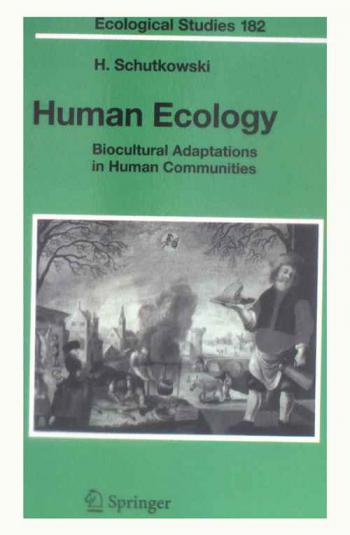
Human ecology : biocultural adaptations in human communities
\"The human condition is composed of culturally mediated biology, and this inherently dual nature is key to our understanding of human/environment interaction. Human Ecology provides a fresh view on the interrelationship between cultural strategies and their biological outcomes. It combines for the first time an ecosystems approach with cultural anthropological, archaeological and evolutionary behavioural concepts. Taking resources use and food procurement behavior as the starting point, the volume examines major subsistence modes, the circumstances and dynamics of large-scale subsistence change, the effect of social differentiation on resource use and the effects of subsistence behaviour on population development and regulation. It is complemented by a brief history on human ecological thought and a discussion of pertinent theoretical issues. Numerous examples from all time periods illustrate the topics and emphasis the universal nature of the interpretive framework.\"--Jacket.
Book

Metaphors for Environmental Sustainability
Scientists turn to metaphors to formulate and explain scientific concepts, but an ill-considered metaphor can lead to social misunderstandings and counterproductive policies, Brendon Larson observes in this stimulating book. He explores how metaphors can entangle scientific facts with social values and warns that, particularly in the environmental realm, incautious metaphors can reinforce prevailing values that are inconsistent with desirable sustainability outcomes.
Metaphors for Environmental Sustainabilitydraws on four case studies-two from nineteenth-century evolutionary science, and two from contemporary biodiversity science-to reveal how metaphors may shape the possibility of sustainability. Arguing that scientists must assume greater responsibility for their metaphors, and that the rest of us must become more critically aware of them, the author urges more critical reflection on the social dimensions and implications of metaphors while offering practical suggestions for choosing among alternative scientific metaphors.
eBook