
Catalogue Search | MBRL


Are you sure you want to remove the book from the shelf?

{{itemTitle}}
13
result(s) for
"Netherlands History Dictionaries."
Sort by:

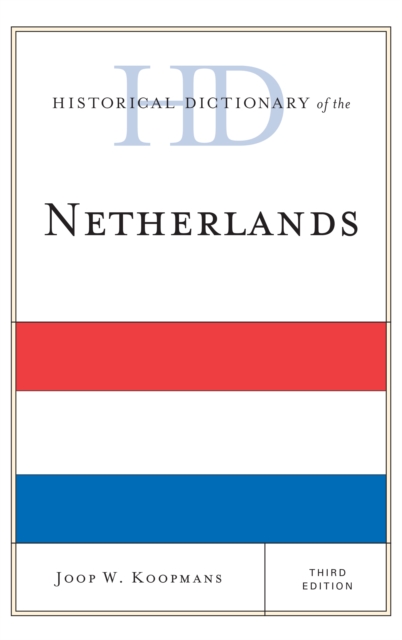
Historical dictionary of the Netherlands
The Kingdom of the Netherlands is a small, but heavily populated country with almost 17 million inhabitants.It is one of the last kingdoms in Europe and in 2015 it celebrated its 200 years anniversary.The Netherlands became a kingdom after the Napoleonic era.During this period it was transformed into a centralized state.
eBook

Psychometrically and qualitatively validating a cross-national cumulative measure of fear-based xenophobia
The article reports the results of a Mokken Scale Procedure (MSP) developing a hierarchical cross-national scale to measure xenophobia, and a qualitative validation of this scale. A pool of 30 xenophobic scale items were collected from several sources and edited according to established unidimensional criteria. The survey was administered to 608 undergraduate students in the USA, 193 undergraduate students in the Netherlands, and 303 undergraduate students in Norway. Fourteen scale statements measuring perceived threat or fear and meeting the criteria of the Stereotype Content Model (e.g., Fiske et al. in Trends Cogn Sci 11:77–83,
2006
) were selected for further analysis. A separate item analysis and subsequently MSP analysis yielded a cumulative scale with the same five items for each of the three samples meeting criteria for homogeneity in all samples with H >.40. The result, a cross-national 5-item scale measuring fear-based xenophobia, was tested by means of the Three-Step Test-Interview (Hak et al. in Surv Res Methods 2:143–150,
2008
) with 10 students in The Netherlands and 10 students in Norway. The analysis of these qualitative interviews shows that individual respondents’ criteria for the ranking of the scale items strongly depend on the way immigrants are framed. Ranking according to different levels of fear turned out to be only one criterion out of several possible ones used by individual respondents.
Journal Article

Standardization of Sign Languages
Over the years attempts have been made to standardize sign languages. This form of language planning has been tackled by a variety of agents, most notably teachers of Deaf students, social workers, government agencies, and occasionally groups of Deaf people themselves. Their efforts have most often involved the development of sign language books with lists of signs in alphabetical order (as distinct from sign language principles) and more recently as CDROMs, DVDs, or websites. With regard to the all-important question about language standardization, Karin Hoyer asks, “Who is behind the effort?” and goes on to say that “standardization actions (often with the aim of reducing lexical variation) have frequently been undertaken with the strong support of the hearing-run education system—from outside, often without any support from the language users themselves” (2012, 32). Today, sign language planning is still carried out largely by hearing professionals; thus, that standardization still needs to be examined in relation to “language ownership” (Eichmann 2009).
Journal Article
Voor elkaar
Eentalige en tweetalige woordenboeken bevatten idealiter alle informatie die nodig is om woorden correct en adequaat te kunnen begrijpen en gebruiken. De betekenisomschrijving in woordenboeken is daarvoor echter vaak te weinig precies, waardoor gebruikers van woordenboeken - zeker bij taalproductie en vertalen - op het verkeerde been worden gezet. Wim Honselaar stelt in zijn oratie dat op tekstcorpora gebaseerde eentalige lexicologische studies, contrastieve tweetalige studies en bestudering van de inpassing van het lexicon in theoretische taalmodellen vruchtbare wegen zijn om betekenisbijzonderheden op te sporen.
eBook

Nipah or Gebang? A Philological and Codicological Study Based on Sources from West Java
This article takes up the question of writing supports, the physical media on which texts were recorded on the island of Java before paper and printing were introduced, with special focus on the western region and the Old Sundanese tradition. In the past, two types of indigenous writing materials prepared from the leaves of palm trees were identified, one known among scholars in the Dutch tradition as 'nipah', the other as 'tontar'. While lontar is a common, widely used designation for the type of palm-leaf writing material used in the vast majority of surviving manuscripts, the nipah is rare and not commonly thought of as a writing material outside of scholarly circles. In an effort to understand the place of nipah in the tradition, the author turns to descriptions of writing materials in old written as well as oral sources and concludes that the terminology used there is at odds with the accepted idea that the second, rare type of leaf used in the palm leaf manuscript tradition came from the nipah palm. Instead, it was prepared from another palm species called gebang. At the same time, the author provides new insight into indigenous conceptualizations that differentiate the types of texts recorded on lontar and gebang materials.
Journal Article
Colonial Neighbours in an Era of Change
This article describes conditions in Timor in 1945–1949. Many problems facing the Portuguese and Dutch administrations revolved around Timorese activities such as unauthorized immigration, localized warfare, and livestock theft. Australia’s ambitions in the region and the support granted to independence movements by other nations created new challenges. The latter was particularly true for the Dutch, who had to deal with the influence of the Indonesian Republic, whose success eventually led to their departure. Portugal feared a similar fate, but it is explained how local conditions and a deal between Portugal and the Allies during the Second World War allowed it to retain its colonial possessions virtually free of criticism. Most histories of Timor concentrate on either the east or the west part of the island. This article, based mainly on primary sources, details the post-war situation in Timor for all the major groups concerned: the Portuguese, the Dutch, and the Timorese.
Journal Article
From Variant to Standard: An Overview of the Standardization Process of the Lexicon of Sign Language of the Netherlands over Two Decades
This article describes the process of the standardization of the basic lexicon of the Sign Language of the Netherlands (SLN) and the different types of dictionaries that were produced. Research into the lexicon of SLN started in the early 1980s with the KOMVA (\"Communicative Competence\") project. The process of the unification of signs through a system of preference signs has been accelerated at the request of the Dutch government to standardize the lexicon of SLN in order to recognize it as an official language. The article describes the background and method of this Standardization of Basic Lexicon (STABOL) project.
Journal Article

Voor elkaar
Eentalige en tweetalige woordenboeken bevatten idealiter alle informatie die nodig is om woorden correct en adequaat te kunnen begrijpen en gebruiken. De betekenisomschrijving in woordenboeken is daarvoor echter vaak te weinig precies, waardoor gebruikers van woordenboeken - zeker bij taalproductie en vertalen - op het verkeerde been worden gezet. Wim Honselaar stelt in zijn oratie dat op tekstcorpora gebaseerde eentalige lexicologische studies, contrastieve tweetalige studies en bestudering van de inpassing van het lexicon in theoretische taalmodellen vruchtbare wegen zijn om betekenisbijzonderheden op te sporen. Zodoende kan er bijgedragen worden aan de verbetering van zowel eentalige als tweetalige woordenboeken. Honselaar onderbouwt zijn stelling aan de hand van de analyse van afzonderlijke woorden als 'nu' en 'elkaar' in het Nederlands en hun vertaling in het Russisch, en van een groep van verzameling-aanduidende woorden als 'echtpaar'. Eentalige lexicografie, tweetalige lexicografie en theoretische taalwetenschap kunnen volgens hem veel voor elkaar betekenen.
eBook
