
Catalogue Search | MBRL


Are you sure you want to remove the book from the shelf?

{{itemTitle}}
1,830
result(s) for
"Pain and suffering"
Sort by:

The modulated scream : pain in late medieval culture
This book provides an integral, readable account of changing attitudes toward pain in late medieval Europe. Since pain itself cannot be known, the book looks at pain by chronicling what people wrote about it, and what they did with and about that.
Book

All Anchors Are Not Created Equal
This experiment examined whether different quantifications of the same damage award request ($175,000 lump sum, $10/hour, $240/day, $7300/month for 2 years) influenced pain and suffering awards compared to no damage award request. Jury-eligible community members (N = 180) read a simulated personal injury case in which defendant liability already had been determined. Awards were: (1) larger for the $10/hour and $175,000 conditions than the $7300/month and control conditions and (2) more variable for the $10/hour condition than the $7300/month and control conditions. No differences emerged on ratings of the parties, their attorneys, or the difficulty of picking a compensation figure. We discuss the theoretical implications of our data for the anchoring and adjustment literature and the practical implications for legal professionals.
Journal Article


Predicting Jewish-Israeli Recognition of Palestinian Pain and Suffering
Recognition is vital for conflict resolution. This study was designed to learn more about the factors underlying the willingness to recognize the pain and suffering of the opponent in the asymmetrical protracted conflict between Israelis and Palestinians. Data were collected through a public opinion survey conducted with a representative sample of Israeli-Jewish adults (N = 511). Perceptions of threat/distrust toward Palestinians and dehumanization of Palestinians each made a significant contribution to explaining Jewish-Israeli (un)willingness to recognize Palestinian pain and suffering (R2 = .36). Hawkishness made an added significant contribution to the overall explanatory power of the model (R2 = .38). Higher scores on the threat/distrust scale and the dehumanization scale, as well as higher hawkishness predicted decreased willingness to recognize Palestinian pain and suffering. The implications of our findings for understanding the role of recognition and of moral concern in conflict resolution are discussed.
Journal Article

Of women borne : a literary ethics of suffering
\"A new approach to the recent turn to ethics in literary studies that emphasizes the gendered and religious syntax of suffering\" -- Provided by publisher.
Book

On Rhetoric and the School of Philosophy Without Tears
This article addresses the contentious philosophical claim that rhetoric is merely a “philosophy without tears.” Mindful of the institutional and disciplinary stakes of this claim today, it offers a genealogy of “philosophy without tears” across the past century, from the popular “no more tears” genre to midcentury debates between ordinary language philosophers and logical atomists. What emerges is an ethical argument concerning the materiality and transitivity of language, fleshed out through a rhetoric of tears and as an ontology of pain and suffering. Drawing on a rhetorical reading of Wittgenstein's “form-of-life,” I argue that both pain and its expression should be understood as transitive rather than as epistemological or private phenomena. Transitivity helps us to better understand the perlocutionary power of pain and suffering in the politics of war and terrorism, in the “man-philosopher,” who disavows such transitivity, and, finally, in the necessary risk of responsibility toward the “other” of philosophy (and of rhetoric).
Journal Article

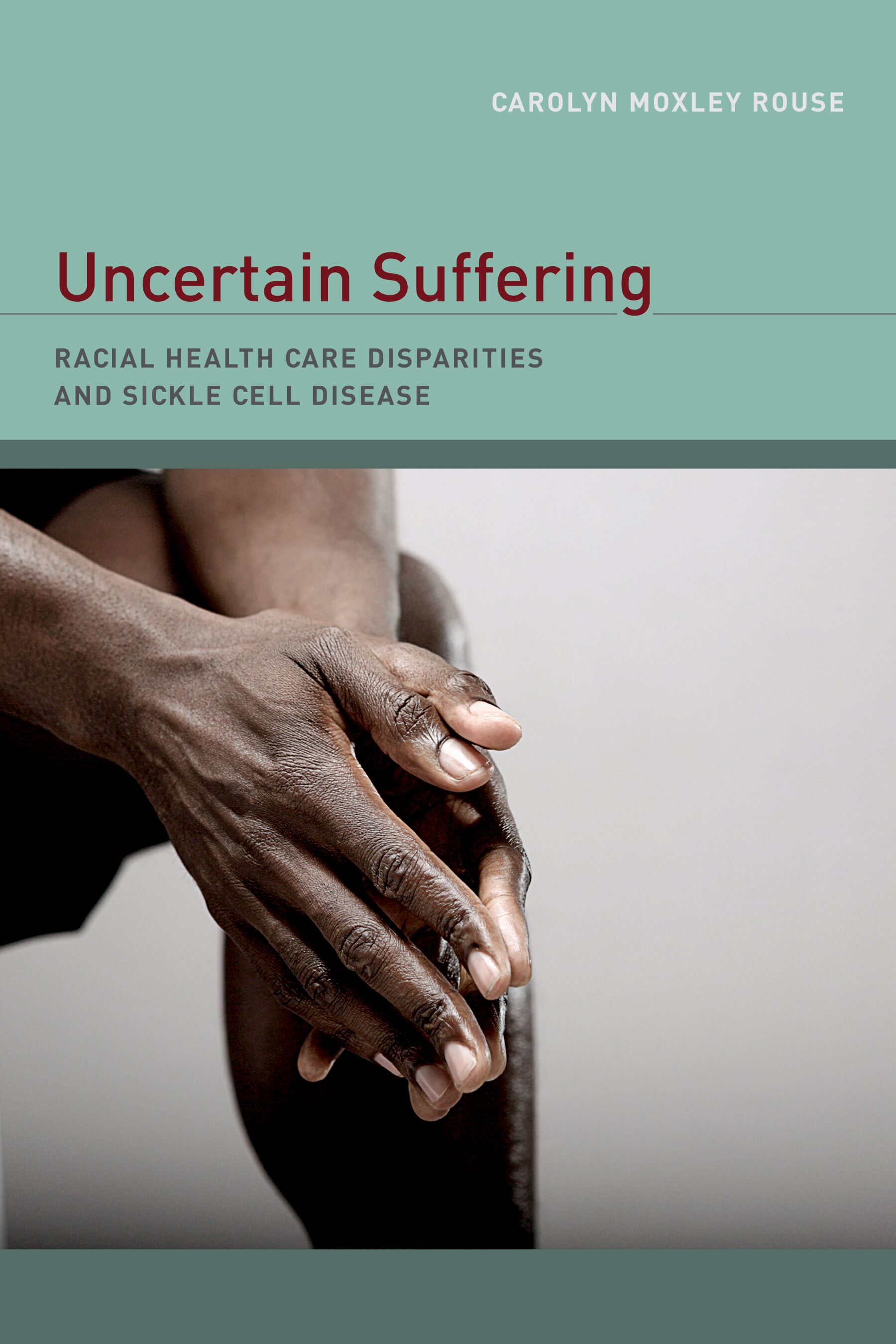
Uncertain Suffering
On average, black Americans are sicker and die earlier than white Americans. Uncertain Suffering provides a richly nuanced examination of what this fact means for health care in the United States through the lens of sickle cell anemia, a disease that primarily affects blacks. In a wide ranging analysis that moves from individual patient cases to the compassionate yet distanced professionalism of health care specialists to the level of national policy, Carolyn Moxley Rouse uncovers the cultural assumptions that shape the quality and delivery of care for sickle cell patients. She reveals a clinical world fraught with uncertainties over how to treat black patients given resource limitations and ambivalence. Her book is a compelling look at the ways in which the politics of racism, attitudes toward pain and suffering, and the reliance on charity for healthcare services for the underclass can create disparities in the U.S. Instead of burdening hospitals and clinics with the task of ameliorating these disparities, Rouse argues that resources should be redirected to community-based health programs that reduce daily forms of physical and mental suffering.
eBook

Are pain and suffering awards (un-)predictable? Evidence from Germany
This paper assesses the widely held belief that damages for pain and suffering are random or arbitrary. In detail, we investigate whether damages for pain and suffering are systematically affected by individual-, injury- and procedural-specific characteristics and how important these factors are relative to each other. To uncover the predictability of these awards, we rely on a sample of German damages for pain and suffering awards including 2.244 verdicts. By estimating a standard regression model we observe that final awards are systematically influenced by the injury's conditions, by the court level the case is brought in and by the engagement of a lawyer. Our findings let us conclude that damages for pain and suffering and the respective assessment process within the German judicial system are largely reasonable and transparent rather than random.
Journal Article

Sexbots: Customizing Them to Suit Us versus an Ethical Duty to Created Sentient Beings to Minimize Suffering
Sex robot scholarship typically focuses on customizable simulacra, lacking sentience and self-awareness but able to simulate and stimulate human affection. This paper argues that future humans will want more: sex robots customized to possess sentience and self-awareness [henceforth, sexbots], capable of mutuality in sexual and intimate relationships. Adopting a transdisciplinary critical methodology focused on the legal, ethical and design implications of sexbots, it assesses implications of sexbots’ non-mammalian subjectivity, balancing designed-in autonomy and control, decision-making capacity and consent, sexual preferences and desire, legal and moral status, vulnerability and contrasts between mammalian and non-mammalian moral decision-making. It explores theoretical, ethical, and pragmatic aspects of the tensions involved in creating sentient beings for utilitarian purposes, concluding that sexbots, customized manufactured humanlike entities with the capacity for thought and suffering, have a consequent claim to be considered moral and legal persons, and may become the first conscious robots. Customizing sexbots thus exemplifies many profound ethical, legal and design issues. The contradictions inherent in their inconsistent ethical and legal status as both manufactured things and sentient, self-aware entities who are customized to be our intimate partners augments existing human/animal scholars’ call for a new theoretical framework which supersedes current person/thing dichotomies governing human responsibilities to other sentient beings. The paper concludes that the ethical limits and legal implications of customizable humanlike robots must be addressed urgently, proposing a duty on humans as creators to safeguard the interests and minimize the suffering of created sentient beings before technological advances pre-empt this possibility.
Journal Article