
Catalogue Search | MBRL


Are you sure you want to remove the book from the shelf?

{{itemTitle}}
79,622
result(s) for
"Science Political aspects."
Sort by:

The power of scientific knowledge : from research to public policy
\"It is often said that knowledge is power, but more often than not relevant knowledge is not used when political decisions are made. This book examines how political decisions relate to scientific knowledge and what factors determine the success of scientific research in influencing policy. The authors take a comparative and historical perspective and refer to well-known theoretical frameworks, but the focus of the book is on three case studies: the discourse of racism, Keynesianism, and climate change. These cases cover a number of countries and different time periods. In all three the authors see a close link between 'knowledge producers' and political decision makers, but show that the effectiveness of the policies varies dramatically. This book will be of interest to scientists, decision makers and scholars alike\"-- Provided by publisher.
Book

Powerless Science?
In spite of decades of research on toxicants, along with the growing role of scientific expertise in public policy and the unprecedented rise in the number of national and international institutions dealing with environmental health issues, problems surrounding contaminants and their effects on health have never appeared so important, sometimes to the point of appearing insurmountable. This calls for a reconsideration of the roles of scientific knowledge and expertise in the definition and management of toxic issues, which this book seeks to do. It looks at complex historical, social, and political dynamics, made up of public controversies, environmental and health crises, economic interests, and political responses, and demonstrates how and to what extent scientific knowledge about toxicants has been caught between scientific, economic, and political imperatives.
eBook

Science not silence : voices from the March for Science Movement
Awareness of science encouraged through events in 2017.
Book

Life as Surplus
Focusing on the period between the 1970s and the present, Life as Surplus is a pointed and important study of the relationship between politics, economics, science, and cultural values in the United States today. Melinda Cooper demonstrates that the history of biotechnology cannot be understood without taking into account the simultaneous rise of neoliberalism as a political force and an economic policy. From the development of recombinant DNA technology in the 1970s to the second Bush administration's policies on stem cell research, Cooper connects the utopian polemic of free-market capitalism with growing internal contradictions of the commercialized life sciences.
The biotech revolution relocated economic production at the genetic, microbial, and cellular level. Taking as her point of departure the assumption that life has been drawn into the circuits of value creation, Cooper underscores the relations between scientific, economic, political, and social practices. In penetrating analyses of Reagan-era science policy, the militarization of the life sciences, HIV politics, pharmaceutical imperialism, tissue engineering, stem cell science, and the pro-life movement, the author examines the speculative impulses that have animated the growth of the bioeconomy.
At the very core of the new post-industrial economy is the transformation of biological life into surplus value. Life as Surplus offers a clear assessment of both the transformative, therapeutic dimensions of the contemporary life sciences and the violence, obligation, and debt servitude crystallizing around the emerging bioeconomy.
eBook


Disrupting Science
In the decades following World War II, American scientists were celebrated for their contributions to social and technological progress. They were also widely criticized for their increasingly close ties to military and governmental power--not only by outside activists but from among the ranks of scientists themselves. Disrupting Science tells the story of how scientists formed new protest organizations that democratized science and made its pursuit more transparent. The book explores how scientists weakened their own authority even as they invented new forms of political action. Drawing extensively from archival sources and in-depth interviews, Kelly Moore examines the features of American science that made it an attractive target for protesters in the early cold war and Vietnam eras, including scientists' work in military research and activities perceived as environmentally harmful. She describes the intellectual traditions that protesters drew from--liberalism, moral individualism, and the New Left--and traces the rise and influence of scientist-led protest organizations such as Science for the People and the Union of Concerned Scientists. Moore shows how scientist protest activities disrupted basic assumptions about science and the ways scientific knowledge should be produced, and recast scientists' relationships to political and military institutions. Disrupting Science reveals how the scientific community cumulatively worked to unbind its own scientific authority and change how science and scientists are perceived. In doing so, the book redefines our understanding of social movements and the power of insider-led protest.
eBook


The Diffusion of Military Power
The Diffusion of Military Power examines how the financial and organizational challenges of adopting new methods of fighting wars can influence the international balance of power. Michael Horowitz argues that a state or actor wishing to adopt a military innovation must possess both the financial resources to buy or build the technology and the internal organizational capacity to accommodate any necessary changes in recruiting, training, or operations. How countries react to new innovations--and to other actors that do or don't adopt them--has profound implications for the global order and the likelihood of war. Horowitz looks at some of the most important military innovations throughout history, including the advent of the all-big-gun steel battleship, the development of aircraft carriers and nuclear weapons, and the use of suicide terror by nonstate actors. He shows how expensive innovations can favor wealthier, more powerful countries, but also how those same states often stumble when facing organizationally complicated innovations. Innovations requiring major upheavals in doctrine and organization can disadvantage the wealthiest states due to their bureaucratic inflexibility and weight the balance of power toward smaller and more nimble actors, making conflict more likely. This book provides vital insights into military innovations and their impact on U.S. foreign policy, warfare, and the distribution of power in the international system.
eBook

Making democratic governance work : how regimes shape prosperity, welfare, and peace
\"Is democratic governance good for economic prosperity? Does it accelerate progress towards social welfare and human development? Does it generate a peace-dividend and reduce conflict at home? Within the international community, democracy and governance are widely advocated as intrinsically desirable goals. Nevertheless, alternative schools of thought dispute their consequences and the most effective strategy for achieving critical developmental objectives. This book argues that both liberal democracy and state capacity need to be strengthened to ensure effective development, within the constraints posed by structural conditions. Liberal democracy allows citizens to express their demands, hold public officials to account and rid themselves of ineffective leaders. Yet rising public demands that cannot be met by the state generate disillusionment with incumbent officeholders, the regime, or ultimately the promise of liberal democracy ideals. Thus governance capacity also plays a vital role in advancing human security, enabling states to respond effectively to citizen's demands\"-- Provided by publisher.
Book
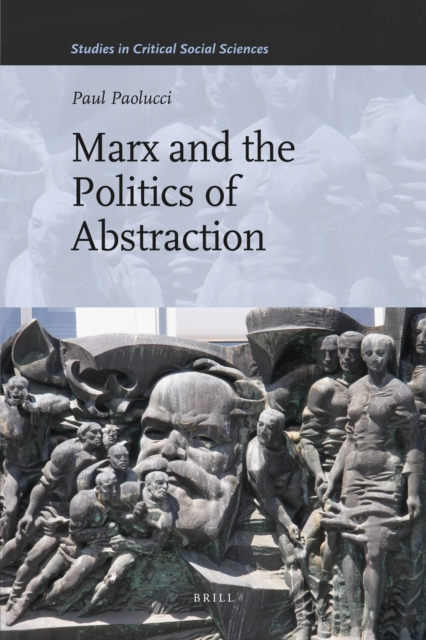
Marx and the Politics of Abstraction
Through examining Marx's methods of critique and abstraction, this book presents a series of problems in conventional social thought and the alternatives Marx's approach poses. It demonstrates how sound social science abstraction cannot but have political, often radical, implications.
eBook