
Catalogue Search | MBRL


Are you sure you want to remove the book from the shelf?

{{itemTitle}}
57,529
result(s) for
"Traffic engineering"
Sort by:

Killed by a traffic engineer : shattering the delusion that science underlies our transportation system
\"Fixing the carnage on our roadways requires a change in mindset and a dramatic transformation of transportation. This goes for traffic engineers in particular because they are still the ones in charge of our streets. In Killed by a Traffic Engineer, civil engineering professor Wes Marshall shines a spotlight on how little science there is behind the way that our streets are engineered, which leaves safety as an afterthought. While traffic engineers are not trying to cause deliberate harm to anyone, he explains, they are guilty of creating a transportation system whose designs remain largely based on plausible, but unproven, conjecture. Killed by a Traffic Engineer is ultimately hopeful about what is possible once we shift our thinking and demand streets engineered for the safety of people, both outside and inside of cars. It will make you look at your city and streets--and traffic engineers--in a new light and inspire you to take action\"-- Provided by publisher.
BOOK
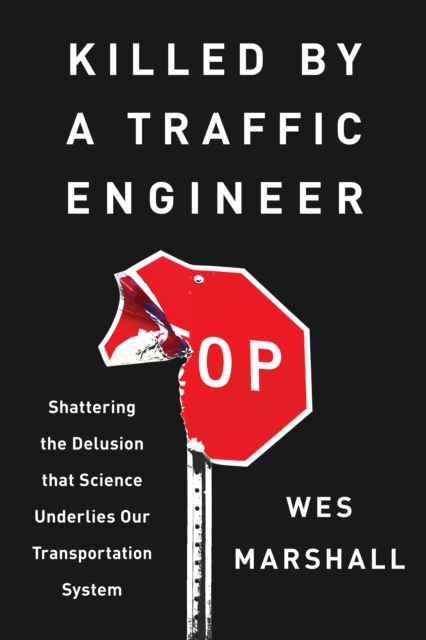
Killed by a Traffic Engineer
In the US we are nearing four million road deaths since we began counting them in 1899. The numbers are getting worse in recent years, yet we continue to accept these deaths as part of doing business. There has been no examination of why we engineer roads that are literally killing us. Fixing the carnage on our roadways requires a change in mindset and a dramatic transformation of transportation. This goes for traffic engineers in particular because they are still the ones in charge of our streets. In
Killed by a Traffic Engineer , civil engineering professor Wes Marshall shines a spotlight on how little science there is behind the way that our streets are engineered, which leaves safety as an afterthought. While traffic engineers are not trying to cause deliberate harm to anyone, he explains, they are guilty of creating a transportation system whose designs remain largely based on plausible, but unproven, conjecture. Thoroughly researched and compellingly written,
Killed by a Traffic Engineer shows how traffic engineering “research” is outdated and unexamined (at its best) and often steered by an industry and culture considering only how to get from point A to B the fastest way possible, to the detriment of safety, quality of life, equality, and planetary health. Marshall examines our need for speed and how traffic engineers disconnected it from safety, the focus on capacity and how it influences design, blaming human error, relying on faulty data, how liability drives reporting, measuring road safety outcomes, and the education (and reeducation) of traffic engineers.
Killed by a Traffic Engineer is ultimately hopeful about what is possible once we shift our thinking and demand streets engineered for the safety of people, both outside and inside of cars. It will make you look at your city and streets—and traffic engineers— in a new light and inspire you to take action.
eBook


Three revolutions : steering automated, shared, and electric vehicles to a better future
For the first time in half a century, real transformative innovations are coming to our world of passenger transportation.The convergence of new shared mobility services with automated and electric vehicles promises to significantly reshape our lives and communities for the better--or for the worse.
eBook

Eliminating serious injury and death from road transport : a crisis of complacency
\"The book explodes the myths that currently drive society's view of traffic safety and limit progress in reducing death and serious injury. It presents current scientific knowledge in a non-technical way and draws parallels with other areas of public safety and public health. It uses examples from the media and from public policy debates to paint a clear picture of a flawed public policy approach and offers preventive medicine principles to take the field forward\"-- Provided by publisher.
Book

The traffic systems of Pompeii
The Traffic Systems of Pompeii is the first sustained examination of the evidence for a regulated circulation of wheeled traffic in the ancient world. The setting to this system is the six-hundred-year evolution of Pompeii’s street network, the focus of which telescopes from the city’s urban grid to the shape of the streets, the treatment of their surfaces, and finally the individual elements of construction—the curbstones, stepping stones, and guard stones—where the evidence for traffic was inscribed. Although ruts are the most evocative evidence of ancient traffic, it is the wearing patterns on the vertical faces of street features that permit the determination of the directions that ancient carts were traveling and undergird the argument for their systematic regulation. Distilled from over five hundred locations recording multiple categories of evidence, all wholly new to archaeology and unique to this research, this book reveals the basic rules of the road and at the same time opens larger historical questions. What does the existence of a traffic system mean for our understanding of ancient urbanism? What other social forces are uncovered in the search for it? To explore these questions, the traffic system at Pompeii is set in its broader contexts as one infrastructural and administrative artifact of the Roman empire, an epiphenomenon of a deeply urban culture.
eBook

Missing traffic data: comparison of imputation methods
Many traffic management and control applications require highly complete and accurate data of traffic flow. However, because of various reasons such as sensor failure or transmission error, it is common that some traffic flow data are lost. As a result, various methods were proposed by using a wide spectrum of techniques to estimate missing traffic data in the last two decades. Generally, these missing data imputation methods can be categorised into three kinds: prediction methods, interpolation methods and statistical learning methods. To assess their performance, these methods are compared from different aspects in this paper, including reconstruction errors, statistical behaviours and running speeds. Results show that statistical learning methods are more effective than the other two kinds of imputation methods when data of a single detector is utilised. Among various methods, the probabilistic principal component analysis (PPCA) yields best performance in all aspects. Numerical tests demonstrate that PPCA can be used to impute data online before making further analysis (e.g. make traffic prediction) and is robust to weather changes.
Journal Article


Beyond mobility : planning cities for people and places
Cities across the globe have been designed with a primary goal of moving people around quickly--and the costs are becoming ever more apparent.The consequences are measured in smoggy air basins, sprawling suburbs, unsafe pedestrian environments, and despite hundreds of billions of dollars in investments, a failure to stem traffic congestion.
eBook