
Catalogue Search | MBRL


Are you sure you want to remove the book from the shelf?

{{itemTitle}}
12
result(s) for
"West (U.S.) Social life and customs 19th century."
Sort by:


The Perfect Fence
Barbed wire is made of two strands of galvanized steel wire twisted together for strength and to hold sharp barbs in place. As creative advertisers sought ways to make an inherently dangerous product attractive to customers concerned about the welfare of their livestock, and as barbed wire became commonplace on battlefields and in concentration camps, the fence accrued a fascinating and troubling range of meanings beyond the material facts of its construction. In The Perfect Fence , Lyn Ellen Bennett and Scott Abbott explore the multiple uses and meanings of barbed wire, a technological innovation that contributes to America’s shift from a pastoral ideal to an industrial one. They survey the vigorous public debate over the benign or “infernal” fence, investigate legislative attempts to ban or regulate wire fences as a result of public outcry, and demonstrate how the industry responded to ameliorate the image of its barbed product. Because of the rich metaphorical possibilities suggested by a fence that controls through pain, barbed wire developed into an important motif in works of literature from the late nineteenth century to the present day. Early advertisements proclaimed that barbed wire was “the perfect fence,” keeping “the ins from being outs, and the outs from being ins.” Bennett and Abbott conclude that while barbed wire is not the perfect fence touted by manufacturers, it is indeed a meaningful thing that continues to influence American identities.
eBook


A Remarkable Curiosity
Collected in this volume for the first time are Cummings's portraits of a land and its assortment of characters unlike anything back East. Characters like Pedro Armijo, the New Mexican sheep tycoon who took Denver by storm, and more prominently the Mormon prophet Brigham Young and one of his wives, Ann Eliza Young, who was filing for divorce at the time of Cummings's arrival.
Although today he is virtually unknown, during his lifetime Cummings was one of the most famous newspapermen in the United States, in part because of stories like these. Complete with a biographical sketch and historical introduction,A Remarkable Curiosityis an enjoyable read for anybody interested in the American West in the latter half of the nineteenth century.
eBook

Knights of the range : a Western story
\"In the wake of [her father's] death, Holly is forced to ... take the reins of [his] beloved cattle empire. In the midst of hordes of outlaws ransacking the ranch and antagonizing their stock, the heiress must learn the ways of the West alongside Captain Britt in an attempt to salvage what's left of her father's dream\"--Publisher marketing.
Book

Feast or famine : food and drink in American westward expansion
This first comprehensive account of food and drink in the winning of the West describes the sustenance of successive generations of western pioneers. Drawing on settlers' and travelers' journals, Horsman records food preparation techniques as well as components of their diets. Not only were buffalo, deer, and wild turkey plentiful, pioneers also gathered greens such as purslane, dandelion, and pigweed-as well as wild fruits, berries, and nuts. Horsman also reveals the willingness of Indians to convey their knowledge of food. He covers regional frontiers, as well as the cuisines of groups such as fur traders, soldiers, miners, and Mormons, and discusses food shortages that resulted from poor preparation, temporary scarcity of game, marginal soil, or simply bad luck.
eBook

Making home work : domesticity and Native American assimilation in the American West, 1860-1919
During the westward expansion of America, white middle-class ideals of home and domestic work were used to measure differences between white and Native American women. Yet the vision of America as \"home\" was more than a metaphor for women's stake in the process of conquest--it took deliberate work to create and uphold. Treating white and indigenous women's struggles as part of the same history, Jane E. Simonsen argues that as both cultural workers and domestic laborers insisted upon the value of their work to \"civilization,\" they exposed the inequalities integral to both the nation and the household.Simonsen illuminates discussions about the value of women's work through analysis of texts and images created by writers, women's rights activists, reformers, anthropologists, photographers, field matrons, and Native American women. She argues that women such as Caroline Soule, Alice Fletcher, E. Jane Gay, Anna Dawson Wilde, and Angel DeCora called upon the rhetoric of sentimental domesticity, ethnographic science, public display, and indigenous knowledge as they sought to make the gendered and racial order of the nation visible through homes and the work performed in them. Focusing on the range of materials through which domesticity was produced in the West, Simonsen integrates new voices into the study of domesticity's imperial manifestations.
eBook
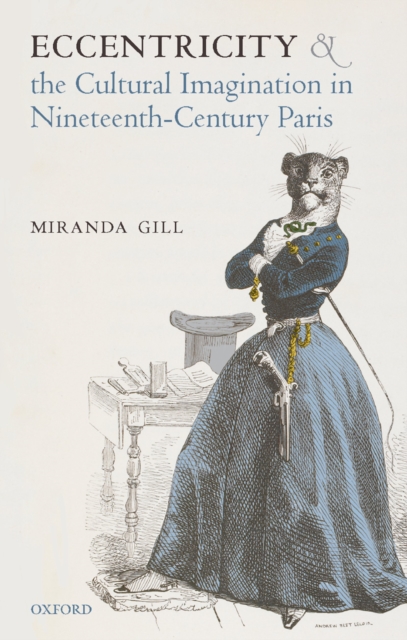
Eccentricity and the cultural imagination in nineteenth-century Paris
What did it mean to call someone ‘eccentric’ in nineteenth-century Paris? And why did breaking with convention arouse such ambivalent responses in middle-class readers, writers, and spectators? From high society to Bohemia and the demi-monde to the madhouse, the scandal of nonconformism provoked anxiety, disgust, and often secret yearning. In a culture preoccupied by the need for order yet simultaneously drawn to the values of freedom and innovation, eccentricity continually tested the boundaries of bourgeois identity, ultimately becoming inseparable from it. This interdisciplinary study charts shifting French perceptions of the anomalous and bizarre from the 1830s to the fin de siècle, focusing on three key issues. First, during the July Monarchy eccentricity was linked to fashion, dandyism, and commodity culture; to many Parisians it epitomized the dangerous seductions of modernity and the growing prestige of the courtesan. Second, in the aftermath of the 1848 Revolution eccentricity was associated with the Bohemian artists and performers who inhabited ‘the unknown Paris’, a zone of social exclusion which middle-class spectators found both fascinating and repugnant. Finally, the popularization of medical theories of national decline in the latter part of the century led to decreasing tolerance for individual difference, and eccentricity was interpreted as a symptom of hidden insanity and deformity. Drawing on a wide range of sources, including etiquette manuals, fashion magazines, newspapers, novels, and psychiatric treatises, the study highlights the central role of gender in shaping perceptions of eccentricity. It provides new readings of works by major French writers and illuminates both well-known and neglected figures of Parisian modernity, from the courtesan and Bohemian to the female dandy and circus freak..
eBook

Down on Mahans Creek
InDown on Mahans Creek, Benjamin Rader provides a fascinating look at a neighborhood in the Missouri Ozarks from the early nineteenth to the mid-twentieth century. He explores the many ways in which Mahans Creek, though remote, was never completely isolated or self-sufficient. The residents were deeply affected by the Civil War, and the arrival of the railroad and the timber boom in the 1890s propelled the community into modern times, creating a more fast-paced and consumer-oriented way of life and a new moral sensibility. During the Great Depression the creek's residents returned to some of the older values for survival. After World War II, modern technology changed their lives again, causing a movement away from the countryside and to the nearby small towns.
Down on Mahans Creektells the dynamic story of this distinctive neighborhood navigating the push and pull of the old and new ways of life.
eBook

Remarkable Curiosity
In 1873, Amos Jay Cummings, a decorated Civil War veteran and journalist for the New York Sun newspaper, set out on a westward journey aboard the newly completed transcontinental railroad. For some time, miners, settlers, and entrepreneurs had already been heading west to make their fortunes, and Cummings made the trip in part to see what all the fuss was about. During his six-month expedition from Kansas to California, Cummings sent extraordinary and engaging accounts of the American West back to his readers in New York. Collected in this volume for the first time are Cummings's portraits of a land and its assortment of characters unlike anything back East. Characters like Pedro Armijo, the New Mexican sheep tycoon who took Denver by storm, and more prominently the Mormon prophet Brigham Young and one of his wives, Ann Eliza Young, who was filing for divorce at the time of Cummings's arrival. Although today he is virtually unknown, during his lifetime Cummings was one of the most famous newspapermen in the United States, in part because of stories like these. Complete with a biographical sketch and historical introduction, A Remarkable Curiosity is an enjoyable read for anybody interested in the American West in the latter half of the nineteenth century.
eBook