
Catalogue Search | MBRL


Are you sure you want to remove the book from the shelf?

{{itemTitle}}
83,537
result(s) for
"Williams, Robert"
Sort by:

Reveal : Robbie Williams
\"More than twelve years ago, Robbie Williams and Chris Heath published a ground-breaking memoir, Feel, about Robert P. Williams' rise to fame, a book that was met with worldwide acclaim, from critics and fans alike. Since that time, Robbie has released six solo albums, reunited with his old band Take That and, in the wake of his twelfth UK number-one album, has returned to the stage with a triumphant summer-long stadium tour. For Reveal, bestselling author Chris Heath has been working closely with Robbie for many years to create a personal and raw account of fame, fortune, family and music; a vivid and detailed story of the real highs and lows as Robbie has found his way forward, that is unprecedented in its intimacy and honesty--the uncensored and compelling portrait of the man as you've never seen him before.\"--Dust jacket flap.


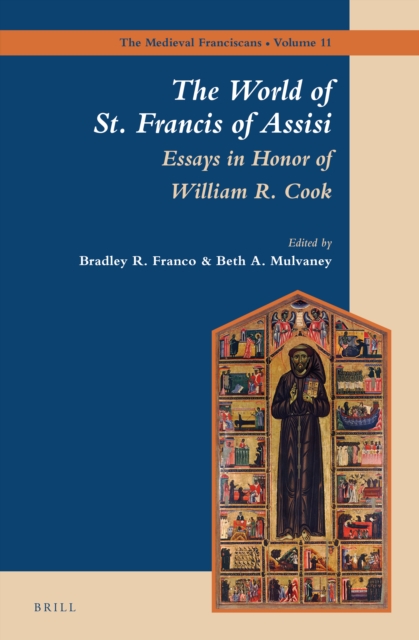
The World of St. Francis of Assisi
In The World of St. Francis of Assisi, thirteen scholars from diverse academic disciplines offer accounts of the way in which St. Francis shaped the world in which he lived and trace the saint's legacy in the intervening seven centuries.
eBook

Hegelians Axel Honneth and Robert Williams on the Development of Human Morality
An individual is in the lowest phase of moral development if he thinks only of his own personal interest and has only his own selfish agenda in his mind as he encounters other humans. This lowest phase corresponds well with sixteenth century British moral egoism which reflects the rise of the new economic order. Adam Smith (1723–1790) wanted to defend this new economic order which is based on economic exchange between egoistic individuals. Nevertheless, he surely did not want to support the moral theory of British egoism. His book
The Wealth of Nations
suits well into the world view of British moral egoism, but in the book
The Theory of Moral Sentiments,
he presents a moral theory which is the total opposite of moral egoism. Contemporary German intellectuals saw contradiction in Adam Smith’s moral (social) philosophy which they called as
Das Adam
-
Smith
-
Problem
. Smith himself didn’t think that there is any contradiction in a situation where in economic sphere (civil society) individual act egoistically and in ethical sphere (encounter with the imagined Other) he feels humanity and compassion toward his fellow men. Hegel was a passionate reader of Adam Smith and he acknowledged
Das Adam
-
Smith
-
Problem
. He set the task of his social philosophy to overcome this paradox. He wanted to create a theory of a social totality where economic egoism and feelings of humanity are not in contradiction. In the same time Hegel wanted to create a theory on
Bildung
process where human spirit develops from moral un-freedom (heteronomy) to moral freedom and maturity (autonomy) taking care both aspect of love and reason. In certain Hegel’s texts notion of recognition plays crucial role. That is why modern Hegelians Ludwig Siep, Axel Honneth and Robert Williams consider the notion of recognition to be elementary in Hegel’s threefold theory of developing human spirit from
family
via
civil society
to
sittliche
state
. For Hegel family is a sphere where people love their “concrete other” and where feeling surpasses reason. Civil Society is a sphere of private contracts and economic exchanges where cold egoistic and calculative reason surpasses feelings. In the sphere of State the contradiction between family and Civil Society (
Das Adam
-
Smith
-
Problem
) is solved by “rational feeling”. According to Hegel State should protect citizens from alienating effect of egoistic reason of Civil Society and cultivate “family-feelings” to rational feelings which integrate citizen into “sittliche community” through reciprocal process of recognition. In this article I want to consider Hegelians Honneth’s and Williams’s relevance to the theory of moral development.
Journal Article


Golden Rules of Anaesthesia: the smallest book on anaesthesia?
Golden Rules of Anaesthesia, a waistcoat pocket-sized book by Robert James Probyn-Williams was published in three editions between 1904 and 1908. It may be the smallest English-language book on anaesthesia.
Journal Article
The Christian Burial Case: An Introduction to Criminal and Judicial Procedure
On December 24, 1968, ten-year-old Pamela Powers was brutally murdered, her body dumped at the side of the road to freeze. Robert Anthony Williams was charged with the crime, and a series of trials, appeals, and reversals ensued. The Christian Burial Case: An Introduction to Criminal and Judicial Procedure introduces readers to the intricacies of the American legal system, using the Williams case to illustrate all the stages of the legal process from the point of arrest, to the trial, the appellate process, and, ultimately, the Supreme Court. The text clearly and concisely explains criminal and court procedures in the context of the Williams case, paying careful attention to the rights against self-incrimination and to counsel, and to the role of the exclusionary rule in our system of justice. This unique introduction to criminal justice and judicial procedure captures the imagination of the reader as it chronicles The Christian Burial case from beginning to end. Because the suspect was observed leaving the scene of the crime with the body of the victim, the Williams case seemed to be open and shut. But due to police procedures in apprehending and questioning the suspect, the resolution of the case took fifteen years and two United States Supreme Court decisions. By highlighting the difficulties of determining the facts of the case and the proper procedural laws that were applicable, McInnis demonstrates the complexities inherent in the legal system. This compelling book is a must-read for all people interested in learning more about criminal procedure and judicial processes.
eBook
