
Catalogue Search | MBRL


Are you sure you want to remove the book from the shelf?

{{itemTitle}}
8,145
result(s) for
"african linguistics"
Sort by:


In support of an OT-DM model
This paper provides support for a modified DM model which I call Optimality-Theoretic Distributed Morphology (OT-DM). The strongest form of this model is that all morphological operations take place in parallel, which I call the Morphology in Parallel Hypothesis (MPH). Although combining OT and DM is unorthodox in practice, I show that a growing body of data warrants this modification (Trommer
2001a
,
2001b
,
2002
; Dawson
2017
; Foley
2017
; a.o.). I provide support for OT-DM from the distribution of verbal clitics in Degema, a language of southern Nigeria. Within, I argue that agreement clitics are inserted post-syntactically via the DM operation Dissociated Node Insertion (DNI), and further that verb complexes are formed post-syntactically via the operation Local Dislocation (LD), operating in tandem with a well-formedness markedness constraint which requires verbs to appear in properly inflected words. These DM operations are decomposed into a series of constraints which are crucially ranked. Candidates are freely generated from
gen
and are subject to all DM operations, and are evaluated via
eval
against the ranked constraint set. I illustrate that under the standard serial DM model in which DNI proceeds VI, this would result in the wrong output form, and that even after parameterizing DM operation order in response, this model does not adequately capture the motivations behind the morphological patterns.
Journal Article


Omotic lexicon in its Afro-Asiatic setting VI: Addenda to Omotic roots with ḅ-, ṗ-, p- (or f-)a
The paper is a new contribution to revealing the Afro-Asiatic heritage in the lexicon of the Omotic languages by means of interbranch comparison using a.o. the ancient Egypto-Semitic evidence.
Journal Article
Dangla-Migama and Afro-Asiatic III: Root Initial ḅ-a
The paper is a new contribution to revealing the Afro-Asiatic heritage in the lexicon of the Dangla-Migama group of Chadic languages by means of interbranch comparison using a.o. the ancient Egypto-Semitic evidence.
Journal Article
Angas-Sura Etymologies IX
The paper is a new contribution to revealing the Afro-Asiatic heritage in the lexicon of the Angas-Sura group of Chadic languages by means of interbranch comparison using a.o. the ancient Egypto-Semitic evidence.
Journal Article

History and the testimony of language
This book is about history and the practical power of language to reveal historical change. Christopher Ehret offers a methodological guide to applying language evidence in historical studies. He demonstrates how these methods allow us not only to recover the histories of time periods and places poorly served by written documentation, but also to enrich our understanding of well-documented regions and eras. A leading historian as well as historical linguist of Africa, Ehret provides in-depth examples from the language phyla of Africa, arguing that his comprehensive treatment can be applied by linguistically trained historians and historical linguists working with any language and in any area of the world.
eBook

Angas-Sura Etymologies VII
The paper as part of a long-running series is devoted to the etymological analysis of a new segment (namely that with initial dental *d-) of the Angas-Sura root stock, a small group of modern languages remotely and ultimately akin to pharaonic Egyptian and the well-known Semitic languages or Twareg in the Sahara etc. Doing so, I wish to continue the noble tradition initiated by J.H. Greenberg (1958), the founding father of modern Afro-Asiatic comparative linguistics (along with I.M. Diakonoff), who was the first scholar ever to have established by Neo-Grammarian the methods regular consonantal correspondences between Angas-Sura and ancient Egyptian in his pioneering (painfully isolated) paper on the ancient trichtomomy of the word-initial labials in both branches. Nowadays our chances in following this path are substantially more favourable being equipped with our gigantic comparative root catalogue system of the Egyptian etymologies ever published (ongoing since 1994) and of the Afro-Asiatic parental lexical stock (ongoing since 1999).
Journal Article

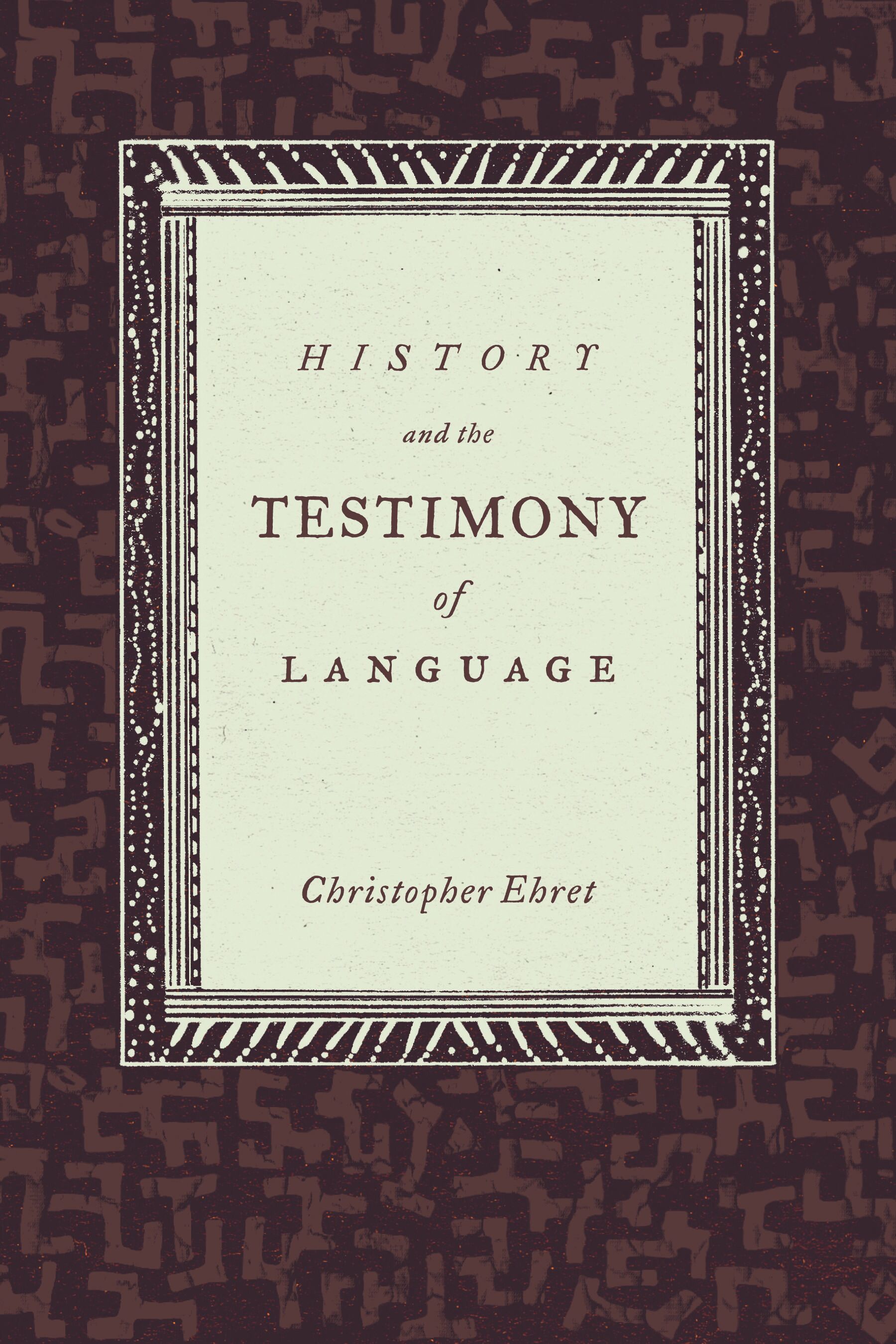
History and the Testimony of Language
This book is about history and the practical power of language to reveal historical change. Christopher Ehret offers a methodological guide to applying language evidence in historical studies. He demonstrates how these methods allow us not only to recover the histories of time periods and places poorly served by written documentation, but also to enrich our understanding of well-documented regions and eras. A leading historian as well as historical linguist of Africa, Ehret provides in-depth examples from the language phyla of Africa, arguing that his comprehensive treatment can be applied by linguistically trained historians and historical linguists working with any language and in any area of the world.
eBook