Catalogue Search | MBRL


هل أنت متأكد أنك تريد إزالة الكتاب من الرف؟

{{itemTitle}}
10
نتائج ل
"Gribbin, John, 1946- author"
صنف حسب:

Out of the Shadow of a Giant
What if Newton had never lived? A compelling dual biography argues that Robert Hooke and Edmond Halley easily could have filled the giant's shoes-and deserve credit for the birth of modern science. Robert Hooke and Edmond Halley, whose place in history has been overshadowed by the giant figure of Newton, were pioneering scientists within their own right, and instrumental in establishing the Royal Society. Although Newton is widely regarded as one of the greatest scientists of all time and the father of the English scientific revolution, John and Mary Gribbin uncover the fascinating story of Robert Hooke and Edmond Halley, whose scientific achievements neatly embrace the hundred years or so during which science as we know it became established. They argue persuasively that, even without Newton, science would have made a great leap forward in the second half of the seventeenth century, headed by two extraordinary figures, Hooke and Halley.
eBook

Einstein's masterwork : 1915 and the general theory of relativity
In 1915, Albert Einstein presented his masterwork to the Prussian Academy of Sciences - a theory of gravity, matter, space and time: the General Theory of Relativity. Einstein himself said it was 'the most valuable theory of my life', and 'of incomparable beauty'. It describes the evolution of the Universe, black holes, the behaviour of orbiting neutron stars, gravitational lensing, and why clocks run slower on the surface of the Earth than in space. It even suggests the possibility of time travel. And yet we think instead of 1905, the year of Einstein's Special Theory of Relativity and his equation E=mc2, as his annus mirabilis, even though the Special Theory is less far-reaching. Today the General Theory is overshadowed by these achievements, regarded as 'too difficult' for ordinary mortals to comprehend. In Einstein's Masterwork, John Gribbin puts Einstein's astonishing breakthrough in the context of his life and work, and make it clear why his greatest year was indeed 1915.
Book

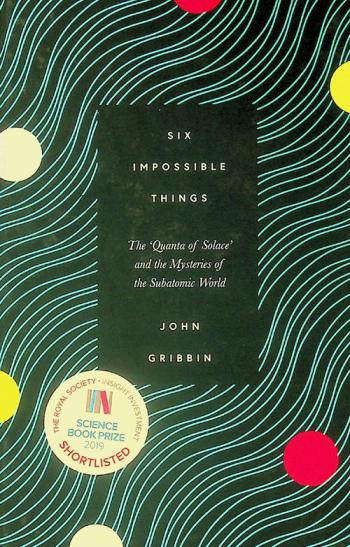
Six impossible things : the 'quanta of solace' and the mysteries of the subatomic world
Quantum physics is strange. It tells us that a particle can be in two places at once. Indeed, that particle is also a wave, and everything in the quantum world can be described entirely in terms of waves, or entirely in terms of particles, whichever you prefer. All of this was clear by the end of the 1920s. But to the great distress of many physicists, let alone ordinary mortals, nobody has ever been able to come up with a common sense explanation of what is going on. Physicists have sought 'quanta of solace' in a variety of more or less convincing interpretations. Popular science master John Gribbin takes us on a delightfully mind-bending tour through the 'big six', from the Copenhagen interpretation via the pilot wave and many worlds approaches. All of them are crazy, and some are more crazy than others, but in this world crazy does not necessarily mean wrong, and being more crazy does not necessarily mean more wrong.
Ten tantalising truths : why the sky is blue, and other big answers to simple questions
John Gribbin is known for giving us simple explanations of big concepts in science. But there is another way to probe the mysteries of the Universe and our place in it. Faced with persistent enquiries from his grandchildren, Gribbin realised that simple questions, such as 'Why is the sky blue?', sometimes require big answers, understandable in straightforward language. In answering those simple questions, he discovered that he was telling the story of our place in the Universe, from the Big Bang to the evolutionary reasons why men are, on average, bigger than women. In this book, Gribbin invites the reader to join him on this voyage of discovery, where you may think you already know the answers but should be prepared to be surprised - or at least, tantalised by the truth.
Book
Companion to the cosmos
This is a comprehensive guide to everything mankind knows about the universe, written by one of our most noted science popularisers. The book takes the form of an A-Z, and ends with a timeline of key dates in scientific history.