
Catalogue Search | MBRL


Are you sure you want to remove the book from the shelf?

{{itemTitle}}
3
result(s) for
"إخوان الصفا author"
Sort by:


Epistles of the Brethren of Purity : on composition and the arts : an Arabic critical edition and English translation of epistles 6-8
\"The Ikhwan al-Safa' (Brethren of Purity), the anonymous adepts of a tenth-century esoteric fraternity based in Basra and Baghdad, hold an eminent position in the history of science and philosophy in Islam due to the wide reception and assimilation of their monumental encyclopaedia, the Rasa 'il Ikhwan al-Safa' (Epistles of the Brethren of Purity). This compendium contains fifty-two epistles offering synoptic accounts of the classical sciences and philosophies of the age; divided into four classificatory parts, it treats themes in mathematics, logic, natural philosophy, psychology, metaphysics, and theology, in addition to didactic fables. Epistles 6 to 8 are from the first division of the Epistles, on the propaedeutical and mathematical sciences. Epistle 6 develops ideas concerning natural numbers and their arithmetic, geometric, and harmonic ratios, marked by the influence of Nicomachus of Gerasa and of Euclid. The Brethren here emphasize practical applications of proportionality in music, medicine, and alchemy. Epistle 7 addresses theoretical scientific knowledge as directed towards the spiritual realities of souls, the goal of which is to actualize human potential; this epistle also presents a remarkable classification of sciences. Epistle 8 surveys material cultures in the Islamic mediaeval milieu, embellished by a consideration of the effects of the heavenly bodies on the predisposition of individuals to follow specific trades. These three epistles are, of course, underpinned by the Brethren's perennial tropes of the microcosm/macrocosm analogy and the emanative hierarchy of existents.\"-- Provided by publisher.
Book
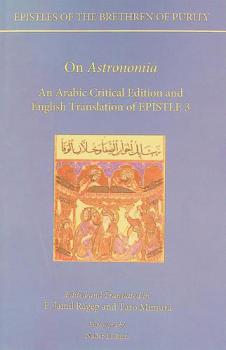
On Astronomia : an Arabic critical edition and English translation of Epistle 3
The Epistles of the Brethren of Purity' is an encyclopedic compendium, probably composed in tenth-century Iraq by a society of adepts with Platonic, Pythagorean, and Shi'i tendencies. Its 52 sections ('epistles') are divided into four parts (Mathematics, Natural Philosophy, Sciences of the Soul and Intellect, and Theology). The current volume provides an edition, translation, and notes to Epistle 3 ('On Astronomia'), which forms one of the 14 sections on Mathematics. The content is a mixture of elementary astronomy and astrology, but it is not a beginner's textbook. Rather, the purpose is to use examples from those disciplines to provide spiritual, moral, and soteriological guidance. Thus the Epistle uses the argument from design to show the necessity for a Creator who made the harmonious universe; this wondrous design is then employed by the authors as a model, providing humans with a paradigm for proper ethical, political, and even economic conduct; and the study of Astronomia helps the soul achieve ultimate happiness as it seeks to throw off the shackles of this mundane world and oppressive body in favour of the purity of the celestial realm.0Although by no means typical of Islamic astronomical literature, Epistle 3 of the Brethren of Purity gives a window into a fascinating and intriguing group operating during the early period of Islam who sought to continue and adopt one of the esoteric strands of Hellenistic philosophy within an Islamic context, meshing astronomy, astrology, Platonic-Pythagorean philosophy, Quranic and Biblical quotations, and anecdotes from the lives of the Abrahamic prophets.
Book