
Catalogue Search | MBRL


Are you sure you want to remove the book from the shelf?

{{itemTitle}}
4
result(s) for
"مطر، هشام، 1970- author"
Sort by:
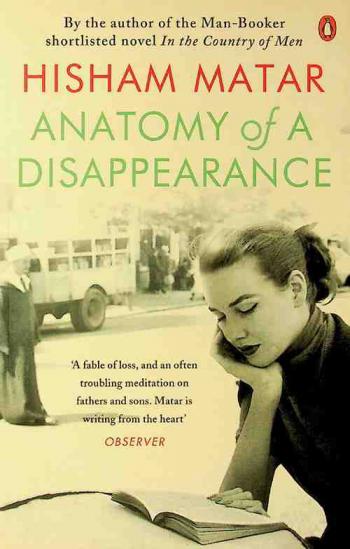
Anatomy of a disappearance
In Egypt, Nuri, a teenage boy, falls in love with Mona - the woman his father will marry. Consumed with longing, Nuri wants to get his father out of the way - to take his place in Mona's heart. But when his father disappears, Nuri regrets what he wished for.

In the country of men
In Tripoli, Libya, in the summer of 1979, nine-year-old Suleiman is shopping with his mother. His father is away on business, but Suleiman is sure he has just seen him, standing across the street. This novel is told from the point of view of a young boy growing up in a terrifying and bewildering world. (Publisher).
Book

The return : fathers, sons and the land in between
\"In the winter of 2010, the Libyan novelist Hisham Matar went with his wife Diana and his brother Ziad to the House of Lords, where they sat in the gallery while Lord Lester, the human rights advocate, asked Her Majesty's government whether it would seek information from the government of Libya as to the whereabouts of Matar's father, Jaballa, who had then been missing for two decades. Hearing his father's name spoken in \"my adopted country's highest chamber\" had a \"vertiginous effect\" on Matar, a feeling that recurred every time it was repeated, and for a while he felt that all he wanted to do was to get up and get out. But whatever its other effects, this \"dizzying hollowness\" did not render him blind, and as he listened to the Lords antiseptically carry out their business -- \"Our embassy in Tripoli has raised this with the Libyans and asked them to investigate further,\" responded Baroness Kinnock, then a minister of state in the Foreign Office -- he couldn't help but notice that Peter Mandelson, a man known to have had a fairly close friendship with Colonel Gaddafi's son, Saif al-Islam, was staring at him. \"His expression was theatrically hard and seemed deliberately without emotion,\" writes Matar. It was a look that seemed to him to sum up the cynicism with which some members of the Blair government were then conducting relations with the Libyan dictatorship. Matar has a reserve that only makes his way with intimacy all the more moving By the time the reader reaches this episode in Matar's new memoir, The Return, he is already heartsick; the behaviour of Tony Blair and his ministers in the matter of Libya -- some days later, David Miliband, the then foreign secretary, suggested to Matar that the \"noise\" he was making over the fate of his father was distinctly unhelpful -- is as nothing to that of Gaddafi's monstrous regime, to whose crimes he has already devoted almost 200 pages. Somehow, though, this encounter and others like it reach another part of you, horror and rage shading suddenly into shame. Cynicism: it seems a mild word for behaviour so unconscionable. In context, however, it has a quiet power. This has to do, I think, with clarity. For all that he has been through personally, Matar is ever clear-eyed. If, as he writes, the calamity that has followed the fall of Gaddafi is more true to the nature of his dictatorship than to the ideals of the 2011 revolution -- \"The masses rule,\" went one of the regime's brutish slogans. \"Representative politics is not democracy\"--Then the role of our present government in that great misfortune can similarly be traced back to Blair's infamous desert kiss in 2004. For isn't the child always the father of the man? But The Return isn't really about politics. It's not even about the last gasp of Gaddafi's rule, for all that the reader must contend in its pages with the sight of Saif al-Islam's puerile swagger: with his arrival at a Knightsbridge hotel (the go-between for this meeting, incidentally, was the financier, Nathaniel Rothschild, another of Peter's friends) surrounded by a group of men in T-shirts who looked \"more like a hip-hop band than a security outfit\"; with his stupid emoticons and his vile cat-and-mouse attitude to Matar. Rather, it is a book about family and loss and love ...\" --Rachel Cooke, The Guardian, accessed May 29, 2017. https://www.theguardian.com/books/2016/jul/03/hisham-matar-the-return-review
BOOK