
Catalogue Search | MBRL


Are you sure you want to remove the book from the shelf?

{{itemTitle}}
4
result(s) for
"林毅夫"
Sort by:
产业政策与我国经济的发展:新结构经济学的视角
虽然许多国家的产业政策不成功,但是没有产业政策的国家,其经济发展必然不成功。因此,作为经济学家的责任不是因为怕产业政策失败而凡产业政策一概都反对,或是因为产业政策是经济发展成功的必要条件就无条件地支持一切产业政策,应该要研究清楚产业政策成功和失败的道理,以帮助政府在使用产业政策时,减少失败,提高成功的概率。本文从新结构经济学的视角分析为何经济发展需要产业政策才能成功。文章指出,经济发展需要“有效的市场”和“有为的政府”之共同作用,进而简要分析了发展中国家和发达国家在运用产业政策时为何会失败。基于新结构经济学的研究视角,将我国的产业分为追赶型、领先型、退出型、弯道超车型、战略型这五种类型,阐述了我国如何才能制定有效的产业政策。文章指出,应根据各种产业的特征,发挥好“有效的市场”和“有为的政府”两只手的作用,共同推动我国的产业转型升级。
Journal Article

The quest for prosperity
How can developing countries grow their economies? Most answers to this question center on what the rich world should or shouldn't do for the poor world. InThe Quest for Prosperity, Justin Yifu Lin--the first non-Westerner to be chief economist of the World Bank--focuses on what developing nations can do to help themselves.
Since the end of the Second World War, prescriptions for economic growth have come and gone. Often motivated more by ideology than practicality, these blueprints have had mixed success on the ground. Drawing lessons from history, economic analysis, and practice, Lin examines how the countries that have succeeded in developing their own economies have actually done it. He shows that economic development is a process of continuous technological innovation, industrial upgrading, and structural change driven by how countries harness their land, labor, capital, and infrastructure. Countries need to identify and facilitate the development of those industries where they have a comparative advantage--where they can produce products most effectively--and use them as a basis for development. At the same time, states need to recognize the power of markets, limiting the role of government to allow firms to flourish and lead the process of technological innovation and industrial upgrading. By following this \"new structural economics\" framework, Lin shows how even the poorest nations can grow at eight percent or more continuously for several decades, significantly reduce poverty, and become middle- or even high-income countries in the span of one or two generations.
Interwoven with insights, observations, and stories from Lin's travels as chief economist of the World Bank and his reflections on China's rise, this book provides a road map and hope for those countries engaged in their own quest for prosperity.
eBook
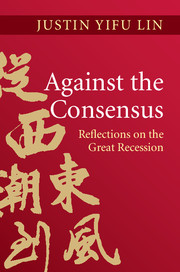
Against the Consensus
In June 2008, Justin Yifu Lin was appointed Chief Economist of the World Bank, right before the eruption of the worst global financial and economic crisis since the Great Depression. Drawing on experience from his privileged position, Lin offers unique reflections on the cause of the crisis, why it was so serious and widespread, and its likely evolution. Arguing that conventional theories provide inadequate solutions, he proposes new initiatives for achieving global stability and avoiding the recurrence of similar crises in the future. He suggests that the crisis and the global imbalances both originated with the excess liquidity created by US financial deregulation and loose monetary policy, and recommends the creation of a global Marshall Plan and a new supranational global reserve currency. This thought-provoking book will appeal to academics, graduate students, policy makers, and anyone interested in the global economy.
eBook
New structural economics : a framework for rethinking development and policy
The new structural economics argues that the best way to upgrade a country's endowment structure is to develop its industries at any specific time according to the comparative advantages determined by its given endowment structure at that time. The economy will be most competitive, the economic surplus will be the largest, and the capital accumulation and the upgrading of factor endowment structure will be the fastest possible. The 'New Structural Economics' presented in this book is an attempt to set out this third wave of development thinking. Taking into account the lessons learned from the growth successes and failures of the last decades, it advances a neoclassical approach to study the determinants and dynamics of economic structure. It postulates that the economic structure of an economy is endogenous to its factor endowment structure and that sustained economic development is driven by changes in factor endowments and continuous technological innovation. The paper also discusses binding constraints to growth in each of these industries' value chains as well as mechanisms through which governance-related issues in the implementation of industrial policy could be addressed.
eBook