
Catalogue Search | MBRL


Are you sure you want to remove the book from the shelf?

{{itemTitle}}
8
result(s) for
"Adam, Thomas, 1968-"
Sort by:


Approaches to the Study of Intercultural Transfer
\"Approaches to the Study of Intercultural Transfer\" presents a collection of compelling case studies in the areas of social reform, museums, philanthropy, football, nonviolent resistance and holiday rituals such as Christmas that demonstrate key mechanisms of intercultural transfers. Each chapter provides the application of the intercultural transfer studies paradigm to a specific and distinct historical phenomenon. These chapters not only illustrate the presence or even the depth and frequency of intercultural transfer, but they also reveal specific aspects of the intercultural transfer of phenomena, the role of agents of intercultural transfer and the transformations of ideas transferred between cultures thereby contributing to our understanding of the mechanisms of intercultural transfers.
eBook


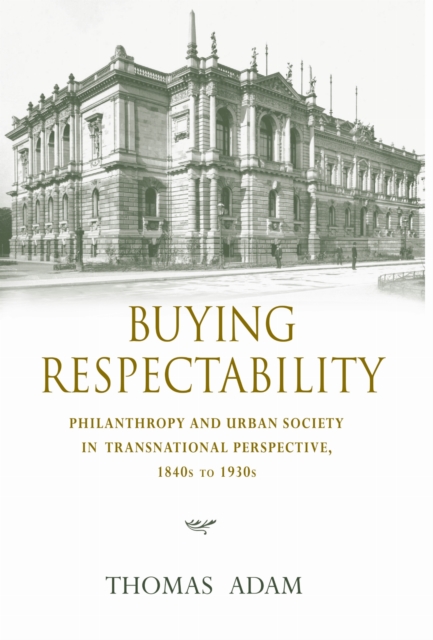
Buying respectability : philanthropy and urban society in transnational perspective, 1840s to 1930s
In 19th-century Leipzig, Toronto, New York, and Boston, a newly emergent
group of industrialists and entrepreneurs entered into competition with older
established elite groups for social recognition as well as cultural and political
leadership. The competition was played out on the field of philanthropy, with the
North American community gathering ideas from Europe about the establishment of
cultural and public institutions. For example, to secure financing for their new
museum, the founders of the Metropolitan Museum of Art organized its membership and
fundraising on the model of German art museums. The process of cultural borrowing
and intercultural transfer shaped urban landscapes with the building of new
libraries, museums, and social housing projects. An important contribution to the
relatively new field of transnational history, this book establishes philanthropy as
a prime example of the conversion of economic resources into social and cultural
capital.
eBook

Philanthropy, patronage, and civil society : experiences from Germany, Great Britain, and North America
In Philanthropy, Patronage, and Civil Society, Thomas Adam has assembled
a comparative set of case studies that challenge long-held and little-studied
assumptions about the modern development of philanthropy. Histories of philanthropy
have often neglected European patterns of giving and the importance of financial
patronage to the emergence of modern industrialized societies. It has long been
assumed, for example, that Germany never developed civic traditions of philanthropy
as in the United States. In truth, however, 19th-century German museums, art
galleries, and social housing projects were not only privately founded and
supported, they were also blueprints for the creation of similar public institutions
in North America. The comparative method of the essays also reveals the extent to
which the wealthy classes on both sides of the Atlantic defined themselves through
their philanthropic activities. Contributors are Thomas Adam,
Maria Benjamin Baader, Karsten Borgmann, Tobias Brinkmann, Brett Fairbairn, Eckhardt
Fuchs, David C. Hammack, Dieter Hoffmann, Simone Lässig, Margaret Eleanor
Menninger, and Susannah Morris.
eBook

Traveling between worlds : German-American encounters
In Traveling between Worlds, six authors explore the connectedness between Germans and Americans in the nineteenth century and their mutual impact on transatlantic history. Despite the ocean between them, these two groups of people were linked not only by the emigration from one to the other but also by ongoing interactions, especially among their intellectuals.
Christof Mauch’s introduction examines the history of the German-American exchange and of cultural exchanges in general. Focusing on various aspects of the German-American relationship, Eberhard Bruning, John T. Walker, Thomas Adam, Gabriele Lingelbach, Andrew P. Yox, and Christiane Harzig examine the cultural and communicative exchanges that occurred both between the two countries and within them. Topics such as travel, cultural interpretation, ideological and intellectual transfer, the immigrant experience, and German-American poetry are all considered.
Traveling between Worlds demonstrates that exchange was facilitated and maintained by ordinary individuals such as teachers and scholars, immigrants and natives, and held implications that last to this day.
eBook