
Catalogue Search | MBRL


Are you sure you want to remove the book from the shelf?

{{itemTitle}}
4
result(s) for
"Addison, Paul, 1943-"
Sort by:

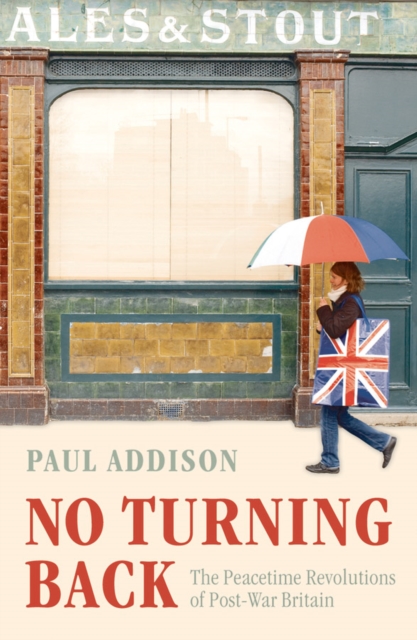
No turning back : the peacetime revolutions of post-war Britain
\"Since the Second World War, Britain has been transformed by a series of peaceful revolutions---the rise of multiculturalism, the permissive society, and the service-based consumer economy, among many others. These, Paul Addison argues, have been more powerful agents of change than the Battle of the Somme or the Blitz ever were.\" \"No Turning Back looks at the changing face of Britain in this period of rapid transformation, highlighting just how much has been gained---but not forgetting that much, too, has been lost.\" \"Historian Paul Addison was born in the 1940s. In No Turning Back, he surveys the vast changes in the character of British society that he has observed in the period since. A series of peaceful revolutions has transformed the country; the comparative peace and growing prosperity of the second half of the twentieth century, he contends, have been more powerful agents of change than the Battle of the Somme or the Blitz.\" \"The Second World War led to the welfare state but in some ways reinforced a conservative way of life. The changes unleashed by the Sixties and Seventies were more radical. Much of the sexual morality preached, if not practised, for centuries has been dismantled with the creation of a لpermissive society'. The employment and career chances of women have radically improved. A white nation has been transformed into a multiracial one. An economy founded upon manufacturing under the watchful eye of the لgentlemen in Whitehall' has morphed into a free market system, heavily dependent on finance, services, and housing; a predominantly working class society has evolved into a predominantly middle class one. And the United Kingdom, which once looked as solid as the rock of Gibraltar, now looks increasingly fragile, as Wales and especially Scotland have started to go their separate ways.\".
Book
No turning back : the peacetime revolutions of post-war Britain
Paul Addison charts the vastly changing character of British society since the end of the Second World War, bringing to the subject the personal point of view of someone who has lived through it all and seen the Britain of his youth turn into a very different country, but who in the final reckoning still prefers the present to the past.
eBook
Churchill
During the Second World War, Winston Churchill won two resounding victories. The first was a victory over Nazi Germany, the second a victory over the sceptics who had excluded him from high office. In this incisive biography, Paul Addison examines the life of the most iconic figure in twentieth-century British history, and also the continuing battl.
eBook
A companion to contemporary Britain, 1939-2000
A Companion to Contemporary Britain covers the key themes and debates of 20th-century history from the outbreak of the Second World War to the end of the century. - Assesses the impact of the Second World War - Looks at Britain’s role in the wider world, including the legacy of Empire, Britain’s ‘special relationship’ with the United States, and integration with continental Europe - Explores cultural issues, such as class consciousness, immigration and race relations, changing gender roles, and the impact of the mass media - Covers domestic politics and the economy - Introduces the varied perspectives dominating historical writing on this period - Identifies the key issues which are likely to fuel future debate
eBook