
Catalogue Search | MBRL


Are you sure you want to remove the book from the shelf?

{{itemTitle}}
108
result(s) for
"Agar, Nicholas"
Sort by:

How to be human in the digital economy
\"An argument in favor of finding a place for humans (and humanness) in the future digital economy.\"-- Provided by publisher.
Book

On the irrationality of mind-uploading: a rely to Neil Levy
In a paper in this journal, Neil Levy challenges Nicholas Agar’s argument for the irrationality of mind-uploading. Mind-uploading is a futuristic process that involves scanning brains and recording relevant information which is then transferred into a computer. Its advocates suppose that mind-uploading transfers both human minds and identities from biological brains into computers. According to Agar’s original argument, mind-uploading is prudentially irrational. Success relies on the soundness of the program of Strong AI—the view that it may someday be possible to build a computer that is capable of thought. Strong AI may in fact be false, an eventuality with dire consequences for mind-uploading. Levy argues that Agar’s argument relies on mistakes about the probability of failed mind-uploading and underestimates what is to be gained from successfully mind-uploading. This paper clarifies Agar’s original claims about the likelihood of mind-uploading failure and offers further defense of a pessimistic evaluation of success.
Journal Article

The sceptical optimist : why technology isn't the answer to everything
The rapid developments in technologies - especially computing and the advent of many 'smart' devices, as well as rapid and perpetual communication via the Internet - has led to a frequently voiced view which Nicholas Agar describes as 'radical optimism'. Radical optimists claim that accelerating technical progress will soon end poverty, disease, and ignorance, and improve our happiness and well-being. Agar disputes the claim that technological progress will automatically produce great improvements in subjective well-being. He argues that radical optimism 'assigns to technological progress an undeserved pre-eminence among all the goals pursued by our civilization'. Instead, Agar uses the most recent psychological studies about human perceptions of well-being to create a realistic model of the impact technology will have. Although he accepts that technological advance does produce benefits, he insists that these are significantly less than those proposed by the radical optimists, and aspects of such progress can also pose a threat to values such as social justice and our relationship with nature, while problems such as poverty cannot be understood in technological terms. He concludes by arguing that a more realistic assessment of the benefits that technological advance can bring will allow us to better manage its risks in future.
Book
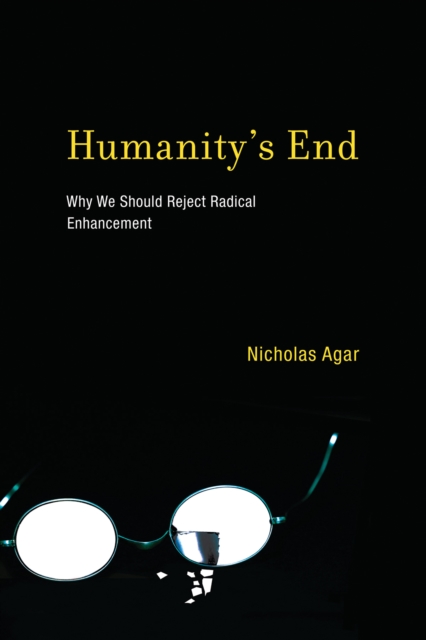
Humanity's End
Proposals to make us smarter than the greatest geniuses or to add thousands of years to our life spans seem fit only for the spam folder or trash can. And yet this is what contemporary advocates of radical enhancement offer in all seriousness. They present a variety of technologies and therapies that will expand our capacities far beyond what is currently possible for human beings. In Humanity's End, Nicholas Agar argues against radical enhancement, describing its destructive consequences. Agar examines the proposals of four prominent radical enhancers: Ray Kurzweil, who argues that technology will enable our escape from human biology; Aubrey de Grey, who calls for anti-aging therapies that will achieve \"longevity escape velocity\"; Nick Bostrom, who defends the morality and rationality of enhancement; and James Hughes, who envisions a harmonious democracy of the enhanced and the unenhanced. Agar argues that the outcomes of radical enhancement could be darker than the rosy futures described by these thinkers. The most dramatic means of enhancing our cognitive powers could in fact kill us; the radical extension of our life span could eliminate experiences of great value from our lives; and a situation in which some humans are radically enhanced and others are not could lead to tyranny of posthumans over humans.
eBook

How to think about progress : a skeptic's guide to technology
\"How to Think about Progress is an interdisciplinary work exploring whether optimistic claims about technology's potential stand up to humanity's most difficult challenges. Will technology solve the problems of climate change, pandemics, cancer, loneliness, unhappiness, and even death? The authors show that techno-hype is all too often accepted because of the horizon bias, i.e. the modern propensity to believe that any problem that can be solved with technology will be solved in the very near future. The authors situate their analysis in a broad context, drawing on history, literature, and popular culture to emphasize their case against techno-hype. They also draw on a wide range of research, including that of biologists, philosophers of science and of language, psychologists, theorists of technological change, specialists on digital technologies, historians of ideas, and economists. As a corrective to much mainstream \"futurism,' the book offers principles for seeing through much of the techno-hype that circulates online and in best-selling books. The authors share insights (without the jargon) from a variety of academic disciplines, making this book an engaging read for all audiences. Readers will find a balanced framework for thinking and writing about technological progress in the face of truly vexing challenges like cancer, climate change, and colonizing Mars.\" -- Provided by publisher.
BOOK

Why We Should Defend Gene Editing as Eugenics
This paper considers the relevance of the concept of “eugenics,”—a term associated with some of the most egregious crimes of the twentieth century—to the possibility of editing human genomes. The author identifies some uses of gene editing as eugenics but proposes that this identification does not suffice to condemn them. He proposes that we should distinguish between “morally wrong” practices, which should be condemned, and “morally problematic” practices that call for solutions, and he suggests that eugenic uses of gene editing fall into this latter category. Although when we choose the characteristics of future people we are engaging in morally dangerous acts, some interventions in human heredity should nevertheless be acknowledged as morally good. These morally good eugenic interventions include some uses of preimplantation genetic diagnosis. The author argues that we should think about eugenic interventions in the same way that we think about morally problematic interventions in public health. When we recognize some uses of gene editing as eugenics, we make the dangers of selecting or modifying human genetic material explicit.
Journal Article

Predicting lymph node metastases in cutaneous squamous cell carcinoma : use of a morphological scoring system
Evaluates a recently described histological risk model validated for mucosal head and neck squamous cell carcinoma (SCC) (HNSCC) when applied to cutaneous tumours. Source: National Library of New Zealand Te Puna Matauranga o Aotearoa, licensed by the Department of Internal Affairs for re-use under the Creative Commons Attribution 3.0 New Zealand Licence.
Journal Article

Why is it possible to enhance moral status and why doing so is wrong?
This paper presents arguments for two claims. First, post-persons, beings with a moral status superior to that of mere persons, are possible. Second, it would be bad to create such beings. Actions that risk bringing them into existence should be avoided. According to Allen Buchanan, it is possible to enhance moral status up to the level of personhood. But attempts to improve status beyond that fail for want of a target - there is no category of moral status superior to that of personhood. Buchanan presents personhood as a threshold. He allows that persons may succeed in enhancing their cognitive and physical powers but insists that they cannot enhance their moral status. I argue that it is an implication of accounts that make a cognitive capacity, or collection of such capacities, constitutive of moral status, that those who do not satisfy the criteria for a given status find these criteria impossible to adequately describe. This obstacle notwithstanding, I offer an inductive argument for the existence of moral statuses superior to personhood, moral statuses that are necessarily beyond human expressive powers. The second part of this paper presents an argument that it is wrong to risk producing beings with moral status higher than persons. We should look upon moral status enhancement as creating especially morally needy beings. We are subject to no obligation to create them in the first place. We avoid creating their needs by avoiding creating them.
Journal Article

The Sceptical Optimist
In The Paradox of Progress, Nicholas Agar challenges the central claims of 'radical optimism': that technological progress will automatically make us happier and healthier. Using recent psychological studies about human well-being, he instead presents a more realistic approach to understand the positive and negative issues that progress brings.
eBook