
Catalogue Search | MBRL


Are you sure you want to remove the book from the shelf?

{{itemTitle}}
7
result(s) for
"Al-Atawneh, Muhammad K"
Sort by:

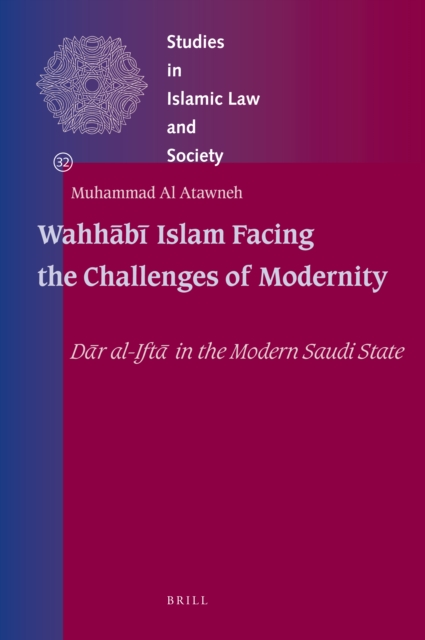
Wahhābī Islam Facing the Challenges of Modernity
This book examines Dār al-Iftā, the official Saudi religious establishment for issuing fatwas, between 1971 and 1999. Specifically, it explores the challenges that this scholarly body encountered when applying Wahhābī interpretations of the Shari'a to late twentieth-century modernity.
eBook

Epidemics in the Medieval Islamic Near East: Theological and Religio-legal Reflections
This article elaborates on the classical Islamic discourse about epidemics in the medieval Near East, with special attention to the crucial question: How were faith and reason presented in the medieval Islamic theological discourse on epidemics? To best address this question, we have chosen an analytical framework for studying how values, beliefs, and scientific assumptions are expressed in theological and medical discourses by various prominent Muslim scholars from different Islamic schools of thought. These scholars appear to have overcome the seeming contradiction between reason (al-akhdh bi'alasbab) and belief (tawakkul) by discovering a \"complementarity theory\" that allowed for a more flexible approach to epidemics, particularly the Black Death, and the application of certain medical and scientific practices without challenging or negating fundamental belief principles. The main conclusion of this study is that Muslim scholars and physicians acknowledged prophetic medicine and the need to take all necessary precautions to prevent and fight epidemics.
Journal Article

The Study of Islam and Muslims in Israel
The Islamic revival in Israel has attracted the attention of scholars from various fields, who have tried to understand its impact on the local Muslim minority. The article illuminates basic flaws in the study of Islam and Muslims in Israel and suggests additional research directions that may enrich this subject-matter. It criticizes the predominant focus on the IM and its attitude towards the State of Israel, while disregarding the existence of a much wider spectrum of voices speaking on a variety of significant issues. We ask what impact Islamization has on Muslim-Jewish relations in Israel, and also suggest the need for more research and literature on the interactions in Israel between the Muslim minority and other local Arab, non-Jewish, and Jewish minorities, and abroad. Two other questions are discussed: How should we approach Islamic fundamentalism in the Israeli context? and What does it represent vis-à-vis the State of Israel and the dominant Israeli society and culture?
Journal Article

Is Saudi Arabia a Theocracy? Religion and Governance in Contemporary Saudi Arabia
This article describes and explains the relationships between religion and government in contemporary Saudi Arabia. It discusses the extent to which religion is practically involved in politics and governance by examining the mechanisms of domination, the actual relationships between religious scholars ('ulama') and rulers (umara'), and the means by which authority is actually implemented. The current Saudi regime, I would suggest, is best described as a theo-monarchy, that draws power from longstanding religio-cultural norms. In this context, Wahhabi Islam seems to authorize a distinctive government paradigm, one not yet recognized by the relevant Islamic literature.
Journal Article
Wahhabi Self-Examination Post-9/11: Rethinking the 'Other', 'Otherness' and Tolerance
Saudi Arabia found itself under an unflattering spotlight in the wake of the events of 9/11, perhaps more than any other country in the Middle East. The fact that 15 of the 19 suicide skyjackers were Saudi citizens provoked an avalanche of criticism in the West as well as in some parts of the Islamic and Arab world against Saudi religious beliefs, rulers, social customs, and school curricula. This article traces the Wahhabi Post-9/11 ideological \"self-examination\" of relationships with non-Wahhabis. Emphasis will be placed on the current Wahhabi perceptions of the fundamental terms of \"other\" and \"otherness\" that are most likely to affect relationships between the Wahhabis and other cultures and religious groups. I argue that post-9/11 Wahhabi Islam acknowledges the problematic nature of its traditional perception of the 'other' and, therefore, is making significant and unprecedented efforts to reformulate and redefine religious doctrines, such as jihad, tolerance, interfaith dialogue and so forth.
Journal Article
