
Catalogue Search | MBRL


Are you sure you want to remove the book from the shelf?

{{itemTitle}}
199
result(s) for
"Albert, David Z"
Sort by:

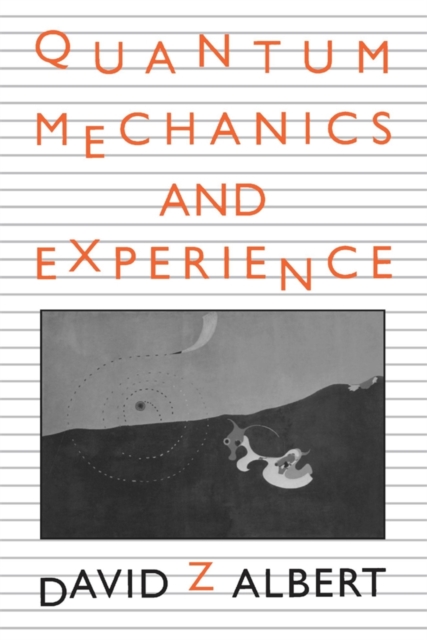
Quantum Mechanics and Experience
The more science tells us about the world, the stranger it looks. Ever since physics first penetrated the atom, early in this century, what it found there has stood as a radical and unanswered challenge to many of our most cherished conceptions of nature. It has literally been called into question since then whether or not there are always objective matters of fact about the whereabouts of subatomic particles, or about the locations of tables and chairs, or even about the very contents of our thoughts. A new kind of uncertainty has become a principle of science. This book is an original and provocative investigation of that challenge, as well as a novel attempt at writing about science in a style that is simultaneously elementary and deep. It is a lucid and self-contained introduction to the foundations of quantum mechanics, accessible to anyone with a high school mathematics education, and at the same time a rigorous discussion of the most important recent advances in our understanding of that subject, some of which are due to the author himself.
eBook

Time and chance
This book is an attempt to get to the bottom of an acute and perennial tension between our best scientific pictures of the fundamental physical structure of the world and our everyday empirical experience of it. The trouble is about the direction of time. The situation is that it is a consequence of almost every one of those fundamental scientific pictures--and that it is at the same time radically at odds with our common sense--that whatever can happen can just as naturally happen backwards.
eBook

Quantum Mechanics and Experience
This lively account of the foundations of quantum mechanics is at once elementary and deeply challenging. It is an introduction accessible to anyone with high school mathematics and, at the same time, a rigorous discussion of the most important recent advances in our understanding of quantum physics, a number of them made by the author himself.
eBook

Introduction: Arguments for and against Limits on Knowledge in a Democracy
The papers in this section are all devoted to arguments for and against limits on knowledge in a democracy. They are all taken up, in one way or another, with questions of privacy; of the transparency (or lack of it) of powerful institutions and consequential decision procedures; of the costs and demands of national security; and so on -- questions that are very much at the heart of this volume and the conference on which it is based. Adapted from the source document.
Journal Article


Physics and Narrative
I'm not going to attempt anything along the lines of a summing up of what Hilary has meant, and what he continues to mean, to my own particular corner of philosophy here. But it needs at least to be mentioned - on an occasion like this - that Hilary has thought about the foundations of physics harder, and longer, and more deeply, and with more openness, and with more wonder, and with more determination, and with more courage, than anyone now living. Sidney Morgenbesser used to say that Hilary was the most quantum-mechanical philosopher in the world, because he and his philosophical position could not simultaneously be identified. And that (as with all of Sidney's jokes) is exactly right. Nobody, to this day, is as young, and as curious, and as willing to be surprised, and as ready to turn his back on everything he has ever believed, and as full of the exuberant expectation of the impossible, as Hilary. And this is how to learn about the world.
Book Chapter

The Foundations of Quantum Mechanics and the Approach to Thermodynamic Equilibrium
It is argued that certain recent advances in the construction of a theory of the collapses of Quantum Mechanical wave functions suggest the possibility of new and improved foundations for statistical mechanics, foundations in which epistemic considerations play no role.
Journal Article


A Quantum-Mechanical Automaton
A Quantum-Mechanical automaton, equipped with mechanisms for the measurement and the recording and the prediction of certain physical properties of the world, is described. It is inquired what sort of empirical description such an automaton would produce of itself. It turns out that this description would be a very novel one, one such as was never imagined in the conventional discussions of measurement.
Journal Article