
Catalogue Search | MBRL


Are you sure you want to remove the book from the shelf?

{{itemTitle}}
7
result(s) for
"Allen, Jeremy, author"
Sort by:

Lonely Planet. Experience France : inspiration, insight & ideas for lovers of champagne, chateaux & joie de vivre
Inside Lonely Planet's Experience France you'll travel through vibrant cities, rural villages, majestic mountains and swanky chateaux, discovering the secrets to French style, embarking on your own study of wines and cheeses and immersing yourself in history, art and all things la belle France.
Book
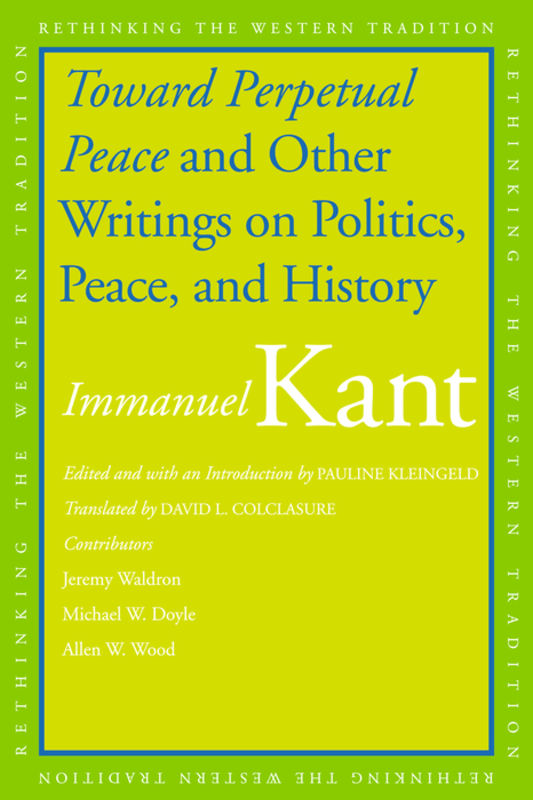
Toward Perpetual Peace and Other Writings on Politics, Peace, and History
Immanuel Kant's views on politics, peace, and history have lost none of their relevance since their publication more than two centuries ago. This volume contains a comprehensive collection of Kant's writings on international relations theory and political philosophy, superbly translated and accompanied by stimulating essays.Pauline Kleingeld provides a lucid introduction to the main themes of the volume, and three essays by distinguished contributors follow: Jeremy Waldron on Kant's theory of the state; Michael W. Doyle on the implications of Kant's political theory for his theory of international relations; and Allen W. Wood on Kant's philosophical approach to history and its current relevance.
eBook


Dragon in ambush
Dragon in Ambush by Jeremy Ingalls is a critique and new translation of the first twenty poems of Mao Zedong’s published poetry. This seminal work stands out from previous translations of Mao’s poems in seeing them as an expression of his core political beliefs, rather than for their poetic effect. Instead, Dr. Ingalls shows in consummate detail that Mao was careful and deliberate in employing imagery in his poetry to lay out procedures for political supremacy in which the central drive was his will to psychological domination. That is, domination of the minds of others is the unifying theme of Mao’s verse-sequence. The crux of Prof. Ingalls’ work lies in her focus on the symbolism in the poems. The poems are, in Mao’s use of them as a means of communication, meaningless on their surface. No image, however seemingly commonplace, is ever employed for merely lyrical or aesthetic description. Every image functions as a factor in an entirely political calculus. According to Dr. Ingalls, “When Mao mentions streams or mountains, suns or moons, clouds or winds or icicles, horses, elephants, snakes, tigers, leopards or bears, specifies kinds of trees or birds or fish, flies, brooms, mats or bridges, these and all his other images have, as their primary function, neither happenstance descriptions nor whimsical metaphor. They all have politically symbolic functions in Mao’s algebra of versified political discourse.” Furthermore, in her analysis, Prof. Ingalls downplays the significance of Marxism-Leninism in the Thought of Mao Zedong. She shows that throughout his career, Mao regarded Marxism-Leninism as a political convenience, not as a doctrine permanently essential to his master-plan. Just as Mao used the Nationalists of Chiang Kai-shek and Stalin’s Soviet Union as means to further his own political ambitions, so did he manipulate Marxist-Leninist ideology to hoodwink and attract, at home and abroad, professional revolutionaries to help do his bidding. Mao’s aims express, in their worldviews, an entirely Chinese tradition. In his poems Mao’s dialectics, his materialism, and his authoritarianism all take their points of reference from within the Chinese cultural order. Dragon in Ambush is a thoroughly unique and revolutionary approach to understanding the Mind of Mao Zedong.
eBook


Closed Minds?: Politics and Ideology in American Universities
From interviews, focus groups, and a national survey, paints a comprehensive picture of today's campus political attitudes. Contrasts the current climate of disengagement with the original civic mission of American colleges and universities, and suggests how universities can reclaim and strengthen their place in the nation's political and civic life.
eBook

New directions in group communication
New Directions in Group Communication takes as its mission the setting of the agenda for the study of group communication in the future. It does so by presenting work that scholars have not previously explored in the current small group communication literature. Part I focuses on new theoretical and conceptual directions, both presenting new views and extending current positions. Part II examines new research methodologies, while Part III looks at antecedent factors affecting group communication. Parts IV and V of the text provide insight into both group communication process and practices. Part VI covers different group communication contexts, including communication patterns in top management teams.
eBook