
Catalogue Search | MBRL


Are you sure you want to remove the book from the shelf?

{{itemTitle}}
16
result(s) for
"Allen, Roger, 1942- translator"
Sort by:


What ʻĪsā ibn Hishām told us : or, a period of time
With What ?Isa ibn Hisham Told Us, the Library of Arabic Literature brings readers an acknowledged masterpiece of early 20th-century Arabic prose. Penned by the Egyptian journalist Muhammad al-Muwaylihi, this exceptional title was first introduced in serialized form in his family's pioneering newspaper Misbah al-Sharq (Light of the East), on which this edition is based, and later published in book form in 1907. Widely hailed for its erudition and its mordant wit, What ?Isa ibn Hisham Told Us was embraced by Egypt's burgeoning reading public and soon became required reading for generations of Egyptian school students. Bridging classical genres and the emerging tradition of modern Arabic fiction, What ?Isa ibn Hisham Told Us is divided into two parts, the second of which was only added to the text with the fourth edition of 1927. Sarcastic in tone and critical in outlook, the book relates the excursions of its narrator ?Isa ibn Hisham and his companion, the Pasha, through a rapidly Westernized Cairo at the height of British occupation, providing vivid commentary of a society negotiating-however imperfectly-the clash of imported cultural values and traditional norms of conduct, law, and education. The \"Second Journey\" takes the narrator to Paris to visit the Exposition Universelle of 1900, where al-Muwaylihi casts the same relentlessly critical eye on European society, modernity, and the role of Western imperialism as it ripples across the globe. Paving the way for the modern Arabic novel, What ?Isa ibn Hisham Told Us is invaluable both for its sociological insight into colonial Egypt and its pioneering role in Arabic literary history.
eBook


Spies, scandals, and sultans: Istanbul in the twilight of the Ottoman Empire : the first English translation of Egyptian Ibrahim al-Muwaylihi's Ma hanalik
Spies, Scandals, and Sultans is the first English translation of a fascinating and acidly critical portrait of the Ottoman capital of Istanbul during the days of the Sultan Abd al-Hamid. This is the first time that the text, written by an Egyptian journalist and politician, has been available since 1896. Originally published as a series of newspaper articles in the mid-1890s, and then as a book entitled Ma Hunalik, the text was ordered to be banned and burned by the Sultan's representatives in Cairo. The ban was carried out, but a few copies survived, one of which has been used for this translation. The text of the Arabic original is prefaced with an extensive introduction in which the author's life is discussed and the highly controversial contents of the book are contextualized and evaluated for their accuracy against other contemporary accounts of life in the Ottoman capital. Spies, Scandals, and Sultans presents a highly critical view of the Ottoman government in Istanbul during the 1890s, with reference to earlier eras in Ottoman history. It is an Egyptian perspective of the Ottoman administration in one of its most problematic periods and is highly critical of every aspect of life in the capital city_not least, the elaborate spy system. Spies, Scandals, and Sultans takes on the theme of modernization and the role of more traditional values, including Islamic ones, in the process of setting the goals for a modern Middle Eastern state_a process that was to come to fruition after World War One in the creation of the modern state of Turkey. This first English translation should arouse intense interest among historians of the Ottoman Empire and Egypt, as well as those who study modernization in the Middle East and the status of Islam within both traditional and modernizing societies in the region. Spies, Scandals, and Sultans has a great deal to say about the processes of decline and the causes for it, and the ever increasing role of European nations in the establishment of priorities within the Ottoman government system.
eBook

Al-Qata'i' : Ibn Tulun's city without walls : a novel
\"Al-Qata'i' is a historical novel set in Egypt over several periods of time and explores the legacy of Ibn Tulun, who ruled Egypt in the 9th century. Inspired by Ibn Tulun's mosque, which still stands as the largest in Cairo and one of the oldest in Africa, the story takes place in and around the smaller cities that were the historic precursors to Cairo in the 9th and 10th centuries, Fustat, Qata'i, and Giza. Ibn Tulun built the city of Al-Qata'i and its mosque as a city where people of multiple beliefs could live together. Bassiouney's novel brings this period of time to life through vivid descriptions and by showing the everyday struggles of people of the time period. These are woven together with scenes from 1918 and 1919 which represent the modern discovery of the historic Tulunid mosque and adjoining houses and function as a narrative bridge between the events of the 9th and 10th centuries and today, showing how this period could present a model for Egyptian harmony today. The structure of the novel is similar to Bassiouney's last novel, Sons of the People. It takes place over three periods in time across three connected sets of characters and is thus in three parts: \"Maisoon,\" \"Ahmad's Dream,\" and \"The Pledge.\" The first part gives a glimpse of life in Egypt before Ibn Tulun arrives. At the start it is very bleak, with a despotic regime ruling Egypt. It ends with Ibn Tulun's rise to power. Part Two relates three different perspectives on Ahmed Ibn Tulun. For Bassiouney, Ibn Tulun was a visionary, uniting Greek, Roman, Coptic, and Arab elements of Egyptian society into his army and the city of Qata'i. This part develops several story lines, including a love story. Part Three recounts the story of Aisha, daughter of Ibn Tulun, after his death. Bassiouney's novels have been praised for their inclusion of strong women characters and focus on viewpoints not often seen in Arab literature and this novel includes a similar focus on women characters\"-- Provided by publisher.
BOOK

The Elusive Fox
Considered one of Morocco's most important contemporary writers, Muhammad Zafzaf created stories of alterity, compassionate tales inhabited by prostitutes, thieves, and addicts living in the margins of society. InThe Elusive Fox, Zafzaf's first novel to be translated into English, a young teacher visits the coastal city of Essaouira in the 1960s. There he meets a group of European bohemians and local Moroccans and is exposed to the grittier side of society.
More than a novel,The Elusive Foxis a portrait of a city during a time of fluidcultural and political mores in Morocco.
eBook

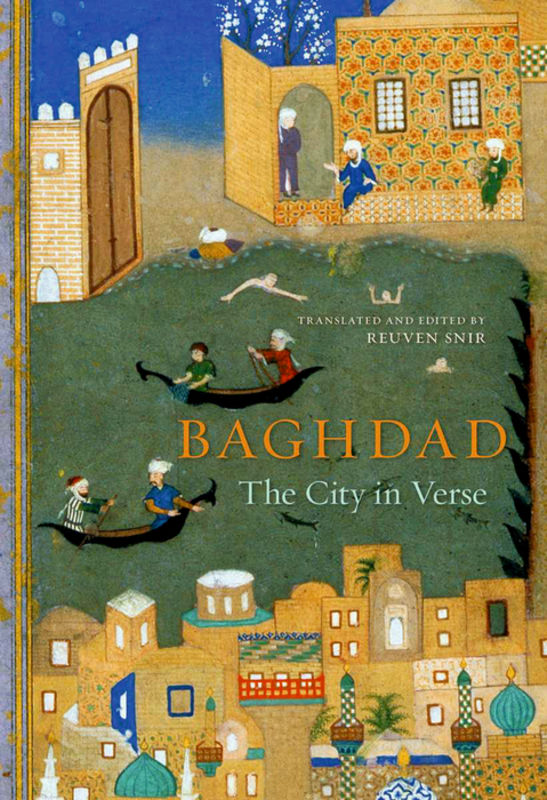
Baghdad
Baghdad: The City in Verse captures the essence of life lived in one of the world's great enduring metropolises.In this unusual anthology, Reuven Snir offers original translations of more than 170 Arabic poems--most of them appearing for the first time in English--which represent a cross-section of genres and styles from the time of Baghdad's.
eBook


The Heart of Lebanon : brief excursions into our mountains and history
\"\"The Heart of Lebanon\" is an English translation of a work by the Lebanese-American writer, Amin al-RIhani. His journeys from his own village of Freike into the mountains of Lebanon allow him to tell the stories of people, villages, and monuments-each journey offering depictions of spectacular scenery and a fascinating cast of characters\"-- Provided by publisher.
BOOK