
Catalogue Search | MBRL


Are you sure you want to remove the book from the shelf?

{{itemTitle}}
23
result(s) for
"Almagor, Eran"
Sort by:

Ancient ethnography : new approaches
\"By providing a platform for scholars working in a variety of fields, this volume presents cutting-edge research dealing with various aspects of ancient ethnographic thought: its formation and devlopment, its intellectual and cultural milieux, the later reception of ethnographic traditons, and the extent to which these represent major constitutive elements of shifting notions of culture, power and identity\"-- Provided by publisher.
Book

The Horse and the Lion in Achaemenid Persia: Representations of a Duality
This paper explores the ambiguous Persian Achaemenid attitude towards the horse and the lion. It examines the way these animals appear in imperial official presentations, local artifacts throughout the empire and Greek textual representations. In the case of the stallion, it looks at the imagery of horse riding or the place of the horse in society and religion alongside the employment of steeds in chariots. Images of the lion are addressed in instances where it appears to be respected as having a significant protective power and as the prey of the chase. This paper attempts to show that this ambiguity corresponds roughly to the dual image of the Persians as both pre-imperial/nomad and imperial/sedentary (and hence allegedly luxurious), a schism that is manifest in both the self-presentation of the Achaemenids and in the Greek texts.
Journal Article
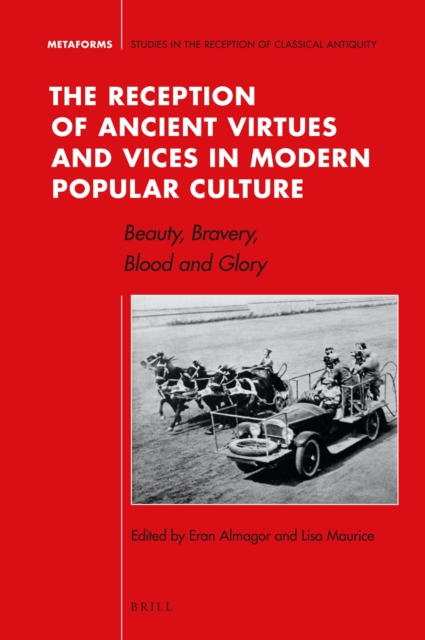
The Reception of Ancient Virtues and Vices in Modern Popular Culture
In Ancient Virtues and Vices in Modern Popular Culture, Eran Almagor and Lisa Maurice offer a collection of chapters dealing with the reception of antiquity in modern popular media, and focusing on a comparison between ancient and modern sets of values.
eBook
Jerusalem and the Bar Kokhba Revolt Again: A Note
This note examines again the overall significance of Jerusalem within the Bar Kokhba revolt. It does so firstly by suggesting a better way to read our texts: Cassius Dio (69.12.1–4) wrote in a partially thematic way, and Eusebius (HE 4.6.1–4) merged several sources together, so that there is no real difference between the two texts in terms of the sequence of the revolt and the establishment of the colony Aelia Capitolina. Secondly, the examination of other sources, different types of evidence and several traditions, may suggest that the Roman reconstruction works in the city did not finish before the revolt, but in fact were halted by it, even without assuming that the rebels actually controlled Jerusalem.
Journal Article
Plutarch and the Persians
This paper deals with the image of Persia and the Persians in the works of Plutarch of Chaeronea (c. 45–c. 120 AD), in both his Moralia and Lives. It explores this theme under several headings: Plutarch as: (a) a Greek Imperial author, (b) an author dealing with historical subjects, (c) a biographer, (d) a moralist, and (e) a philosopher and an essayist concerned with religious themes.
Journal Article
Ctesias and the Importance of His Writings Revisited
Following the recent attempts to rehabilitate the reputation of Ctesias and the information given in his works, this paper proposes to understand certain of the seemingly fanciful details that were associated with the physician and his writings. It tries to shed some light on several uncertainties connected with Ctesias (i.e., his sojourn in Persia) and the Persica (i.e., date, original style and sources of imagery). It argues that the pedestrian lists included in the work might have been later interpolations and that the minor works circulating under Ctesias’ name might have been either sections of the Persica that were taken out to be presented as stand-alone volumes or else falsely attributed to him. The paper addresses the Indica and puts forward several possibilities concerning its relation with the Persica. The influence of Ctesias on the author Deinon is examined, and in the appendix the impact of the Persica on Xenophon’s Anabasis is analyzed.
Journal Article

Josephus and Greek Imperial Literature
Traditionally, Flavius Josephus has not been considered a figure properly belonging to a study of Greek imperial literature. He was perceived as too foreign in the eyes of scholars who have emphasized the Hellenic character and substance of the cultural activity associated with the so‐called Greek “Renaissance”. Another attitude has highlighted the practical rather than the literary importance of the intellectual figures, sophists or men of letters at that period, as mediators between the imperial center and the periphery, and hence has tended to ignore Josephus. This chapter examines features found within Josephus's works as part of the cultural trends in the surrounding Greek‐speaking world, to which he was without doubt exposed in various degrees. It presents a case for viewing Josephus as being right in the thick of late first‐century cultural activity surrounding the production of literature, especially oratory.
Book Chapter

