
Catalogue Search | MBRL


Are you sure you want to remove the book from the shelf?

{{itemTitle}}
338
result(s) for
"Alston, Richard"
Sort by:


I thought I got an A!
Students often exhibit overconfident grade expectations and tend to overestimate the actual course grade at the completion of a course. Current theories of student motivation suggest such overconfidence may lead students to study less than if they had accurate grade perceptions. The authors report the findings of a survey of students enrolled in economics and quantitative courses at a large public university. They analyze the difference between a student's expected and actual grade and how teacher pedagogies can influence student overconfidence. They find male students and those with lower GPAs exhibit greater overconfidence. Students in lower division classes have a greater tendency to be overconfident than do those in upper division classes. The findings also indicate that grading practices influence overconfidence.
Journal Article

R.J. Evans and M. De Marre
The focus of this collection is elusive. I began with Clifford Ando’s introduction (pp. 1-8) and Seth Richardson’s essay on Middle Bronze Age Mesopotamia (pp. 9-26) and thought that the book was about bandits and, potentially, pirates. Matthew Trundle (pp. 27-37) provides an essay on mercenary service and Athenian state structures before Richard Evans’s treatment of state finances and raiding with a focus on Syracuse (pp. 38-59). Alex McAuley (pp. 60-83) shifts attention to Seleucid colonisation and issues of identity.
Journal Article
Ethnic Violence in Roman Alexandria: A Comparative Approach
The aim of this article is to offer a new approach to the study of the riots in Alexandria in 38 CE. This riot is one of the better attested outbreaks of mass urban violence from antiquity. Yet, in spite of the weight of scholarship, the rioting remains a puzzle. The article argues that rather than seeing the riots as a function of deep-seated hostility between Greek and Jewish communities or as a dispute over citizenship rights, we need to see the riot as embedded within the urban sociology of Alexandria. A close reading of the literary accounts points to the importance of associations in the organisation of the riots. The article argues that the associations were integrated with the Alexandrian political elite through large social networks, to which the Jews had limited access. Alexandrian politics centred on competing networks. These networks allowed a community of interest to develop between elites and lower class members of the network. In explaining how that competition might have encouraged extreme violence, the article deploys a range of comparative examples concerning the operation of such networks and extreme civil violence. In a similar fashion to several of the referenced cases, I argue that the Alexandrian violence resulted from a political crisis which allowed both elite and street-level political agents to mobilise violent support in pursuance of their individual interests. The result was to polarise the city and set the conditions for the subsequent decades of violence. * I would like to thank the editor for his consistent and careful support in bringing this article to publication. I would also like to thank the three anonymous reviewers for their cogent and constructive readings, and in particular the expert in African history.
Journal Article
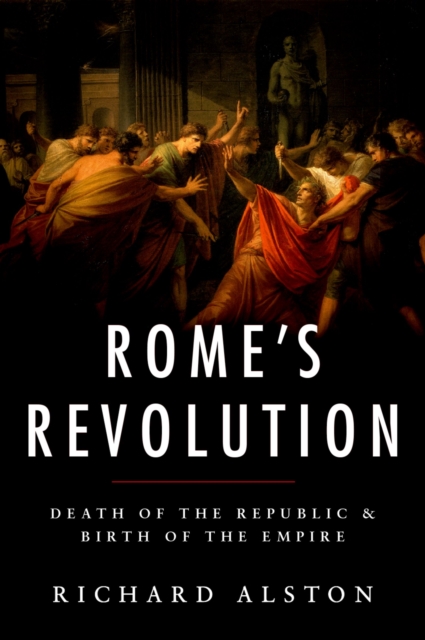
Rome's Revolution
On March 15th, 44 BC a group of senators stabbed Julius Caesar, the dictator of Rome. By his death, they hoped to restore Rome's Republic. Instead, they unleashed a revolution. By December of that year, Rome was plunged into a violent civil war. Three men--Mark Antony, Lepidus, and Octavian--emerged as leaders of a revolutionary regime, which crushed all opposition. In time, Lepidus was removed, Antony and Cleopatra were dispatched, and Octavian stood alone as sole ruler of Rome. He became Augustus, Rome's first emperor, and by the time of his death in AD 14 the 500-year-old republic was but a distant memory and the birth of one of history's greatest empires was complete. Rome's Revolution provides a riveting narrative of this tumultuous period of change. Historian Richard Alston digs beneath the high politics of Cicero, Caesar, Antony, and Octavian to reveal the experience of the common Roman citizen and soldier. He portrays the revolution as the crisis of a brutally competitive society, both among the citizenry and among the ruling class whose legitimacy was under threat. Throughout, he sheds new light on the motivations that drove men to march on their capital city and slaughter their compatriots. He also shows the reasons behind and the immediate legacy of the awe inspiringly successful and ruthless reign of Emperor Augustus. An enthralling story of ancient warfare, social upheaval, and personal betrayal, Rome's Revolution offers an authoritative new account of an epoch which still haunts us today.
eBook

Modes of Production and Reproduction in Roman-Era Egyptian Villages
This study considers the rural Romano-Egyptian house in its social functions. I begin from the premise that houses provided the material environment for the social practices of the everyday, which ensured social production and reproduction over the short and long term. I approach the problem as one of microhistory, making the ideological assumption that society is generated in multiple engagements through which social power is manifested. The house allows us access to some of those processes.
I approach the problem in four main segments. In a short preliminary part, I focus on methodological issues, discussing primarily the house as a
Book Chapter
Soldier and Society in Roman Egypt
The province of Egypt provides unique archaeological and documentary evidence for the study of the Roman army. In this fascinating social history Richard Alston examines the economic, cultural, social and legal aspects of a military career, illuminating the life and role of the individual soldier in the army. Soldier and Society in Roman Eygpt provides a complete reassessment of the impact of the Roman army on local societies, and convincingly challenges the orthodox picture. The soldiers are seen not as an isolated elite living in fear of the local populations, but as relatively well-integrated into local communities. The unsuspected scale of the army's involvement in these communities offers a new insight into both Roman rule in Egypt and Roman imperialism more generally.
eBook