
Catalogue Search | MBRL


Are you sure you want to remove the book from the shelf?

{{itemTitle}}
361
result(s) for
"Altman, Edward I."
Sort by:

Applications of distress prediction models: What have we learned after 50 years from the Z-Score models?
Fifty years ago, I published the initial, classic version of the Z-score bankruptcy prediction models. This multivariate statistical model has remained perhaps the most well-known, and more importantly, most used technique for providing an early warning signal of firm financial distress by academics and practitioners on a global basis. It also has been used by scholars as a benchmark of credit risk measurement in countless empirical studies. Practical applications of the Altman Z-score model have also been numerous and can be divided into two main categories: (1) from an external analytical standpoint, and (2) from an internal to the distressed firm viewpoint. This paper discusses a number of applications from the former's standpoint and in doing so, we hope, also provides a roadmap for extensions beyond those already identified.
Journal Article

Global zombie companies: measurements, determinants, and outcomes
Academics and practitioners are increasingly concerned about global zombieism, a term used to describe insolvent firms that survive with the support of financial institutions, investors, or governments, particularly during unusual market conditions. Using dual-filters of interest coverage ratio and an empirically validated default prediction model, we propose a new measure to gauge the extent of zombieism in the world’s 20 largest economies. The average zombie share of listed firms has increased significantly since 1990, to about 7% in 2020. Zombie firms are typically found among small and medium-sized enterprises. Economic growth, industry compositions, and lenient monetary policies have strong explanatory power for global zombieism. We show that the presence of zombie firms generates significant market congestion, limiting the growth of healthy firms. We also find that the development of global corporate bond markets contributes to zombie firm growth. Leveraging staggered bankruptcy reforms as an exogenous variation, we find that these reforms lower zombie ratio by 1.4% points. The reduction is more substantial if the bankruptcy law becomes more creditor-friendly. Having failed to recover, zombie firms can survive for an average of 5 years before declaring bankruptcy, being delisted, or being acquired. Bankruptcy reforms accelerate the dissolution of zombie status.
Journal Article

The Link between Default and Recovery Rates: Theory, Empirical Evidence, and Implications
This paper analyzes the association between default and recovery rates on credit assets and seeks to empirically explain this critical relationship. We examine recovery rates on corporate bond defaults over the period 1982–2002. Our econometric univariate and multivariate models explain a significant portion of the variance in bond recovery rates aggregated across seniority and collateral levels. We find that recovery rates are a function of supply and demand for the securities, with default rates playing a pivotal role. Our results have important implications for credit risk models and for the procyclicality effects of the New Basel Capital Accord.
Journal Article

Corporate Financial Distress, Restructuring, and Bankruptcy
A comprehensive look at the enormous growth and evolution of distressed debt markets, corporate bankruptcy, and credit risk models. --
eBook

Effects of the New Basel Capital Accord on Bank Capital Requirements for SMEs
Using data from three countries (US, Italy and Australia) and surveying related studies from several other countries in Europe, we investigate the effects of the New Basel Capital Accord on bank capital requirements for small and medium sized enterprises (SMEs). We find that, for all the countries, banks will have significant benefits, in terms of lower capital requirements, when considering small and medium sized firms as retail customers. But they will be obliged to use the Advanced IRB approach and to manage them on a pooled basis. For SMEs as corporate, however, capital requirements will be slightly greater than under the existing Basel I Capital Accord. We believe that most eligible banks will use a blended approach (considering some SMEs as retail and some as corporate). Through a breakeven analysis, we find that for all of our countries, banking organizations will be obliged to classify as retail at least 20% of their SME portfolio in order to maintain the current capital requirement (8%). [PUBLICATION ABSTRACT]
Journal Article
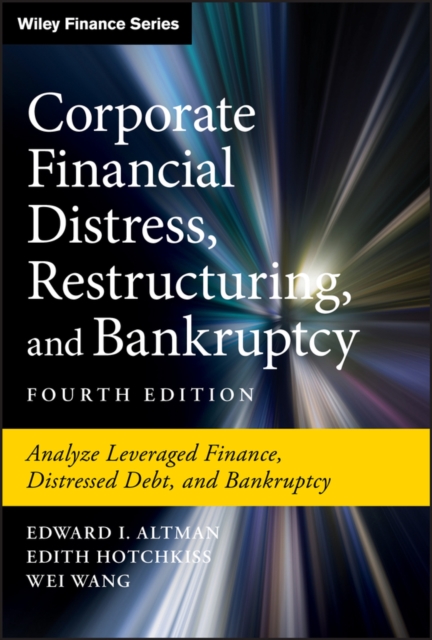
Corporate Financial Distress, Restructuring, and Bankruptcy
A comprehensive look at the enormous growth and evolution of distressed debt markets, corporate bankruptcy, and credit risk models
This Fourth Edition of the most authoritative finance book on the topic updates and expands its discussion of financial distress and bankruptcy, as well as the related topics dealing with leveraged finance, high-yield, and distressed debt markets. It offers state-of-the-art analysis and research on U.S. and international restructurings, applications of distress prediction models in financial and managerial markets, bankruptcy costs, restructuring outcomes, and more.
eBook

Forecasting Credit Cycles: The Case of the Leveraged Finance Market in 2024 and Outlook
There are certain times in our economic and financial environments when it makes sense to assess carefully and dispassionately where we are in the credit cycle and how this cycle relates to the business cycle. Now, mid-2024, is one of those times, as the economic uncertainties are at substantial levels. This note reflects my long history of studying credit cycles dating back to the early 1970s. My current assessment is that the Benign Credit Cycle we have enjoyed since 2010, with the exception of a few months in 2016 and early 2020, ended in 2023. We recently reached an inflection point for an average credit risk scenario. This assessment is based on an analysis of a number of historical indicators over the last 50 years. This conclusion is tempered by the possibility that the U.S. credit picture will continue its heightened risk trend toward a Stressed Scenario by the end of 2024, and combined with a “hard-landing” economic recession, we could witness another financial-credit crisis.
Journal Article

The value of non-financial information in small and medium-sized enterprise risk management
Few studies that have focused on developing credit risk models specifically for small and medium-sized enterprises (SMEs) have included non-financial information as a predictor of company creditworthiness. In this study we have available non-financial, regulatory compliance and \"event\" data to supplement the limited accounting data that is often available for non-listed firms. We employ a sample consisting of over 5.8 million sets of accounts of unlisted firms, of which over 66,000 failed during the period 2000-2007. We find that data relating to legal action by creditors to recover unpaid debts, company filing histories, comprehensive audit report/opinion data and firm-specific characteristics make a significant contribution to increasing the default prediction power of risk models built specifically for SMEs. [PUBLICATION ABSTRACT]
Journal Article

Risky Corporate Bonds in 2021: A Bubble, or Rational Underwriting in a Low-Rate Environment?
In response to the pandemic, the Federal Reserve and US Treasury aggressively supported the corporate debt markets in 2020, both through easy monetary policy and direct participation. As the economy recovered, the Fed maintained an easy monetary policy in pursuit of more robust employment, gross domestic product growth, and inflation targets. Many observers have asserted that these policy actions and other factors have driven a bubble in risk assets, such as equities, special purpose acquisition companies, real estate, commodities, cryptocurrencies, nonfungible tokens, and risky bonds. Others believe that the valuations for at least some of these assets reflect investors’ rational incorporation of the current interest rate environment and economic outlook into their underwriting assumptions. Here, the authors analyze this question with regard to one of the riskiest classes of debt securities—the CCC-rated portion of the corporate high-yield debt market—to draw broader conclusions about the leveraged credit markets in the United States. Using historical market metrics, this portion of the market at its recent peak offered almost no excess return to compensate investors for the risk taken relative to low-risk alternatives. From this, the authors conclude that investors are underwriting significantly more optimistic outcomes than those reflected in historical averages. Although the authors believe that this segment of the market falls short of a true bubble, as they define it, they warn that current conditions pose key risks to investors and to the broader economy. Key Findings ▪ The US high-yield bond market, like other asset classes in the wake of the current easy monetary environment, has reached peak levels. ▪ Consistent with past bubbles, investors have moved up the risk curve, disproportionately bidding up the riskiest portion of this market. ▪ Although this reflects excessive risk appetite on the part of investors, it falls short of a true bubble as we define it. ▪ That said, these conditions pose key risks to investors and to the broader economy.
Journal Article
