
Catalogue Search | MBRL


Are you sure you want to remove the book from the shelf?

{{itemTitle}}
2
result(s) for
"Amariglio, Jack, author"
Sort by:

Postmodern moments in modern economics
Of all the areas of contemporary thought, economics seems the most resistant to the destabilizing effects of postmodernism. Yet, David Ruccio and Jack Amariglio argue that one can detect, within the diverse schools of thought that comprise the discipline of economics, \"moments\" that defy the modernist ideas to which many economists and methodologists remain wedded. This is the first book to document the existence and to explore the implications of the postmodern moments in modern economics. Ruccio and Amariglio begin with a powerful argument for the general relevance of postmodernism to contemporary economic thought. They then conduct a series of case studies in six key areas of economics. From the idea of the \"multiple self\" and notions of uncertainty and information, through market anomalies and competing concepts of value, to analytical distinctions based on gender and academic standing, economics is revealed as defying the modernist frame of a singular science. The authors conclude by showing how economic theory would change if the postmodern elements were allowed to flourish. A work of daring analysis sure to be vigorously debated, Postmodern Moments in Modern Economics is both accessible and relevant to all readers concerned about the modernist straightjacket that has been imposed on the way economics is thought about and practiced in the world today. -- Provided by publisher.
Book
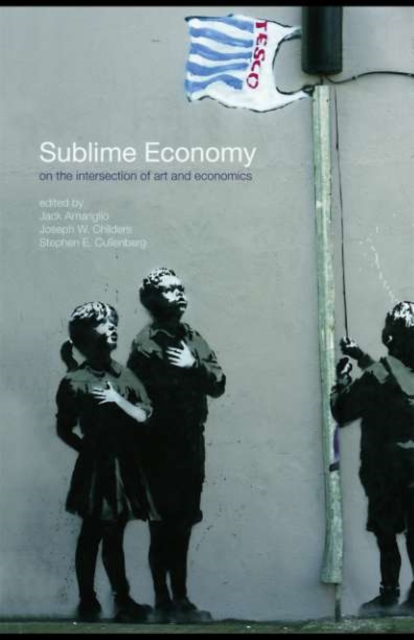
Sublime Economy
Over the last two centuries, artists, critics, philosophers and theorists have contributed significantly to such representations of \"the economy\" as sublime. It might even be said that much of the emergence of a distinctly \"modern\" art in the West is inextricably linked to the perception of art’s own autonomy and, therefore, its privileged, mostly critical, gaze at the terrible mixture of wonder and horror of capitalist economic practices and institutions. The premise of this collection is that despite this perceptual sharing, \"sublime economy\" has yet to be investigated in a purely cross-disciplinary way. Sublime Economy seeks to map this critical territory by exploring the ways diverse concepts of economy and economic value have been culturally constituted and disseminated through modern art and cultural practice.
Comprising of 14 individual essays along with an editors’ introduction, Sublime Economy draws together work from some of the leading scholars in the several fields currently exploring the intersection of economic and aesthetic practices and discourses. A pressing issue of this cross-disciplinary conversation is to discern how artists’, writers’, and cultural scholars’ constructions of distinct conceptions of economic value, as pertains to aesthetic objects as well as to more \"everyday\" objects and relations of mass consumption, have contributed to the ways \"value\" functions in and across disparate discourses. Thus this book looks at how cultural critics and theorists have put forward working notions of economic value that have regularities and effects similar to those of the \"expert\" conceptions and discourses about value that have been the preserve of professional economists.
Jack Amariglio is Professor of Economics at Merrimack College. Joseph W. Childers is Professor of English at the University of California, Riverside. Stephen E. Cullenberg is Professor of Economics at the University of California, Riverside.
Introduction. Sublime Economy: On the Intersection of Art and Economics Jack Amariglio, Joseph W. Childers, Stephen Cullenberg. Tokens of Eccentricity’: Value and the Aesthetic Representation of Economy 1. Tracing the Economic: Modern Art’s Construction of Economic Value Jack Amariglio 2. Meaning to Say... Judith Mehta 3. Use, Value, Aesthetics: Gambling with Difference/Speculating with Value Joseph W. Childers and Stephen Cullenberg. Sublime Intercourse: Economics Meets Aesthetics (and Vice Versa) 4. Reluctant Partners: Aesthetic and Market Value, 1708-1871 Neil DeMarchi 5. On the Contemporaneousness of Roger de Piles' Balance des Peintres Victor Ginsburgh and Sheila Wyers 6. How Aesthetics and Economics Met in Voc Ed Evan Watkins 7. Economics Meets Esthetics in the Bloomsbury Group Craufurd D. Goodwin 8. Individualism, Civilization, and National Character in Market Democracies Regenia Gagnier 9. Fleeing Capitalism: A Slightly Disputatious Conversation/Interview among Friends Deirdre McCloskey and Jack Amariglio. Name Your Price 10. Imaginary Currencies:Contemporary Art on the Market - Critique Confirmation, or Play Olav Velthuis 11. The Sociology of the New Art Gallery Scene in Chelsea, Manhattan David Halle 12. Lives of Cultural Goods Arjo Klamer. Moral Economies and the Romance of Money 13. Wampum: Foreign Legal Tender of the United States Marc Shell 14. The Rhetoric of Prostitution Jennifer Doyle 15. From Roman Copy to Greek Original: Nineteenth Century Re-evaluation of the Classical Statue Yota Batsaki
eBook