
Catalogue Search | MBRL


Are you sure you want to remove the book from the shelf?

{{itemTitle}}
98
result(s) for
"Amyx, Jennifer"
Sort by:

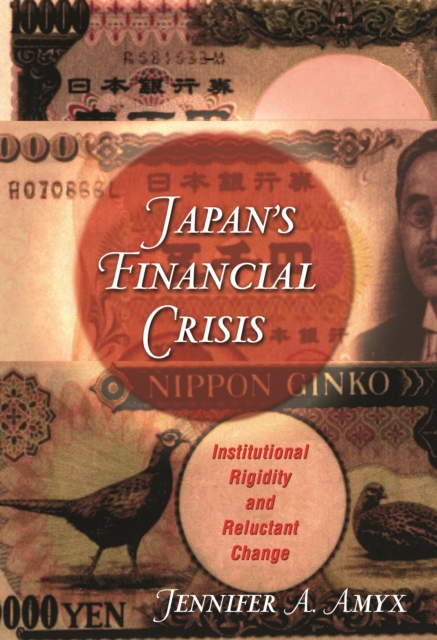
Japan's Financial Crisis
At the beginning of the 1990s, a massive speculative asset bubble burst in Japan, leaving the nation's banks with an enormous burden of nonperforming loans. Banking crises have become increasingly common across the globe, but what was distinctive about the Japanese case was the unusually long delay before the government intervened to aggressively address the bad debt problem. The postponed response by Japanese authorities to the nation's banking crisis has had enormous political and economic consequences for Japan as well as for the rest of the world. This book helps us understand the nature of the Japanese government's response while also providing important insights into why Japan seems unable to get its financial system back on track 13 years later.
The book focuses on the role of policy networks in Japanese finance, showing with nuance and detail how Japan's Finance Ministry was embedded within the political and financial worlds, how that structure was similar to and different from that of its counterparts in other countries, and how the distinctive nature of Japan's institutional arrangements affected the capacity of the government to manage change.
The book focuses in particular on two intervening variables that bring about a functional shift in the Finance Ministry's policy networks: domestic political change under coalition government and a dramatic rise in information requirements for effective regulation. As a result of change in these variables, networks that once enhanced policymaking capacity in Japanese finance became \"paralyzing networks\"--with disastrous results.
eBook
Japan's financial crisis
Networks and state performance -- Pt. 1. Contours of Japan's financial policy networks. Finance ministry ties with the political arena -- Finance ministry ties with private and quasi-governmental financial institutions -- Finance ministry ties with other government agencies and the central bank -- Pt. 2. Evolution of network-based regulation. Institutional \"fit\" for rapid growth -- Slowed growth, institutional rigidity, and reforms postponed -- Network-managed forbearance after the \"bubble\" bursts -- Policy paralysis amid deepening crisis -- Pt. 3. Institutional change and system transition. A new regulatory and policymaking paradigm -- Why can't Japan get back on track? -- Conclusion
eBook

Japanese Governance
Japan Inc was once used to describe the powerful political and economic system that delivers Japan's transformation to an industrial power. This book is about the breakdown and failure of policy coherence in Japan in the 1990s and how the political economy of Japan has changed in response. The essays in the volume seek to identify where change has occurred, as well as where things have not changed and why. The issue of policymaking transparency is accorded particular attention.The book covers a wide range of Japanese institutions and policy areas, including the political party system, electoral and legal reforms, deliberation councils and the financial and agricultural sectors. The findings suggest that resistance to change through the political system is at the root of Japan's inability to deal with its national policy problems. Nonetheless, there has been considerable reform and change towards more open economic and political competition. And, these changes profoundly affect the way in which foreign governments must now relate to domestic political processes in their dealings with Japan.This interdisciplinary book draws together contributions from experts in political science, economics, law and Japanese studies to give a deeper understanding of how Japan's political economy and policymaking processes are working today.
eBook


Japanese governance
This interdisciplinary book gathers contributions from experts in political science, economics, law and Japanese studies to give a deeper understanding of how Japan's political economy and policymaking processes are working today
Book

THE POLITICS OF POSTAL SAVINGS REFORM IN JAPAN
The article provides an overview of the politics of postal savings reform in Japan. Although reform of the system has been a subject of debate over the last twenty years, the ascension of Koizumi Jun'ichiro to the prime minister's post in 2001 raised the issue to the forefront of Japanese politics. However, in the course of the past two decades the terms of debate have radically shifted. The key consideration that we analyze is how the nature of political conflict over privatizing the postal savings system has changed over time. Forces opposing reform are at their weakest level in the postwar period while forces in favor of reform are clearly stronger. Yet, particular economic impediments to full-blown privatization are greater than ever. The path to reforming the system is mined with political and financial hazards.
Journal Article

Informality and Institutional Inertia: the Case of Japanese Financial Regulation
This article examines the case of institutional inertia in Japanese financial regulation, focusing on the reasons why institutions centered on informal modes of organization and interaction proved particularly ‘sticky.’ The Japanese case serves as a particularly tough test for theories of institutional adaptation and change because even crisis – a time when the costs of inaction tend to far exceed the benefits – failed to produce timely institutional change. The paper argues that informal, exclusionary and opaque relational ties served as a functional substitute for formal regulation and promoted cooperative government-bank relationships in an earlier period. Yet, when the informal attributes of the system began to impede the sound functioning of the financial system, the very opacity of these ties and the informational dynamics underlying them meant that the Diet and the general public were less than fully aware of the extent of dysfunction present as time went on.
Journal Article

What Motivates Regional Financial Cooperation in East Asia Today?
Regional financial cooperation in East Asia is proceeding with unprecedented intensity. Latest developments include two Asian Bond Funds, created by the regional central bankers group, and an Asian Bond Markets Initiative launched by the finance ministers of the Association of South East Asian Nations member states plus China, Japan, and South Korea (or ASEAN+3). Some observers continue to attribute such cooperation to sharpened antagonism between East Asia and the West since the Asian financial crisis of 1997-98. But this view overlooks a key internal driver: China's shift to a more proactive stance toward regional cooperation. Far from demonstrating an antagonism toward market-based financial systems, ASEAN+3 members are embracing more liberal rules for economic interaction in their creation of regional bond funds and markets. Financial cooperation in East Asia is today motivated by factors that differ considerably from those observed in the immediate aftermath of the Asian financial crisis-and the implications extend beyond East Asia.
Journal Article
