
Catalogue Search | MBRL


Are you sure you want to remove the book from the shelf?

{{itemTitle}}
481
result(s) for
"Armstrong, Philip"
Sort by:
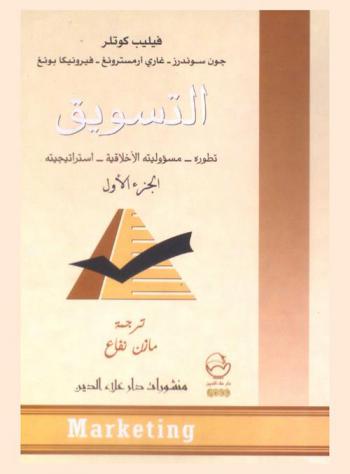
التسويق
يدرس هذا الكتاب التغيرات السريعه فى الأسواق، وتوسع الاتحادات والمؤسسات التجارية، وكيفيه تأقلم التسويق مع هذه المتغيرات، لآنه أكثر بكثير من نوع بسيط من النشاط الاقتصادى، فهو فلسفه اقتصاديه تهدف إلى تلبيه الاحتياجات والإجابه على الاستفسارات أنه كتاب يساعدنا فى الحصول على تصور واسع جدا على التسويق وتطبيقاته فى الأسواق الوطنية أو العالمية، ويقدم أنماط من التسويق الحديث والسياسات التسويقية القوية لبعض الشركات، أن الأسلوب الواضح والاستخدام الكبير للأمثلة والنماذج التى يتصف بها هذا الكتاب تجمعل منه كتابا مهما وحيويا يساعدنا فى أمتلاك المعارف والخبرات الضرورية.
Book

Investigating the dose-dependency of the midgut escape barrier using a mechanistic model of within-mosquito dengue virus population dynamics
Arboviruses can emerge rapidly and cause explosive epidemics of severe disease. Some of the most epidemiologically important arboviruses, including dengue virus (DENV), Zika virus (ZIKV), Chikungunya (CHIKV) and yellow fever virus (YFV), are transmitted by Aedes mosquitoes, most notably Aedes aegypti and Aedes albopictus . After a mosquito blood feeds on an infected host, virus enters the midgut and infects the midgut epithelium. The virus must then overcome a series of barriers before reaching the mosquito saliva and being transmitted to a new host. The virus must escape from the midgut (known as the midgut escape barrier; MEB), which is thought to be mediated by transient changes in the permeability of the midgut-surrounding basal lamina layer (BL) following blood feeding. Here, we present a mathematical model of the within-mosquito population dynamics of DENV (as a model system for mosquito-borne viruses more generally) that includes the interaction of the midgut and BL which can account for the MEB. Our results indicate a dose-dependency of midgut establishment of infection as well as rate of escape from the midgut: collectively, these suggest that the extrinsic incubation period (EIP)—the time taken for DENV virus to be transmissible after infection—is shortened when mosquitoes imbibe more virus. Additionally, our experimental data indicate that multiple blood feeding events, which more closely mimic mosquito-feeding behavior in the wild, can hasten the course of infections, and our model predicts that this effect is sensitive to the amount of virus imbibed. Our model indicates that mutations to the virus which impact its replication rate in the midgut could lead to even shorter EIPs when double-feeding occurs. Mechanistic models of within-vector viral infection dynamics provide a quantitative understanding of infection dynamics and could be used to evaluate novel interventions that target the mosquito stages of the infection.
Journal Article
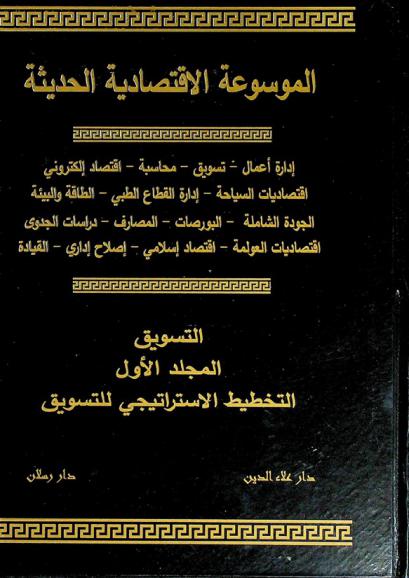
الموسوعة الاقتصادية الحديثة : إدارة أعمال-تسويق-تمويل- محاسبة اقتصاد إلكتروني-اقتصاديات السياحة -إدارة القطاع الطبي-الطاقة والبيئة-الجودة الشاملة-البورصات المصارف-دراسات الجدوى-اقتصاديات العولمة-اقتصاد إسلامي-إصلاح إداري-القيادة : التسويق
هي مجموعة موسوعية ضخمة تضم ٣٢ مجلدا، من بين المجلدات الـ 32، تم تخصيص ٧ مجلدات مخصصة بالكامل لقطاع التسويق يحتوي أول مجلد في مجموعة التسويق على عنوان \"التسويق 1 – التخطيط الاستراتيجي للتسويق كل مجلد متخصص يتناول أحد أبعاد التسويق بشكل معمق.على سبيل المثال : التخطيط الاستراتيجي للتسويق : الاستراتيجيات والتخطيط طويل المدى. محتويات أخرى تشمل : سلوك المستهلك، المزيج التسويقي، التسويق الرقمي، تسويق الخدمات، بحوث التسويق، تصميم المنتجات والتسعير وغيرها من المفاهيم المعاصرة.
BOOK

Ecology and Epidemiology of Eastern Equine Encephalitis Virus in the Northeastern United States: An Historical Perspective
In the current review, we examine the regional history, ecology, and epidemiology of eastern equine encephalitis virus (EEEV) to investigate the major drivers of disease outbreaks in the northeastern United States. EEEV was first recognized as a public health threat during an outbreak in eastern Massachusetts in 1938, but historical evidence for equine epizootics date back to the 1800s. Since then, sporadic disease outbreaks have reoccurred in the Northeast with increasing frequency and northward expansion of human cases during the last 20 yr. Culiseta melanura (Coquillett) (Diptera: Culicidae) serves as the main enzootic vector that drives EEEV transmission among wild birds, but this mosquito species will occasionally feed on mammals. Several species have been implicated as bridge vectors to horses and humans, with Coquilletstidia perturbans (Walker) as a leading suspect based on its opportunistic feeding behavior, vector competence, and high infection rates during recent disease outbreaks. A diversity of bird species are reservoir competent, exposed to EEEV, and serve as hosts for Cs. melanura, with a few species, including the wood thrush (Hlocichia mustelina) and the American robin (Turdus migratorius), contributing disproportionately to virus transmission based on available evidence. The major factors responsible for the sustained resurgence of EEEV are considered and may be linked to regional landscape and climate changes that support higher mosquito densities and more intense virus transmission.
Journal Article

Increased blood meal size and feeding frequency compromise Aedes aegypti midgut integrity and enhance dengue virus dissemination
Aedes aegypti is a highly efficient vector for numerous pathogenic arboviruses including dengue virus (DENV), Zika virus, and yellow fever virus. This efficiency can in part be attributed to their frequent feeding behavior. We previously found that acquisition of a second, full, non-infectious blood meal could accelerate virus dissemination within the mosquito by temporarily compromising midgut basal lamina integrity; however, in the wild, mosquitoes are often interrupted during feeding and only acquire partial or minimal blood meals. To explore the impact of this feeding behavior further, we examined the effects of partial blood feeding on DENV dissemination rates and midgut basal lamina damage in Ae . aegypti . DENV-infected mosquitoes given a secondary partial blood meal had intermediate rates of dissemination and midgut basal lamina damage compared to single-fed and fully double-fed counterparts. Subsequently, we evaluated if basal lamina damage accumulated across feeding episodes. Interestingly, within 24 hours of feeding, damage was proportional to the number of blood meals imbibed; however, this additive effect returned to baseline levels by 96 hours. These data reveal that midgut basal lamina damage and rates of dissemination are proportional to feeding frequency and size, and further demonstrate the impact that mosquito feeding behavior has on vector competence and arbovirus epidemiology. This work has strong implications for our understanding of virus transmission in the field and will be useful when designing laboratory experiments and creating more accurate models of virus spread and maintenance.
Journal Article
Patterns of mosquito and arbovirus community composition and ecological indexes of arboviral risk in the northeast United States
In the northeast United States (U.S.), mosquitoes transmit a number of arboviruses, including eastern equine encephalitis, Jamestown Canyon, and West Nile that pose an annual threat to human and animal health. Local transmission of each arbovirus may be driven by the involvement of multiple mosquito species; however, the specificity of these vector-virus associations has not been fully quantified.
We used long-term surveillance data consistently collected over 18 years to evaluate mosquito and arbovirus community composition in the State of Connecticut (CT) based on land cover classifications and mosquito species-specific natural histories using community ecology approaches available in the R package VEGAN. We then used binomial-error generalized linear mixed effects models to quantify species-specific trends in arbovirus detections.
The composition of mosquito communities throughout CT varied more among sites than among years, with variation in mosquito community composition among sites explained mostly by a forested-to-developed-land-cover gradient. Arboviral communities varied equally among sites and years, and only developed and forested wetland land cover classifications were associated with the composition of arbovirus detections among sites. Overall, the avian host arboviruses, mainly West Nile and eastern equine encephalitis, displayed the most specific associations among mosquito species and sites, while in contrast, the mammalian host arboviruses (including Cache Valley, Jamestown Canyon, and Potosi) associated with a more diverse mix of mosquito species and were widely distributed throughout CT.
We find that avian arboviruses act as vector specialists infecting a few key mosquito species that associate with discrete habitats, while mammalian arboviruses are largely vector generalists infecting a wide diversity of mosquito species and habitats in the region. These distinctions have important implications for the design and implementation of mosquito and arbovirus surveillance programs as well as mosquito control efforts.
Journal Article

Seasonal temperatures and hydrological conditions improve the prediction of West Nile virus infection rates in Culex mosquitoes and human case counts in New York and Connecticut
West Nile virus (WNV; Flaviviridae: Flavivirus) is a widely distributed arthropod-borne virus that has negatively affected human health and animal populations. WNV infection rates of mosquitoes and human cases have been shown to be correlated with climate. However, previous studies have been conducted at a variety of spatial and temporal scales, and the scale-dependence of these relationships has been understudied. We tested the hypothesis that climate variables are important to understand these relationships at all spatial scales. We analyzed the influence of climate on WNV infection rate of mosquitoes and number of human cases in New York and Connecticut using Random Forests, a machine learning technique. During model development, 66 climate-related variables based on temperature, precipitation and soil moisture were tested for predictive skill. We also included 20-21 non-climatic variables to account for known environmental effects (e.g., land cover and human population), surveillance related information (e.g., relative mosquito abundance), and to assess the potential explanatory power of other relevant factors (e.g., presence of wastewater treatment plants). Random forest models were used to identify the most important climate variables for explaining spatial-temporal variation in mosquito infection rates (abbreviated as MLE). The results of the cross-validation support our hypothesis that climate variables improve the predictive skill for MLE at county- and trap-scales and for human cases at the county-scale. Of the climate-related variables selected, mean minimum temperature from July-September was selected in all analyses, and soil moisture was selected for the mosquito county-scale analysis. Models demonstrated predictive skill, but still over- and under-estimated WNV MLE and numbers of human cases. Models at fine spatial scales had lower absolute errors but had greater errors relative to the mean infection rates.
Journal Article
Jamestown Canyon virus comes into view: understanding the threat from an underrecognized arbovirus
This review examines the epidemiology, ecology, and evolution of Jamestown Canyon virus (JCV) and highlights new findings from the literature to better understand the virus, the vectors driving its transmission, and its emergence as an agent of arboviral disease. We also reanalyze data from the Connecticut Arbovirus Surveillance Program which represents the largest dataset on JCV infection in mosquitoes. JCV is a member of the California serogroup of the genus Orthobunyavirus, family Peribunyaviridae, and is found throughout much of temperate North America. This segmented, negative-sense RNA virus evolves predominately by genetic drift punctuated by infrequent episodes of genetic reassortment among novel strains. It frequently infects humans within affected communities and occasionally causes febrile illness and neuroinvasive disease in people. Reported human cases are relatively rare but are on the rise during the last 20 yr, particularly within the northcentral and northeastern United States. JCV appears to overwinter and reemerge each season by transovarial or vertical transmission involving univoltine Aedes (Diptera: Culicidae) species, specifically members of the Aedes communis (de Geer) and Ae. stimulans (Walker) Groups.The virus is further amplified in a mosquito-deer transmission cycle involving a diversity of mammalophilic mosquito species. Despite progress in our understanding of this virus, many aspects of the vector biology, virology, and human disease remain poorly understood. Remaining questions and future directions of research are discussed.
Journal Article
Northern range expansion of the Asian tiger mosquito (Aedes albopictus): Analysis of mosquito data from Connecticut, USA
The Asian tiger mosquito (Aedes albopictus) is an invasive species and important arbovirus vector that was introduced into the U.S. in the 1980's where it continues to expand its range. Winter temperature is an important constraint to its northward expansion, with potential range limits located between the 0° and -5°C mean cold month isotherm. Connecticut is located within this climatic zone and therefore, Ae. albopictus was monitored statewide to assess its northern range expansion and to delineate where populations can stably persist.
Ae. albopictus females were monitored at fixed trapping sites throughout Connecticut from June-October over a 20-year period, 1997-2016. In addition, Ae. albopictus larvae and pupae were collected from tire habitats and tires were retrieved from the field in the spring and flooded to evaluate overwintering success of hatching larvae. Ae. albopictus was first detected during statewide surveillance when a single adult female was collected in 2006. This species was not collected again until 2010 and was subsequently detected each successive year with increasing abundance and distribution except following the unusually cold winters of 2014 and 2015. Ae. albopictus mosquitoes were most abundant in urban and suburban locations along the southwestern shoreline of Connecticut; however, single specimens were occasionally detected in central parts of the state. Field-collected females were also screened for arbovirus infection yielding two isolations of Cache Valley virus and one isolation of West Nile virus, highlighting the threat posed by this mosquito. Ae. albopictus overwintered in Connecticut under mild winter conditions as shown by recovery of hatched larvae from field collected tires in spring and by early season detection of larvae and pupae.
This study documents the establishment and expansion of Ae. albopictus at the northern boundary of its range in the northeastern U.S. and provides a baseline for monitoring the future spread of this species anticipated under climate change.
Journal Article