
Catalogue Search | MBRL


Are you sure you want to remove the book from the shelf?

{{itemTitle}}
103
result(s) for
"Arnold, Michaela"
Sort by:

Regenerative multibunch beam breakup instabilities and countermeasures for a high-intensity electron accelerator and the superconducting Darmstadt linear electron accelerator
Regenerative multibunch beam breakup instabilities are a well-known phenomenon in recirculating linacs where particle bunches pass multiple times through the same superconducting rf cavities with extremely high quality factor. This is in particular true for energy recovery linacs. Parasitic electromagnetic modes excited in the cavities can affect bunch dynamics in such a way, that on its subsequent passes it excites the modes further and a positive feedback loop is formed. Direct bunch tracking and a stability analysis technique can be used to study the instability. Usually only dipole modes are considered. In the present work, similar approaches are applied to monopole and quadrupole modes and illustrated with simulation results for the S-DALINAC and MESA facilities. An approximated stability analysis technique with better performance for the case of multiple recirculations is proposed. Countermeasures including betatron phase advance adjustment and additional betatron coupling are considered and a universal criterion for assessment of their effectiveness is proposed. A simple model of a damped oscillator with feedback is proposed as a universal example illustrating the phenomenon in general.
Journal Article
First operation of the superconducting Darmstadt linear electron accelerator as an energy recovery linac
The superconducting Darmstadt linear electron accelerator (S-DALINAC) has been operated as an energy recovery linac (ERL) for the first time. The S-DALINAC is a recirculating superconducting radio-frequency (SRF) accelerator and had been upgraded with an additional recirculation beamline. It features a path length adjustment system that provides a freedom of choice of 360° for the rf phase difference between the electron bunches recirculated through the new beamline and the phase of the acceleratingTM010mode of the oscillating electromagnetic field in the SRF cavities of the accelerator. A choice of around 180° for this phase difference results in a deceleration of the recirculated beam and a corresponding transfer of the particles’ kinetic energy back to the energy of the electromagnetic field in the cavities. The main components relevant for ERL operation are described and data of the first operation as an SRF-ERL are presented.
Journal Article

Effects of Psychoactive Massage in Outpatients with Depressive Disorders: A Randomized Controlled Mixed-Methods Study
The clinical picture of depressive disorders is characterized by a plethora of somatic symptoms, psychomotor retardation, and, particularly, anhedonia. The number of patients with residual symptoms or treatment resistance is high. Touch is the basic communication among humans and animals. Its application professionally in the form of, e.g., psychoactive massage therapy, has been shown in the past to reduce the somatic and mental symptoms of depression and anxiety. Here, we investigated the effects of a specially developed affect-regulating massage therapy (ARMT) vs. individual treatment with a standardized relaxation procedure, progressive muscle relaxation (PMR), in 57 outpatients with depression. Patients were given one ARMT or PMR session weekly over 4 weeks. Changes in somatic and cognitive symptoms were assessed by standard psychiatric instruments (Hamilton Depression Scale (HAMD) and the Bech–Rafaelsen–Melancholia–Scale (BRMS)) as well as a visual analogue scale. Furthermore, oral statements from all participants were obtained in semi-structured interviews. The findings show clear and statistically significant superiority of ARMT over PMR. The results might be interpreted within various models. The concept of interoception, as well as the principles of body psychotherapy and phenomenological aspects, offers cues for understanding the mechanisms involved. Within a neurobiological context, the significance of C-tactile afferents activated by special touch techniques and humoral changes such as increased oxytocin levels open additional ways of interpreting our findings.
Journal Article
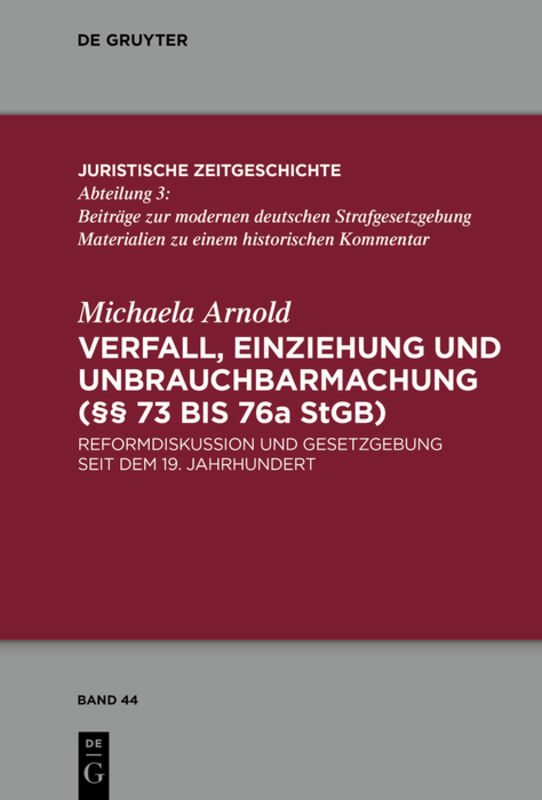
Verfall, Einziehung und Unbrauchbarmachung ( 73 bis 76a StGB)
Die Dissertation beschreibt die Entwicklung der gegen das Eigentum gerichteten Sanktionen des Verfalls, der Einziehung sowie der in der Titelüberschrift der heutigen §§ 73 ff. StGB nicht ausdrücklich genannten, aber mitgeregelten Unbrauchbarmachung insbesondere seit 1871. Kurz wird auch die vorausgegangene Entwicklung im römischen sowie im deutschen Recht vor 1871 dargestellt, da diese Einfluss auf die Ausgestaltung der Vorschriften im Reichsstrafgesetzbuch hatte. In diesem Zusammenhang werden die Veränderungen, deren Hintergründe, die Motive sowie die Argumente der Beteiligten aufgezeigt. Die Dissertation macht deutlich, welche Unzulänglichkeiten bis heute im Hinblick auf die Vorschriften bestehen und an welchen Stellen es wünschenswert wäre, dass der Gesetzgeber tätig wird. Von daher ist die Dissertation für all jene, die sich vertiefter mit der Thematik auseinandersetzten wollen, unverzichtbar.
eBook

Realization of a multi-turn energy recovery accelerator
Conventional electron linear accelerators are essential research tools but limited in providing high beam currents. Energy recovery technology enables high beam currents with reasonable and sustainable power supply requirements by recycling the electrons’ kinetic energy. Independently, higher beam energies can be achieved if electrons are accelerated multiple times in a linear accelerator. The combination of both techniques results in a multi-turn energy recovery linear accelerator, which is capable of providing high beam power. Here we report the demonstration of efficient energy recycling in multi-turn operation where we saved up to 87% of the consumed beam power in the main linear accelerator of the superconducting Darmstadt electron linear accelerator (S-DALINAC). In this setting, the cumulative phase slippage effect, caused by the different speeds of the electrons per main linear accelerator pass and the resulting different interactions with the alternating electric field, cannot be neglected and was compensated. Our proof-of-principle demonstration shows how multi-turn energy recovery linear accelerators can outperform conventional machines due to the potential for considerable power saving while providing higher beam power.By combining energy recovery technology and a multi-turn accelerating scheme in a linear accelerator, high-power beams can be achieved with considerably reduced energy consumption.
Journal Article
Energy Recovery LINACs -- an Overview
The seminar on energy recovery linacs (ERLs) is giving an overview of the field: How does an ERL work? What have been important milestones in ERL history? What are the reasons to use an ERL instead of a conventional accelerator? As examples of the landscape of machines, ranging from ancient ERLs up to future projects, this chapter will give results of the runs from CBETA (USA) and S-DALINAC (Germany). The two facilities bERLin-Pro/SEALab (Germany) and MESA (Germany) will belong to the next ERLs to be in operation and will be introduced briefly. The way to future ERLs will also be addressed.
Paper
