
Catalogue Search | MBRL


Are you sure you want to remove the book from the shelf?

{{itemTitle}}
26
result(s) for
"Aroles, Jeremy"
Sort by:
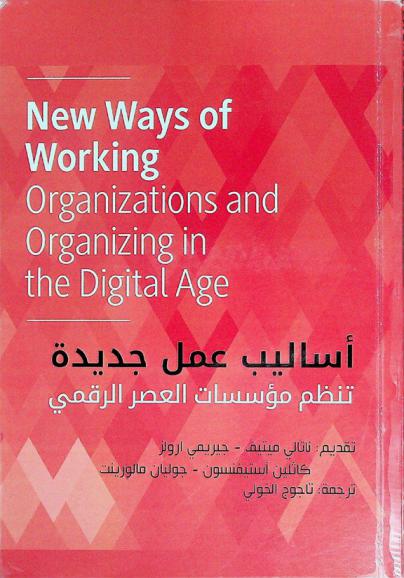
العصر الرقمي : أساليب عمل جديدة لمنظمات الأعمال
يستكشف كتاب \"العصر الرقمي : أساليب عمل جديدة لمنظمات الأعمال\" كيف تؤثر التقنيات الرقمية على طبيعة العمل والتنظيم داخل المؤسسات. يقدم رؤية معمقة حول تطور أنماط العمل، مستندا إلى تجارب دولية من أوروبا، أفريقيا، آسيا ... ويقوم بتحليل كيف غيرت الثورة الرقمية الممارسات التنظيمية، الموارد البشرية، الهوية المؤسسية، والمساحات البدنية والافتراضية للعمل.
BOOK

Rethinking Stability and Change in the Study of Organizational Routines: Difference and Repetition in a Newspaper-Printing Factory
Organizational life consists of an ever-changing world of encounters, experiences, and complex sociomaterial relations. Within this context, standard routines can be seen as a solution to problems of inefficiency within organizations, especially when associated with images of stability, repeatability, and standardization. This can bring a sense of order where there is disorder, and stability in the face of change. However, whereas standard routines may be seen as providing solutions within complex and ever-changing organizational worlds, they can also be viewed as sources of organizational problems. Through an ethnographic examination of two routines within a newspaper-printing factory, our paper seeks to build on and add to contributions within routine dynamics (RD) by highlighting the emergence and coexistence of change and stability and the enactment of standard routines through a performative process of difference and repetition. In particular, our paper examines how organizational stability and change emerge through the dynamic relations underlying the enactment of difference and repetition and how these relations involve various—sometimes hidden—microprocesses that include the simplification and amplification of facts, scripts, and concerns. By drawing together the findings from our ethnographic research, studies within the area of RD, and concepts relating to a Deleuzian and Latourian perspective, our paper therefore contributes to the work on the repetition of routines by further unpacking the generative sociomaterial dynamics, creative forces, and microprocesses that underlie the emergence of stability and change through difference and repetition.
Journal Article

Smoothing, striating and territorializing
Drawing on a rich two-year ethnographic study that followed evolutionary biologists in their everyday work, this paper explores the making of scientific knowledge through the spatial conceptual imagery developed by Deleuze and Guattari. In particular, this paper focuses on a field expedition to the South Pacific and investigates how different rhythms, forces and intensities are harmonized and assembled in the production of scientific knowledge. Within this setting, maintaining a balance between striating and smoothing forces is an important yet difficult task. On many occasions, alternative rhythms and ‘tropical forces’ jeopardized the success of the expedition, despite the scientists’ best efforts to formalize the research process and bring the striations of the laboratory into the forest. Paradoxically, these challenges also played a key role in the inquiry as they opened new possibilities and ultimately led to more intense engagements with the tropical forest and its rhythms and spatiality.
Journal Article

The Fictional Archetypes of AI: For a Qualitative-Quantitative Analysis of Representations in Films
MOS research on films has tended to focus on individual cases or series. In this article, we are proposing an approach that mobilizes background analysis, computational text analysis, and hermeneutics in order to provide a systematic, critically inclined analysis of a large corpus. We illustrate this approach by exploring the political and symbolical representations of artificial intelligence (AI) in the film industry. Using the Internet Movie Database, we identified all the films dealing with AI (113 in total), compiled their synopses, and recorded 11 characteristics for each. Highlighting the spatial, temporal, and gendered polarization of films depicting AI, our article proposes four representations of AI and critically reflects upon the role of these representations and their influence in shaping societal perceptions of AI. Our article makes two main contributions to the literature. First, it demonstrates the potential of combining quantitative-based, lexical forms of analysis with hermeneutic interpretations in the study of cultural representations. Second, it develops a nuanced, in-depth, and critical analysis of the symbolical and political representations of AI in cinematic productions, thus enhancing our understanding of this industry.
Journal Article

Assessing the role of managerial feedback in changing routines in small and medium enterprises
PurposeIn an ever-complexifying business context, organizations need to continuously adapt, adjust and change their routines in order to remain competitive. Drawing upon a qualitative study focusing on three Southeastern European countries (Greece, Bulgaria and Serbia), this paper explores the role played by managerial feedback on routine change within small and medium enterprises (SMEs).Design/methodology/approachThe authors draw from an in-depth qualitative study of six manufacturing SMEs located in three Southeastern European countries: Greece, Bulgaria and Serbia. The process of data collection, which spanned over a period of fifteen months, was centred around both interviews and observations.FindingsThe authors argue that feedback is a powerful and constructive managerial practice that sets to initiate changes in routines through three different means: (1) making sense of the changes required (by channelling information), (2) rationalizing the decision for changing the unproductive routines and (3) reviewing the process of change through the legitimization of situational routines. In addition to this, the authors found that managers perceive that routines need to change for four main reasons: inability to meet targets (e.g. performance); too cumbersome to deal with complex environments; inflexibility and failing to provide control; obsolete in terms of providing a sense of confidence.Practical implicationsThis research provides evidence that feedback is an important managerial means of changing routines in informal, less bureaucratic and less formalized workplaces such as SMEs. Managers might embrace deformalized approaches to feedback when dealing with routines in SMEs. Working within a very sensitive structure where the majority of changes on routines need to be operationalized through their hands, managers and practitioners should deploy feedback in order to highlight the importance of routines as sources of guiding actions, activities and operations occurring in SMEs that create better internal challenges and processes.Originality/valueThe authors’ research suggests that routines are subject of change in dynamic and turbulent situations. Perceiving routines as antithetical to change fails to capture the distinctive features of change such as its fluidity, open-endedness, and inseparability. Likewise, the authors claim that routines are socially constructed organizational phenomena that can be modulated in different ways in SMEs.
Journal Article
Mapping themes in the study of new work practices
Both shaping and shaped by technological, economic and social facets, the world of work has witnessed a wide array of changes. This review article sets out to provide a synthesis of some of the main directions and insights of existing research connected to the new world of work. In particular, we approached the topic of new work practices through four key dimensions: (1) Conceptual and methodological dimensions in the study of new work practices; (2) Spatial and temporal manifestations of new work practices in the collaborative economy; (3) Individuals, organizations and new work configurations; (4) Power and control. The review article critically discusses the future of work and argues that the ‘new' world of work simply repeats asymmetrical power relations and inequalities that characterise work activities, with the potential of exacerbating even further disparities, inequalities and precarity.
Paper
Deciphering signs
The aim of the article is to explore how an apprenticeship through signs can inform ethnographic inquiries. Upon engaging with signs, one can develop new empirical sensibilities that could allow for the appreciation of the flows, forces and intensities encountered during such research processes. In particular, it enables us to attend to those aspects of research that we may struggle to capture or illuminate. We suggest naming such endeavour nomadography in order to emphasize the move away from anthropocentric accounts and to reflect the iterative, polymorphic and experiential nature of this approach. We also draw on a brief extract from some fieldwork in Fiji that focused on the ‘discovery’ of a new plant species. In particular, we wish to explore how a nomadographic approach provides a way of rejuvenating our thinking conceptually, empirically and methodologically by rethinking these three interconnecting and overlapping aspects of the research process.
Journal Article


Organizational memorialization: spatial history and legitimation as chiasms
PurposeThe purpose of this paper is to understand how historical materialities might play a contemporary role in legitimation processes through the memorialization of history and its reproduction in the here-and-now of organizations and organizing.Design/methodology/approachThe authors briefly review the existing management and organization studies (MOS) literature on legitimacy, space and history; engage with the work of Merleau-Ponty to explore how organizational legitimacy is managed in time and space; and use the case of two Parisian universities to illustrate the main arguments of the paper.FindingsThe paper develops a history-based phenomenological perspective on legitimation processes constitutive of four possibilities identified by means of chiasms: heterotopic spatial legacy, thin spatial legacy, institutionalized spatial legacy and organizational spatial legacy.Research limitations/implicationsThe authors discuss the implications of this research for the neo-institutional literature on organizational legitimacy, research on organizational space and the field of management history.Originality/valueThis paper takes inspiration from the work of Merleau-Ponty on chiasms to conceptualize how the temporal layers of space and place that organizations inhabit and inherit (which we call “spatial legacies”), in the process of legitimation, evoke a sensible tenor.
Journal Article