
Catalogue Search | MBRL


Are you sure you want to remove the book from the shelf?

{{itemTitle}}
78
result(s) for
"Atack, Iain"
Sort by:

Nonviolence in political theory
Examines the relevance of nonviolent tactics to current debates about political action and political thought. Nonviolent political action has played a significant role in achieving social and political change in the last century. Mahatma Gandhi and Martin Luther King were prominent proponents of nonviolence. Nonviolent political action or civil resistance has also been central to toppling communist regimes in Eastern Europe and to pro-democracy popular movements in Serbia, Georgia and the Ukraine. By scrutinizing the theories behind nonviolence, such as the role of the state, the rule of law and the nature of social and political power, Atack establishes nonviolence as a credible theme within Western political thought -- Publisher's description.
Book

Nonviolence in Political Theory
By scrutinising the philosophical and theoretical assumptions of proponents of nonviolent political action, for example the role of the state, the rule of law and the nature of social and political power, Ian Atack establishes nonviolence as a credible theme within Western political thought.
eBook
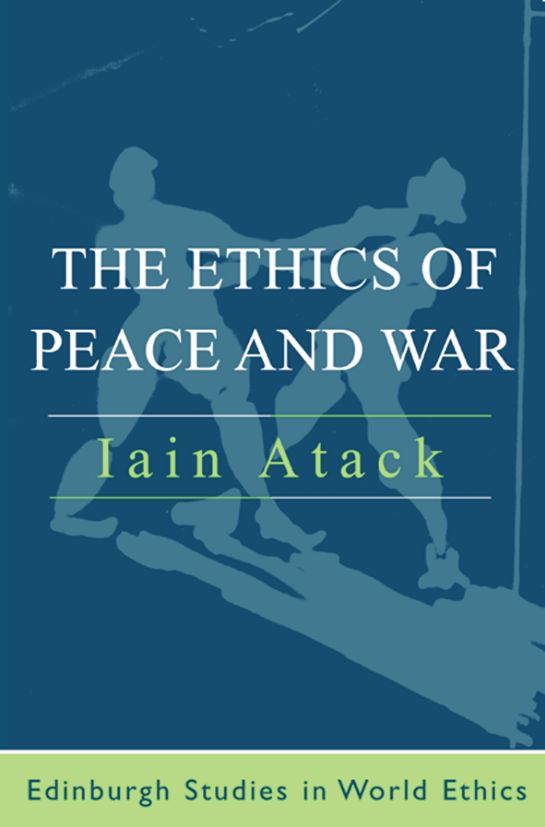
The Ethics of Peace and War
The ethics of peace and war is one of the central ethical issues in International Relations today.This book looks at three key theories which have implications for the role of ethics in war and armed conflict: cosmopolitanism; internationalism; and political realism. It argues for the appropriateness of cosmopolitanism above the other two general theories, with its emphasis on the equal worth of all human beings as the basis for a global moral community. This ethical theory is shown to have a vital role to play in international politics in light of changing conceptions of peace and security, the prevalence of internal over international wars, and the increasing emphasis on international humanitarian intervention as a justification for the use of military force.The book is divided into three parts - after a general introduction to peace and war in world ethics there follow sections on International Politics and the Morality of Peace and War; Ethical Approaches to Armed Conflict; and Cosmopolitan Strategies. A conclusion sums up the arguments.This is a topical book suitable for a range of courses in Philosophy, Politics, Peace Studies and International Relations.Key Features*Evaluates the relevance of the theory of cosmopolitanism to the specific problems of war and armed conflict*Examines two contrasting positions on the ethics of war and armed conflict: pacifism and just war theory*Analyses contemporary issues and debates including postmodern and asymmetrical war, and peace-building and conflict prevention*A central theme is the ambiguous role of the state in controlling and justifying the use of military force and in constructing a new cosmopolitan world order
eBook

Nonviolence in political theory
By scrutinising the philosophical and theoretical assumptions of proponents of nonviolent political action, for example the role of the state, the rule of law and the nature of social and political power, Ian Atack establishes nonviolence as a credible theme within Western political thought.
eBook


The Ethics of Peace and War
This book looks at three key theories which have implications for the role of ethics in war and armed conflict: cosmopolitanism; internationalism; and political realism.
eBook

The ethics of peace and war : from state security to world community
This book looks at three key theories which have implications for the role of ethics in war and armed conflict: cosmopolitanism; internationalism; and political realism.
eBook
PACIFISM AND NONVIOLENCE
Pacifism and nonviolence are sometimes seen to be synonymous, because they both oppose the use of violence to achieve particular political ends. They are, however, logically distinct, if sometimes complementary and even overlapping, moral and political positions.
Pacifism objects to the institutionalised or organised use of violence, in the form of war and armed conflict, for ethical reasons. It involves the refusal to participate in political violence, because of the loss of human life and the scale of destruction it entails.
A pacifist position can be adopted at the level of individuals or social groups, with particular religious or ethical
Book Chapter
THE THEORY AND PRACTICE OF NONVIOLENT POLITICAL ACTION
Nonviolent political action, civil resistance or ‘people power’ have become increasingly important mechanisms for achieving significant political and social change, especially where both conventional constitutional politics and political violence or armed force have failed. This has become particularly noticeable during the last century or so – a century devastated by war and armed conflict, but also characterised by a trend towards democratisation and popular sovereignty, as well as the recognition and protection of fundamental human rights and civil liberties. Recent examples of political change, achieved through nonviolent action or civil resistance, include the ‘Arab spring’ (especially regime change in Tunisia
Book Chapter
NONVIOLENCE AND POLITICAL POWER
Power is a central theme of political theory (together with violence), because it concerns the capacity to achieve goals in a social context – individually, but also collectively – through social organisation and political institutions. The theme of power, then, is one of the most contentious issues affecting evaluations of nonviolent political action, but it also marks one of the most distinctive contributions of nonviolence to political theory.
Classic theories of power in Western political theory view it in terms of competition for scarce resources. Power, then, becomes intimately connected to issues of individual and collective security and survival and
Book Chapter