
Catalogue Search | MBRL


Are you sure you want to remove the book from the shelf?

{{itemTitle}}
50
result(s) for
"Atienza, Rowel"
Sort by:

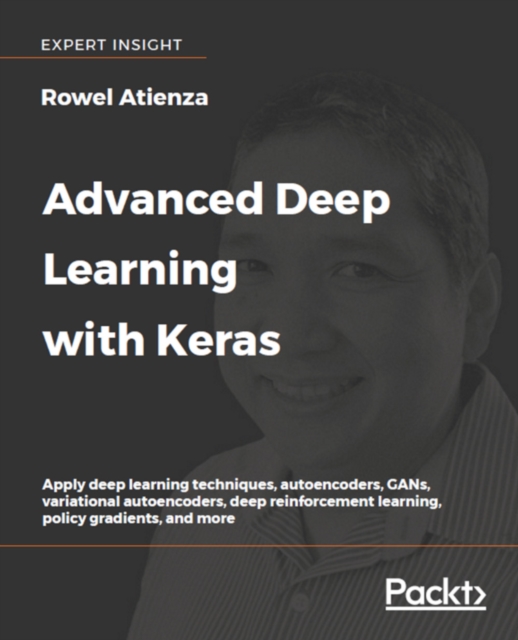
Advanced Deep Learning with Keras
Understanding and coding advanced deep learning algorithms with the most intuitive deep learning library in existence
Key Features
* Explore the most advanced deep learning techniques that drive modern AI results
* Implement deep neural networks, autoencoders, GANs, VAEs, and deep reinforcement learning
* A wide study of GANs, including Improved GANs, Cross-Domain GANs, and Disentangled Representation GANs
Book Description
Recent developments in deep learning, including Generative Adversarial Networks (GANs), Variational Autoencoders (VAEs), and Deep Reinforcement Learning (DRL) are creating impressive AI results in our news headlines - such as AlphaGo Zero beating world chess champions, and generative AI that can create art paintings that sell for over $400k because they are so human-like.Advanced Deep Learning with Keras is a comprehensive guide to the advanced deep learning techniques available today, so you can create your own cutting-edge AI. Using Keras as an open-source deep learning library, you'll find hands-on projects throughout that show you how to create more effective AI with the latest techniques.The journey begins with an overview of MLPs, CNNs, and RNNs, which are the building blocks for the more advanced techniques in the book. You'll learn how to implement deep learning models with Keras and TensorFlow 1.x, and move forwards to advanced techniques, as you explore deep neural network architectures, including ResNet and DenseNet, and how to create autoencoders. You then learn all about GANs, and how they can open new levels of AI performance. Next, you'll get up to speed with how VAEs are implemented, and you'll see how GANs and VAEs have the generative power to synthesize data that can be extremely convincing to humans - a major stride forward for modern AI. To complete this set of advanced techniques, you'll learn how to implement DRL such as Deep Q-Learning and Policy Gradient Methods, which are critical to many modern results in AI.
What you will learn
* Cutting-edge techniques in human-like AI performance
* Implement advanced deep learning models using Keras
* The building blocks for advanced techniques - MLPs, CNNs, and RNNs
* Deep neural networks – ResNet and DenseNet
* Autoencoders and Variational Autoencoders (VAEs)
* Generative Adversarial Networks (GANs) and creative AI techniques
* Disentangled Representation GANs, and Cross-Domain GANs
* Deep reinforcement learning methods and implementation
* Produce industry-standard applications using OpenAI Gym
* Deep Q-Learning and Policy Gradient Methods
Who this book is for
Some fluency with Python is assumed. As an advanced book, you'll be familiar with some machine learning approaches, and some practical experience with DL will be helpful. Knowledge of Keras or TensorFlow 1.x is not required but would be helpful.
]]>
eBook

Advanced deep learning with TensorFlow 2 and Keras : apply DL, GANs, VAEs, deep RL, unsupervised learning, object detection and segmentation, and more
A second edition of the bestselling guide to exploring and mastering deep learning with Keras, updated to include TensorFlow 2.x with new chapters on object detection, semantic segmentation, and unsupervised learning using mutual information.
eBook
Advanced Deep Learning with TensorFlow 2 and Keras - Second Edition
This definitive guide delves into the breadth of deep learning methodologies, emphasizing hands-on applications with TensorFlow 2 and Keras. Readers are introduced to advanced topics such as generative models, object detection, unsupervised learning, and deep reinforcement learning, equipping them with the tools to develop cutting-edge AI solutions.What this Book will help me doDesign and implement advanced neural networks such as ResNet and DenseNet for real-world tasks.Execute generative model approaches including GANs and VAEs for data generation and feature learning.Apply deep reinforcement learning algorithms like Deep Q-Learning and Policy Gradient Methods.Develop object detection systems and semantic segmentation models for accurate image processing.Master unsupervised techniques using mutual information for diverse data applications.Author(s)Rowel Atienza is an accomplished data scientist and researcher specializing in deep learning and artificial intelligence. With a rich background in both industry and academia, he brings practical insights along with theoretical depth. His writing style combines clarity and rigor, providing a conversational yet comprehensive approach to advanced technical topics.Who is it for?This book is crafted for data scientists, AI researchers, and machine learning engineers seeking to master state-of-the-art deep learning techniques. Ideal readers possess foundational Python skills and basic knowledge of machine learning concepts. While familiarity with TensorFlow or Keras is recommended, the book's content is accessible to those looking to deepen their expertise in advanced neural networks and AI solutions.
eBook
Advanced Deep Learning with TensorFlow 2 and Keras
Updated and revised second edition of the bestselling guide to advanced deep learning with TensorFlow 2 and Keras
Key Features
* Explore the most advanced deep learning techniques that drive modern AI results
* New coverage of unsupervised deep learning using mutual information, object detection, and semantic segmentation
* Completely updated for TensorFlow 2.x
Book Description
Advanced Deep Learning with TensorFlow 2 and Keras, Second Edition is a completely updated edition of the bestselling guide to the advanced deep learning techniques available today. Revised for TensorFlow 2.x, this edition introduces you to the practical side of deep learning with new chapters on unsupervised learning using mutual information, object detection (SSD), and semantic segmentation (FCN and PSPNet), further allowing you to create your own cutting-edge AI projects.
Using Keras as an open-source deep learning library, the book features hands-on projects that show you how to create more effective AI with the most up-to-date techniques.
Starting with an overview of multi-layer perceptrons (MLPs), convolutional neural networks (CNNs), and recurrent neural networks (RNNs), the book then introduces more cutting-edge techniques as you explore deep neural network architectures, including ResNet and DenseNet, and how to create autoencoders. You will then learn about GANs, and how they can unlock new levels of AI performance.
Next, you'll discover how a variational autoencoder (VAE) is implemented, and how GANs and VAEs have the generative power to synthesize data that can be extremely convincing to humans. You'll also learn to implement DRL such as Deep Q-Learning and Policy Gradient Methods, which are critical to many modern results in AI.
What you will learn
* Use mutual information maximization techniques to perform unsupervised learning
* Use segmentation to identify the pixel-wise class of each object in an image
* Identify both the bounding box and class of objects in an image using object detection
* Learn the building blocks for advanced techniques - MLPss, CNN, and RNNs
* Understand deep neural networks - including ResNet and DenseNet
* Understand and build autoregressive models – autoencoders, VAEs, and GANs
* Discover and implement deep reinforcement learning methods
Who this book is for
This is not an introductory book, so fluency with Python is required. The reader should also be familiar with some machine learning approaches, and practical experience with DL will also be helpful. Knowledge of Keras or TensorFlow 2.0 is not required but is recommended.
eBook
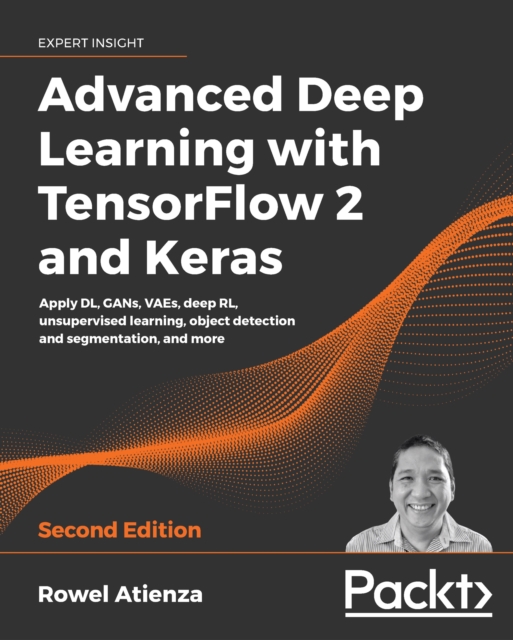
Advanced Deep Learning With TensorFlow 2 and Keras: Apply DL Techniques, GANs, VAEs, Deep RL, SSL, Object Detection, Semantic Segmentation, and More
Updated and revised second edition of the bestselling guide to advanced deep learning with TensorFlow 2 and KerasKey FeaturesExplore the most advanced deep learning techniques that drive modern AI resultsNew coverage of unsupervised deep learning using mutual information, object detection, and semantic segmentationCompletely updated for TensorFlow 2.xBook DescriptionAdvanced Deep Learning with TensorFlow 2 and Keras, Second Edition is a completely updated edition of the bestselling guide to the advanced deep learning techniques available today. Revised for TensorFlow 2.x, this edition introduces you to the practical side of deep learning with new chapters on unsupervised learning using mutual information, object detection (SSD), and semantic segmentation (FCN and PSPNet), further allowing you to create your own cutting-edge AI.Using Keras as an open-source deep learning library, the book features hands-on projects that show you how to create more effective AI with the most up-to-date techniques.Starting with an overview of multi-layer perceptrons (MLPs), convolutional neural networks (CNNs), and recurrent neural networks (RNNs), the book then introduces more cutting-edge techniques as you explore deep neural network architectures, including ResNet and DenseNet, and how to create autoencoders. You will then learn about GANs, and how they can unlock new levels of AI performance.Next, you'll discover how a variational autoencoder (VAE) is implemented, and how GANs and VAEs have the generative power to synthesize data that can be extremely convincing to humans. You'll also learn to implement DRL such as Deep Q-Learning and Policy Gradient Methods, which are critical to many modern results in AI.What you will learnImplement advanced deep learning models using TensorFlow 2 and Keras (tf.keras)Use segmentation to identify the pixel-wise class of each object in an imageIdentify both the bounding box and class of objects in an image using object detectionLearn the building blocks for advanced techniques - MLPss, CNN, and RNNsUnderstand deep neural networks - including ResNet and DenseNetUnderstand and build autoregressive models - autoencoders, VAEs, and GANsDiscover and implement deep reinforcement learning methods Who This Book Is ForThis is not an introductory book, so fluency with Python is required. The reader should also be familiar with some machine learning approaches, and practical experience with DL will also be helpful. Knowledge of Keras or TensorFlow 2.0 is not required but is recommended.
eBook
EfficientSpeech: An On-Device Text to Speech Model
State of the art (SOTA) neural text to speech (TTS) models can generate natural-sounding synthetic voices. These models are characterized by large memory footprints and substantial number of operations due to the long-standing focus on speech quality with cloud inference in mind. Neural TTS models are generally not designed to perform standalone speech syntheses on resource-constrained and no Internet access edge devices. In this work, an efficient neural TTS called EfficientSpeech that synthesizes speech on an ARM CPU in real-time is proposed. EfficientSpeech uses a shallow non-autoregressive pyramid-structure transformer forming a U-Network. EfficientSpeech has 266k parameters and consumes 90 MFLOPS only or about 1% of the size and amount of computation in modern compact models such as Mixer-TTS. EfficientSpeech achieves an average mel generation real-time factor of 104.3 on an RPi4. Human evaluation shows only a slight degradation in audio quality as compared to FastSpeech2.
Paper

A Flexible Control Architecture for Mobile Robots: An Application for a Walking Robot
To get the best features of both deliberative and reactive controllers, present mobile robot control architectures are designed to accommodate both types of controller. However, these architectures are still very rigidly structured thus deliberative modules are always assigned to the same role as a high-level planner or sequencer while low-level reactive modules are still the ones directly interacting with the robot environment. Furthermore, within these architectures communication and interface between modules are if not strongly established, they are very complex thus making them unsuitable for simple robotic systems. Our idea in this paper is to present a control architecture that is flexible in the sense that it can easily integrate both reactive and deliberative modules but not necessarily restricting the role of each type of controller. Communication between modules is through simple arbitration schemes while interface is by connecting a common communication line between modules and simple read and/or write access of data objects. On top of these features, the proposed control architecture is scalable and exhibits graceful degradation when some of the modules fail, similar to the present mobile robot architectures. Our idea has enabled our four-legged robot to walk autonomously in a structured uneven terrain.
Journal Article
Scene Text Recognition Models Explainability Using Local Features
Explainable AI (XAI) is the study on how humans can be able to understand the cause of a model's prediction. In this work, the problem of interest is Scene Text Recognition (STR) Explainability, using XAI to understand the cause of an STR model's prediction. Recent XAI literatures on STR only provide a simple analysis and do not fully explore other XAI methods. In this study, we specifically work on data explainability frameworks, called attribution-based methods, that explain the important parts of an input data in deep learning models. However, integrating them into STR produces inconsistent and ineffective explanations, because they only explain the model in the global context. To solve this problem, we propose a new method, STRExp, to take into consideration the local explanations, i.e. the individual character prediction explanations. This is then benchmarked across different attribution-based methods on different STR datasets and evaluated across different STR models.
Paper
Improving Model Generalization by Agreement of Learned Representations from Data Augmentation
Data augmentation reduces the generalization error by forcing a model to learn invariant representations given different transformations of the input image. In computer vision, on top of the standard image processing functions, data augmentation techniques based on regional dropout such as CutOut, MixUp, and CutMix and policy-based selection such as AutoAugment demonstrated state-of-the-art (SOTA) results. With an increasing number of data augmentation algorithms being proposed, the focus is always on optimizing the input-output mapping while not realizing that there might be an untapped value in the transformed images with the same label. We hypothesize that by forcing the representations of two transformations to agree, we can further reduce the model generalization error. We call our proposed method Agreement Maximization or simply AgMax. With this simple constraint applied during training, empirical results show that data augmentation algorithms can further improve the classification accuracy of ResNet50 on ImageNet by up to 1.5%, WideResNet40-2 on CIFAR10 by up to 0.7%, WideResNet40-2 on CIFAR100 by up to 1.6%, and LeNet5 on Speech Commands Dataset by up to 1.4%. Experimental results further show that unlike other regularization terms such as label smoothing, AgMax can take advantage of the data augmentation to consistently improve model generalization by a significant margin. On downstream tasks such as object detection and segmentation on PascalVOC and COCO, AgMax pre-trained models outperforms other data augmentation methods by as much as 1.0mAP (box) and 0.5mAP (mask). Code is available at https://github.com/roatienza/agmax.
Paper