
Catalogue Search | MBRL


Are you sure you want to remove the book from the shelf?

{{itemTitle}}
2,764
result(s) for
"Atkinson, David"
Sort by:


Warming-induced reductions in body size are greater in aquatic than terrestrial species
Most ectothermic organisms mature at smaller body sizes when reared in warmer conditions. This phenotypically plastic response, known as the \"temperature-size rule\" (TSR), is one of the most taxonomically widespread patterns in biology. However, the TSR remains a longstanding life-history puzzle for which no dominant driver has been found. We propose that oxygen supply plays a central role in explaining the magnitude of ectothermic temperature-size responses. Given the much lower oxygen availability and greater effort required to increase uptake in water vs. air, we predict that the TSR in aquatic organisms, especially larger species with lower surface area-body mass ratios, will be stronger than in terrestrial organisms. We performed a meta-analysis of 1,890 body mass responses to temperature in controlled experiments on 169 terrestrial, freshwater, and marine species. This reveals that the strength of the temperature-size response is greater in aquatic than terrestrial species. In animal species of ~100 mg dry mass, the temperature-size response of aquatic organisms is 10 times greater than in terrestrial organisms (-5.0% °C⁻¹ vs. -0.5% °C⁻¹). Moreover, although the size response of small (< 0.1 mg dry mass) aquatic and terrestrial species is similar, increases in species size cause the response to become increasingly negative in aquatic species, as predicted, but on average less negative in terrestrial species. These results support oxygen as a major driver of temperaturesize responses in aquatic organisms. Further, the environment-dependent differences parallel latitudinal body size dines, and will influence predicted impacts of climate warming on food production, community structure, and food-web dynamics.
Journal Article


LLM ethics benchmark: a three-dimensional assessment system for evaluating moral reasoning in large language models
This study establishes a novel framework for systematically evaluating the moral reasoning capabilities of large language models (LLMs) as they increasingly integrate into critical societal domains. Current assessment methodologies lack the precision needed to evaluate nuanced ethical decision-making in AI systems, creating significant accountability gaps. Our framework addresses this challenge by quantifying alignment with human ethical standards through three dimensions: foundational moral principles, reasoning robustness, and value consistency across diverse scenarios. This approach enables precise identification of ethical strengths and weaknesses in LLMs, facilitating targeted improvements and stronger alignment with societal values. To promote transparency and collaborative advancement in ethical AI development, we are publicly releasing both our benchmark datasets and evaluation codebase at
https://github.com/The-Responsible-AI-Initiative/LLM_Ethics_Benchmark.git
.
Journal Article

Usborne first encyclopedia of space
A bright, lively introduction to space with simple text, amazing photographs and detailed illustrations. It provides simple explanations to questions such as 'What are stars made of?' 'Why does the Moon shine?' and 'What do space toilets look like?'.
CHILDBOOK

The Anglo-Scottish Ballad and its Imaginary Contexts
This is the first book to combine contemporary debates in ballad studies with the insights of modern textual scholarship. Just like canonical literature and music, the ballad should not be seen as a uniquely authentic item inextricably tied to a documented source, but rather as an unstable structure subject to the vagaries of production, reception, and editing. Among the matters addressed are topics central to the subject, including ballad origins, oral and printed transmission, sound and writing, agency and editing, and textual and melodic indeterminacy and instability. While drawing on the time-honoured materials of ballad studies, the book offers a theoretical framework for the discipline to complement the largely ethnographic approach that has dominated in recent decades. Primarily directed at the community of ballad and folk song scholars, the book will be of interest to researchers in several adjacent fields, including folklore, oral literature, ethnomusicology, and textual scholarship.
eBook
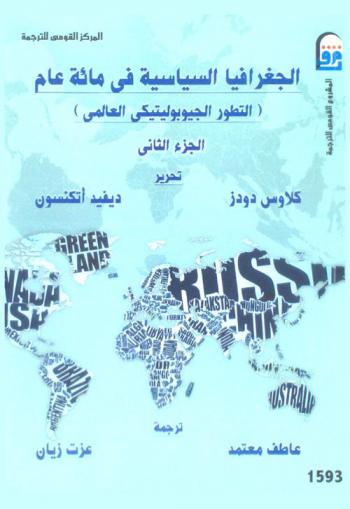
الجغرافيا السياسية في مائة عام : التطور الجيوبوليتيكي العالمي
منذ ظهور الجيوبوليتيك كمصطلح مبهم قبيل نهاية القرن التاسع عشر وحتى انتشار استخداماته غير الدقيقة أحيانا في الوقت الحاضر، كان هذا المصطلح محور جدل شديد وحاد في كثير من الأحوال. يقوم هذا الكتاب بجمع التأملات المتعلقة بالإشكالية المزمنة لما هو جيوبوليتيكي طوال القرن العشرين، وهو يحقق ذلك في ضوء المقاربات التي وفرتها التواريخ النقدية للجغرافيا والجيوبوليتيك النقدية، ويتناول بعض التعبيرات الموضوعية للجيوبوليتيك، كما يتناول بعض التجارب غير الأنجلوفونية الأقل شهرة.
BOOK

Recipes for Forming a Carbon–Rich Giant Planet
The exploration of carbon-to-oxygen ratios has yielded intriguing insights into the composition of close-in giant exoplanets, giving rise to a distinct classification: carbon-rich planets, characterized by a carbon–to–oxygen ratio ≥ 1 in their atmospheres, as opposed to giant planets exhibiting carbon–to–oxygen ratios close to the protosolar value. In contrast, despite numerous space missions dispatched to the outer solar system and the proximity of Jupiter, Saturn, Uranus, and Neptune, our understanding of the carbon-to-oxygen ratio in these giants remains notably deficient. Determining this ratio is crucial as it serves as a marker linking a planet’s volatile composition directly to its formation region within the disk. This article provides an overview of the current understanding of the carbon-to-oxygen ratio in the four gas giants of our solar system and explores why there is yet no definitive dismissal of the possibility that Jupiter, Saturn, Uranus, or Neptune could be considered carbon-rich planets. Additionally, we delve into the three primary formation scenarios proposed in existing literature to account for a bulk carbon-to-oxygen ratio ≥ 1 in a giant planet. A significant challenge lies in accurately inferring the bulk carbon-to-oxygen ratio of our solar system’s gas giants. Retrieval methods involve integrating in situ measurements from entry probes equipped with mass spectrometers and remote sensing observations conducted at microwave wavelengths by orbiters. However, these methods fall short of fully discerning the deep carbon-to-oxygen abundance in the gas giants due to their limited probing depth, typically within the 10–100 bar range. To complement these direct measurements, indirect determinations rely on understanding the vertical distribution of atmospheric carbon monoxide in conjunction with thermochemical models. These models aid in evaluating the deep oxygen abundance in the gas giants, providing valuable insights into their overall composition.
Journal Article