
Catalogue Search | MBRL


Are you sure you want to remove the book from the shelf?

{{itemTitle}}
796
result(s) for
"Atwood, Sarah"
Sort by:

The power and promise of transparency: Perspectives from citizens’ juries of pandemic health data sharing
The COVID-19 pandemic response in the UK, as in other countries, drew heavily on health and social care data, making its utility extremely visible as necessary for timely government decision-making and planning. The urgency created by the crisis, however, meant that additional data collection and sharing under emergency legislation was implemented with minimal public consultation. To understand the public perception of these new data measures and initiatives, three citizens’ juries took place in the spring of 2021. This article reports on qualitative observations of the small group deliberations from these juries. The analysis shows that jurors frequently drew on normative discourses of transparency and trust in discussions, and the different roles they were assumed to fulfil. Transparency was expected to offer greater visibility into the organisations involved in health and social care data sharing, but this was made difficult by the increased complexity of the health data economy. Transparency into the political justifications for additional health data collection was important for jurors. The utilitarian narratives used by the government were considered problematic, restricting opportunities for individuals to express concerns and leading to cynicism. The findings will be situated with the critical literature on visibility practices to highlight the need to unpick what the promise of transparency and trust offers to the public and how it links to power and control. Lastly, it will examine what the deliberations around transparency mean for wider policy on health and social care data-sharing.
Journal Article
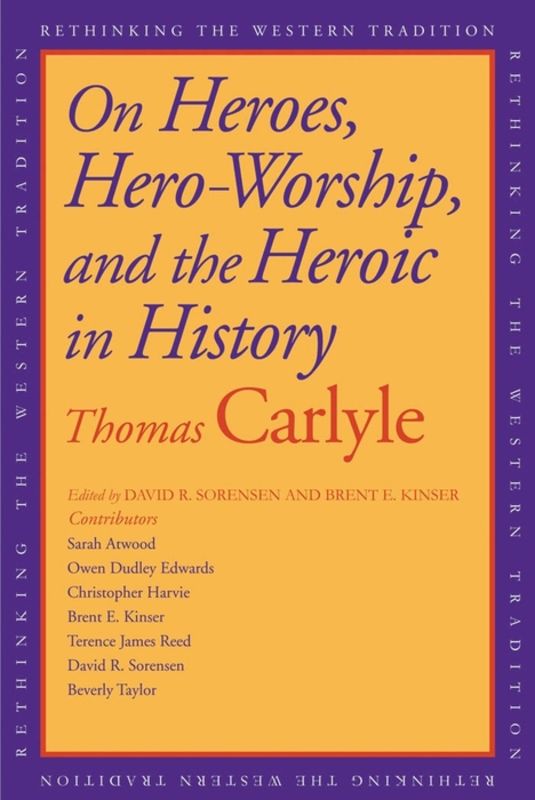
On Heroes, Hero Worship, and the Heroic in History
Based on a series of lectures delivered in 1840, Thomas Carlyle'sOn Heroes, Hero-Worship, and the Heroic in Historyconsiders the creation of heroes and the ways they exert heroic leadership. From the divine and prophetic (Odin and Muhammad) to the poetic (Dante and Shakespeare) to the religious (Luther and Knox) to the political (Cromwell and Napoleon), Carlyle investigates the mysterious qualities that elevate humans to cultural significance.By situating the text in the context of six essays by distinguished scholars that reevaluate both Carlyle's work and his ideas, David Sorensen and Brent Kinser argue that Carlyle's concept of heroism stresses the hero's spiritual dimension. In Carlyle's engagement with various heroic personalities, he dislodges religiosity from religion, myth from history, and truth from \"quackery\" as he describes the wondrous ways in which these \"flowing light-fountains\" unlock the heroic potential of ordinary human beings.
eBook
