
Catalogue Search | MBRL


Are you sure you want to remove the book from the shelf?

{{itemTitle}}
20
result(s) for
"Autio, Tero"
Sort by:

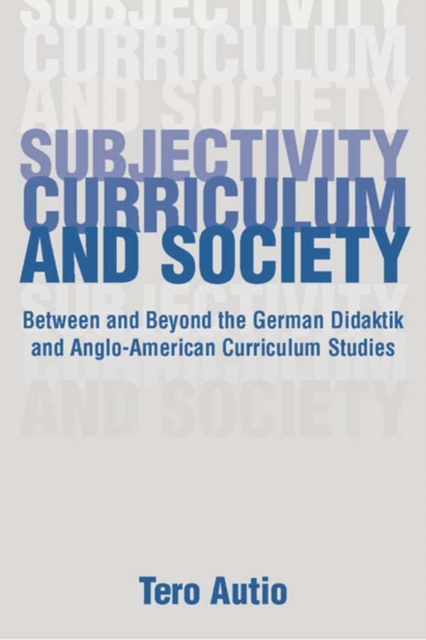
Subjectivity, curriculum and society
In this book Tero Autio traces not only the key philosophical currents that structure traditional Anglo-American instrumental curriculum theory and Didaktik theories of curriculum which are lesser-known in the U.S., but also the divide between them and, implicitly, the opportunities for traversing this divide. Using careful historical and theoretical exposition to work through the tension between the two intellectual traditions, he describes a different perspective--one that counters the current move toward politicization and commodification. Autio's articulation of the complexity, intellectual honesty, and educational value of theoretical breakthroughs over the past few decades, especially in the American field of curriculum studies, leads to a better understanding of the complicated nature of curriculum work, as contrasted with the simplified demands of actual curriculum theory, policy, and practice worldwide.
This original work of great intellectual power and theoretical significance is an essential text for scholars in the fields curriculum studies, philosophy of education, and comparative education and for graduate-level courses in these areas.
Contents: Preface. Introduction. \"Truth As Utility\": Reconsidering the Rise of Scientific Method as a Pragmatic Precursor for Modernist Curriculum Thinking. From Theology and Metaphysics to the Culture of Method: The Cartesian Revolution of Epistemology and Curriculum. The Puritan-Protestant Disenchantment of Spirituality: The Rationalization of Religion, Inquiring Mind, and Education. Curricular Predicaments of John Locke's Liberalism: Pleasure and Reason; Psychology and Politics. Curriculum and the Politics of Psychology: \"Conformity of Wills and Predictability of Behavior.\" Epilogue: Toward a Curriculum Discourse Sui Generis.
eBook

Curriculum and the Politics of Psychology: “Conformity of Wills and Predictability of Behavior”
The foregoing historical excursions were intended to show the rise of the new
scientific approach which superseded scholastic philosophy and its conception of reason and rationality. Instead of disinterested philosophical speculation, modern scientific reason powered by novel mathematical innovations
and the experimental method was geared ultimately to practical purposes.
Not only philosophy but also the status of theology as a viable worldview was
challenged. The isolation of the divine from the emergent scientific interests
was already implicitly present, as noted before, in the Cartesian epistemology. The dualistic two-world theory of reality had pervaded intellectual history from Plato down to Luther, but it was the Cartesian division between the
divine and the human as the epistemological stand that proved decisive for the
breakthrough of modernity. That original division was now focused as the
duality between mind and body. This picture, where mind inhabited the infinite, transcendental, and free realm of Ideas and body was subordinated to
the orders of the phenomenal world was reflected again in Immanuel Kant’s
formulation of the dual nature of the human being: as the inhabitant of the
determinate, knowable world of Erscheinungen in space and time and as the
free moral agent of the invisible, indeterminate, and unknowable world of
Dinge an sich (Kant, 1978, p. 53). The basic dilemma already hovering above
the Cartesian conceptions resurfaced in Kant’s metaphorical ponderings in
the conclusion to the Critique of Practical Reason: how to combine the lawsof the ‘starry heavens’ with the demands of moral law. The human is the irreconcilable double manifestation as an animal creation (“als ein tierisches
Geschöpf”) composed temporarily of celestial dust and as a personality who
is disembedded from the animality and the constraints of sensual reality by
the recognition of the infinite and free Intelligenz, whose main instance the
moral law is (Kant, 1984, pp. 253-254). The Kantian project, with its three
Critiques, may be conceived in its entirety as an effort to understand reason
and Intelligenz beyond their merely instrumental uses Kant might already
have anticipated in the powerfully rising profile of the natural sciences. But
the difficulties involved in the attempt to conceive reason and rationality in
more comprehensive terms derived initially from the structure of his reasoning, where the transcendental preconditions of morality (“die absolute
Spontaneität der Freiheit”; Kant, 1984, p. 81; p. 159) were analogous to the a
priori conditions of knowledge of outer reality; because, in practice, this
structural decision was based, conceivably, on a dream of the “sicheren Gang
der Wissenschaften” also in the realm of moral study-as in Locke. The
moral equivalent of the thought categories-the Categorical Imperative:
“Handle so, dass die Maxime deines Willens jederzeit als Prinzip einer
allgemeinen Gesetzgebung gelten könne” (Kant, 1984, p. 53)—would function rather as a formal test of the moral principles, “als die oberste Bedingung
aller Maximen” (p. 53), we already have than as a genuine source of those
principles. Thus determination of the transcendental conditions for the moral
world remained elusive and uninformative:We cannot, therefore, know morality; we can only by a priori reasoning arrive
at the conclusion that it must exist logically as a corrective to the determinate
world, as a source of values. At this point [Kant’s] philosophy becomes most
controversial, since his moral theory is one in which we are obliged to recognize
a moral law and to strive towards its imperatives even though we cannot know
it. Indeed, by definition, the moral law cannot be known; if it were, it would be
part of the external, determinate order. The problem as Kant posed it is virtually insoluble; either the separate moral realm must be affirmed or else morality
must be accepted as part of the determinate world, with the inevitable consequence that it has no absolute value. (Bowen, 1981, p. 211)KANT ON EDUCATIONThe philosophical controversy between the determinate and free order of
moral reality also shaped in some respect Kant’s theory of education. He was
firmly convinced that “the greatest and most difficult problem to which man
can devote himself is the problem of education” (Kant, 1991, p. 11). Related
more specifically to the moral aspects of education he was pondering:One of the greatest problems of education is how to unite submission to the necessary restraint with the child’s capability of exercising his free will-for restraint is necessary. How am I to develop the sense of freedom in spite of the restraint? I am to accustom my pupil to endure the restraint of his freedom, and at
the same time I am to guide him to use his freedom aright. Without this all education is merely mechanical, and the child, when his education is over, will
never be able to make a proper use of his freedom. He should be made to feel
early the inevitable opposition of society, that he may learn how difficult it is to
support himself, to endure privation, and to acquire those things which are necessary to make him independent. (pp. 27-28)These words have proved prophetic; they comprise many keys to an understanding of modern education (and, for that matter, also the context of its
postmodern critique): the dilemma between the regulation of behavior and
individual freedom; the same dualistic problematique at societal level: the
sharply liberalistic focus on the individual struggle against society; and the
partly “mechanical” nature of modern education and schooling.
Book Chapter
From Theology and Metaphysics to the Culture of Method: The Cartesian Revolution of Epistemology and Curriculum
The idea of the self-sufficient rational actor Descartes was aiming for in his
coup d’état over Aristotelian thought could hardly have dispensed with the
deliberate educational contribution, and Descartes clearly recognized the
need for its creation. Based on the ‘rightly conducting one’s reason’ and on
the principle of the growth of knowledge, Descartes was able to refresh the
already method-focused tradition of educational field (e.g., Ramus and
Comenius) in accordance with the vistas of the rising New Science. In his paradigm dispute against Aristotelian science Descartes clearly saw the crucial
importance of education. His constant appeal to the educability of the public,
provided proper (his!) curricular terms are met, would form one front of this
ideological battle.
Book Chapter
Introduction
Simply put, two basic models of thought have been applied in conceptualizing Western education with its interrelated notions of teaching and learning.
The one draws on the Anglo-Saxon tradition of curriculum studies, the other
on the Continental European tradition of Didaktik (Gundem & Hopmann,
1998). The division is somewhat gross and it does only partial justice to the
Latin European Continent (i.e., France, Italy, Spain, Portugal, and some
parts of Switzerland) and the Nordic countries (Denmark, Finland, Iceland,
Norway, and Sweden). National principles of curriculum study and design
may involve their own rather autonomous principles or a blend of elements
from both of those models. Indeed, shifts in emphasis may even have occurred from one model to another, as the example of Finland might prove,
where the former authoritative curriculum partnership with the German
Didaktik has been gradually altered since WWII, to a conception of teaching and learning in terms of curriculum study and design informed mostly by
Anglo-American educational psychology-albeit paradoxically, still in the
name of Didaktik. Furthermore, most recently, the neat compartmentalization of the two models may be disturbed by worldwide developments in education where its structures and functions have been strongly challenged during the last two decades by what A. V. Kelly (1999) terms “the politicization
of the curriculum.” This phenomenon has also become known as the “restructuring education” movement, a kind of globalization of educational institutions in terms of economic metaphors (see, for instance, Carlgren &
Klette, 2000; Kelly, 1999; Whitty, 2002; Whitty, Power, & Halpin, 1998). Asa consequence of these events the national character and imagery of education are shifting to become more amenable to transnational or global influences. For this reason, apart from acknowledging the national roots of each
of these discourses and their international influence, it might be equally appropriate to find discursive means of going beyond any single and/or set of alternatives in more adequate and novel terms of education. The ruptures and
breaks in question concern the field of curriculum studies as well as other
fields of human practice. In this context it is well to recognize the ideological
interest of the and/or to reproduce the educational hopes of the civilized
Western hemisphere, plagued as it is by the dynamics of upheaval in economic, social, cultural and identity structures. Research into international
curriculum discourse in terms of two alternatives would decisively obscure
some of the complexity of the problems of current educational practice if it
were to restrict itself to this binary relation as subordinated versions of those
supposed superdiscourses. In this sense, then, the division may rather be accepted for pedagogic reasons, as a historically conditioned point of departure
in more nuanced and decompartmentalizing, deconstructive studies of education, teaching, and learning.
Book Chapter
Epilogue: Toward a Curriculum Discourse Sui Generis?
The symbolic curriculum of the Tyler Rationale as a model of social world
rested ultimately on the presumption of infallible scientific method and perfectly exact language. The univocal source of authority in this approach has
been left intact in most recent productions of the reified and commodified images of curriculum discourse. The apparent inability of this logic to face the
complexity of education and the subsequent challenge to conceive curriculum
discourse across sweeping revisions, fragmentations, and ruptures in aesthetics, ethics, politics, science, and in the notions of subjectivity have been convincingly mapped in the magnum opus of the reconceptualized field, Understanding Curriculum, by Pinar and associates (1995). Here, a brief and
preliminary account will be given as a kind of second round of the still ongoing modernity-postmodernity debate focused particularly on the critique of
curricular instrumentalism raised in the Understanding Curriculum. This account may be useful in featuring, in an albeit sketchy and summary way, the
historical roots of instrumental curriculum discourse first imbued with moral
concerns (Descartes), subsequently embodied as ‘sheer’ instrumentality as a
response to “the needs of society” (as in the reception of the Tyler Rationale).
Most recently, in the context of late (Giddens, 1991), second (Beck, 1994) orpostmodernity, performativity as a simulation even of instrumentality has
emerged as our grasp of “the needs of society” in terms of totality and homogeneity has been lost. Literally, and not only ironically, the idea of progress in
terms of performativity would have been transformed to the notion of delivering outputs at the lowest cost. Specifically, the suggestions of Jean Baudrillard and Niklas Luhmann refer to the transition in science whereby
“ ‘performativity’ rather than ‘truth’ has become the criterion of scientific
knowledge” (Crook et al., 1992, p. 216).
Book Chapter
Curricular Predicaments of John Locke’s Liberalism: Pleasure and Reason; Psychology and Politics
In this chapter we focus on the historical and symbolical extension of the contributions of Cartesianism and Calvinism. The symbolic meaning is highly
significant in that in education the choice of content and methods, for instance, invariably reflects some valuespheres; education is essentially a moral
and political enterprise where, arguably, even the most concrete or ‘objective’
plans and actions may symbolize something beyond themselves. Additionally, the boundaries between ideological ‘isms’ might prove permeable.
For instance, when we speak of an educational agenda of Calvinism we have
at the same time to admit that there might be similar elements in ideological
rivals: the Catholicist paradigm of the 16th and 17th centuries, the Ratio
studiorum, exercised by the Jesuits, shared the same disciplined outlook on
education as its Calvinist counterpart: “the Jesuits established, for the first
time in history of Western education, an instrument of potentially farreaching control” (Bowen, 1981, p. 24). However, the Jesuit system lacked
the same cultural strength due to the success of Protestantism among the rising new bourgeois classes. By the same token, Cartesianism-arguably a
symbolic curriculum of modernism with its body-mind distinctions, its preference for reason over other modalities of existence, and its thrust to a quasimathematical blueprint of reality as a guiding image for the politics of knowledge-has maintained its ideological status quo through the varied phases of
history-and despite the obsolescence of Cartesian theories of knowledge
and nature as such.
Book Chapter
“Truth as Utility”: Reconsidering the Rise of Scientific Method as a Pragmatic Precursor for Modernist Curriculum Thinking
This chapter constitutes an attempt to delineate the rise of the modern (or
modernist) notion of science and the way it was geared to learning and education from the very outset. Hence, although the names usually linked to pioneering work in philosophy or science-names such as Bacon, Galileo, or
Descartes-the objective here is to show the direct or mediated relevance of
their respective contributions to the formative field of education and curriculum. Education has its own rich history, recorded and interpreted by each
generation in turn, where an auxiliary or foundational role has been reserved
for those great eminences behind the scientific revolution from the 16th century onwards. In fact, however, it may be argued with good reasons that they
have a status among other pioneers of modern education. If the project of the
Enlightenment were conceived as a huge pedagogic project, then the seeds of
the Enlightenment could be argued to have been sown during the era when
mathematics and the empirical method won the battle for the souls of philosophers and scholars. To elucidate the explicit educational bearing of the
modern scientific outlook reflected by many of those early pioneers, notably
Descartes, is one of the main tasks of this and the following chapter. These influences should by no means be conceived as if pedagogic and educational
thought and practice had resulted from philosophical or scientific innovations in any straightforward manner. On the contrary, a more plausible
model of development might be such as has taken place rather on a reciprocalbasis. For instance, the Cartesian epistemological and scientific revolution
grew out of a critique of the school practices of his time; and his invention of
Method might arguably be attributed to educational and curricular discourses in earlier centuries, for example Peter Ramus’ “map of knowledge,”
John Comenius’ methodizations of traditional teaching (Doll, 1998, p. 303),
and the exhaustive method of teaching set out in the Catholic Jesuit scheme
of studies, Ratio Studiorum (Bowen, 1981, p. 24).
Book Chapter