
Catalogue Search | MBRL


Are you sure you want to remove the book from the shelf?

{{itemTitle}}
323
result(s) for
"Avila, Eric"
Sort by:

The folklore of the freeway : race and revolt in the modernist city
\" When the interstate highway program connected America's cities, it also divided them, cutting through and destroying countless communities. Affluent and predominantly white residents fought back in a much heralded \"freeway revolt,\" saving such historic neighborhoods as Greenwich Village and New Orleans's French Quarter. This book tells of the other revolt, a movement of creative opposition, commemoration, and preservation staged on behalf of the mostly minority urban neighborhoods that lacked the political and economic power to resist the onslaught of highway construction.Within the context of the larger historical forces of the 1960s and 1970s, Eric Avila maps the creative strategies devised by urban communities to document and protest the damage that highways wrought. The works of Chicanas and other women of color--from the commemorative poetry of Patricia Preciado Martin and Lorna Dee Cervantes to the fiction of Helena Maria Viramontes to the underpass murals of Judy Baca--expose highway construction as not only a racist but also a sexist enterprise. In colorful paintings, East Los Angeles artists such as David Botello, Carlos Almaraz, and Frank Romero satirize, criticize, and aestheticize the structure of the freeway. Local artists paint murals on the concrete piers of a highway interchange in San Diego's Chicano Park. The Rondo Days Festival in St. Paul, Minnesota, and the Black Archives, History, and Research Foundation in the Overtown neighborhood of Miami preserve and celebrate the memories of historic African American communities lost to the freeway.Bringing such efforts to the fore in the story of the freeway revolt, The Folklore of the Freeway moves beyond a simplistic narrative of victimization. Losers, perhaps, in their fight against the freeway, the diverse communities at the center of the book nonetheless generate powerful cultural forces that shape our understanding of the urban landscape and influence the shifting priorities of contemporary urban policy. \"-- Provided by publisher.
Book
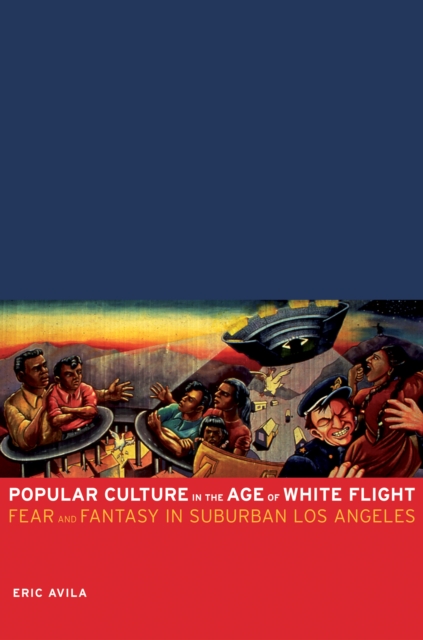
Popular culture in the age of white flight
Los Angeles pulsed with economic vitality and demographic growth in the decades following World War II. This vividly detailed cultural history of L.A. from 1940 to 1970 traces the rise of a new suburban consciousness adopted by a generation of migrants who abandoned older American cities for Southern California's booming urban region. Eric Avila explores expressions of this new \"white identity\" in popular culture with provocative discussions of Hollywood and film noir, Dodger Stadium, Disneyland, and L.A.'s renowned freeways. These institutions not only mirrored this new culture of suburban whiteness and helped shape it, but also, as Avila argues, reveal the profound relationship between the increasingly fragmented urban landscape of Los Angeles and the rise of a new political outlook that rejected the tenets of New Deal liberalism and anticipated the emergence of the New Right. Avila examines disparate manifestations of popular culture in architecture, art, music, and more to illustrate the unfolding urban dynamics of postwar Los Angeles. He also synthesizes important currents of new research in urban history, cultural studies, and critical race theory, weaving a textured narrative about the interplay of space, cultural representation, and identity amid the westward shift of capital and culture in postwar America.
eBook

Dynamical latent state computation in the male macaque posterior parietal cortex
Success in many real-world tasks depends on our ability to dynamically track hidden states of the world. We hypothesized that neural populations estimate these states by processing sensory history through recurrent interactions which reflect the internal model of the world. To test this, we recorded brain activity in posterior parietal cortex (PPC) of monkeys navigating by optic flow to a hidden target location within a virtual environment, without explicit position cues. In addition to sequential neural dynamics and strong interneuronal interactions, we found that the hidden state - monkey’s displacement from the goal - was encoded in single neurons, and could be dynamically decoded from population activity. The decoded estimates predicted navigation performance on individual trials. Task manipulations that perturbed the world model induced substantial changes in neural interactions, and modified the neural representation of the hidden state, while representations of sensory and motor variables remained stable. The findings were recapitulated by a task-optimized recurrent neural network model, suggesting that task demands shape the neural interactions in PPC, leading them to embody a world model that consolidates information and tracks task-relevant hidden states.
Natural behaviors induce changes to hidden states of the world that may be vital to track. Here, in monkeys navigating virtually to hidden goals, the authors show that neural interactions in the posterior parietal cortex play a role in tracking displacement from an unobservable goal.
Journal Article

Roles of bacterial membrane vesicles
Outer membrane vesicles (OMVs) are released from the outer membrane of Gram-negative bacteria. Moreover, Gram-positive bacteria also produce membrane-derived vesicles. As OMVs transport several bacterial components, especially from the cell envelope, their interaction with the host cell, with other bacteria or as immunogens, have been studied intensely. Several functions have been ascribed to OMVs, especially those related to the transport of virulence factors, antigenic protein composition, and development as acellular vaccines. In this work, we review some of the recent findings about OMVs produced by specific pathogenic bacterial species.
Journal Article

Coding of latent variables in sensory, parietal, and frontal cortices during closed-loop virtual navigation
We do not understand how neural nodes operate and coordinate within the recurrent action-perception loops that characterize naturalistic self-environment interactions. Here, we record single-unit spiking activity and local field potentials (LFPs) simultaneously from the dorsomedial superior temporal area (MSTd), parietal area 7a, and dorsolateral prefrontal cortex (dlPFC) as monkeys navigate in virtual reality to ‘catch fireflies’. This task requires animals to actively sample from a closed-loop virtual environment while concurrently computing continuous latent variables: (i) the distance and angle travelled (i.e., path integration) and (ii) the distance and angle to a memorized firefly location (i.e., a hidden spatial goal). We observed a patterned mixed selectivity, with the prefrontal cortex most prominently coding for latent variables, parietal cortex coding for sensorimotor variables, and MSTd most often coding for eye movements. However, even the traditionally considered sensory area (i.e., MSTd) tracked latent variables, demonstrating path integration and vector coding of hidden spatial goals. Further, global encoding profiles and unit-to-unit coupling (i.e., noise correlations) suggested a functional subnetwork composed by MSTd and dlPFC, and not between these and 7a, as anatomy would suggest. We show that the greater the unit-to-unit coupling between MSTd and dlPFC, the more the animals’ gaze position was indicative of the ongoing location of the hidden spatial goal. We suggest this MSTd-dlPFC subnetwork reflects the monkeys’ natural and adaptive task strategy wherein they continuously gaze toward the location of the (invisible) target. Together, these results highlight the distributed nature of neural coding during closed action-perception loops and suggest that fine-grain functional subnetworks may be dynamically established to subserve (embodied) task strategies.
Journal Article

The Folklore of the Freeway
When the interstate highway program connected America's cities, it also divided them, cutting through and destroying countless communities. Affluent and predominantly white residents fought back in a much heralded \"freeway revolt,\" saving such historic neighborhoods as Greenwich Village and New Orleans's French Quarter. This book tells of theotherrevolt, a movement of creative opposition, commemoration, and preservation staged on behalf of the mostly minority urban neighborhoods that lacked the political and economic power to resist the onslaught of highway construction.
Within the context of the larger historical forces of the 1960s and 1970s, Eric Avila maps the creative strategies devised by urban communities to document and protest the damage that highways wrought. The works of Chicanas and other women of color-from the commemorative poetry of Patricia Preciado Martin and Lorna Dee Cervantes to the fiction of Helena Maria Viramontes to the underpass murals of Judy Baca-expose highway construction as not only a racist but also a sexist enterprise. In colorful paintings, East Los Angeles artists such as David Botello, Carlos Almaraz, and Frank Romero satirize, criticize, and aestheticize the structure of the freeway. Local artists paint murals on the concrete piers of a highway interchange in San Diego's Chicano Park. The Rondo Days Festival in St. Paul, Minnesota, and the Black Archives, History, and Research Foundation in the Overtown neighborhood of Miami preserve and celebrate the memories of historic African American communities lost to the freeway.
Bringing such efforts to the fore in the story of the freeway revolt,The Folklore of the Freewaymoves beyond a simplistic narrative of victimization. Losers, perhaps, in their fight against the freeway, the diverse communities at the center of the book nonetheless generate powerful cultural forces that shape our understanding of the urban landscape and influence the shifting priorities of contemporary urban policy.
eBook

Global dynamics of a two-strain flu model with a single vaccination and general incidence rate
Influenza remains one of the major infectious diseases that target humankind, therefore, understand transmission mechanisms and control strategies can help us obtain more accurate predictions. There are many control strategies, one of them is vaccination. In this paper, our purpose is to extend the incidence rate of a two-strain flu model with a single vaccination, which includes a wide range of incidence rates among them, some cases are not monotonic nor concave, which may be used to reflect media education or psychological effect. Our main aim is to mathematically analyze the effect of the vaccine for strain 1, the general incidence rate of strain 1 and the general incidence rate of strain 2 on the dynamics of the model. Four equilibrium points were obtained and the global dynamics of the model are completely determined via suitable Lyapunov functions. We illustrate our results by some numerical simulations. Our results showed that the vaccination is always beneficial for controlling strain 1, its impact on strain 2 depends on the force of infection of strain 2. Also, the psychological effect is always beneficial for controlling the disease.
Journal Article

Modeling the Transmission of the SARS-CoV-2 Delta Variant in a Partially Vaccinated Population
In a population with ongoing vaccination, the trajectory of a pandemic is determined by how the virus spreads in unvaccinated and vaccinated individuals that exhibit distinct transmission dynamics based on different levels of natural and vaccine-induced immunity. We developed a mathematical model that considers both subpopulations and immunity parameters, including vaccination rates, vaccine effectiveness, and a gradual loss of protection. The model forecasted the spread of the SARS-CoV-2 delta variant in the US under varied transmission and vaccination rates. We further obtained the control reproduction number and conducted sensitivity analyses to determine how each parameter may affect virus transmission. Although our model has several limitations, the number of infected individuals was shown to be a magnitude greater (~10×) in the unvaccinated subpopulation compared to the vaccinated subpopulation. Our results show that a combination of strengthening vaccine-induced immunity and preventative behavioral measures like face mask-wearing and contact tracing will likely be required to deaccelerate the spread of infectious SARS-CoV-2 variants.
Journal Article
Purkinje Cell Activity in the Medial and Lateral Cerebellum During Suppression of Voluntary Eye Movements in Rhesus Macaques
Volitional suppression of responses to distracting external stimuli enables us to achieve our goals. This volitional inhibition of a specific behavior is supposed to be mainly mediated by the cerebral cortex. However, recent evidence supports the involvement of the cerebellum in this process. It is currently not known whether different parts of the cerebellar cortex play differential or synergistic roles in planning and execution of this behavior. Here, we measured Purkinje cell (PC) responses in the medial and lateral cerebellum in two rhesus macaques during a pro- and antisaccade task. During an antisaccade trial, non-human primates were instructed to make a saccadic eye movement away from a target, rather than towards it, as in prosaccade trials. Our data shows that the cerebellum plays an important role not only during execution of the saccades, but also during the volitional inhibition of eye movements towards the target. Simple Spike (SS) modulation during the instruction and execution period of pro- and antisaccades was prominent in PCs of both medial and lateral cerebellum. However, only the SS activity in the lateral cerebellar cortex contained information about trial identity and showed a stronger reciprocal interaction with complex spikes. Moreover, SS activity of different PC groups modulated bidirectionally in both regions, but the PCs that showed facilitating and suppressive activity were predominantly associated with instruction and execution, respectively. These findings show that different cerebellar regions and PC groups contribute to goal-directed behavior and volitional inhibition, but with different propensities, highlighting the rich repertoire of cerebellar control in executive functions.
Journal Article

The Chicano Studies Reader
The Chicano Studies Reader , the best-selling anthology
of articles from Aztlán: A Journal of Chicano Studies , has
been newly expanded with a group of essays that focus on Chicana/o
and Latina/o youth. This section, Generations against Exclusion,
joins Decolonizing the Territory, Performing Politics,
(Re)Configuring Identities, Remapping the World, and Continuing to
Push Boundaries. Introductions to each section offer analysis and
contextualization. This fourth edition of the Reader
documents the foundation of Chicano studies, testifies to its broad
disciplinary range, and explores its continuing development.
eBook