
Catalogue Search | MBRL


Are you sure you want to remove the book from the shelf?

{{itemTitle}}
404
result(s) for
"BÉJA, JEAN PHILIPPE"
Sort by:
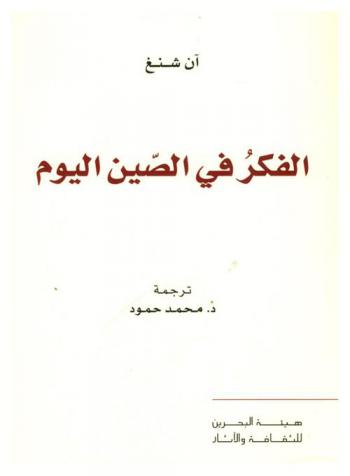
الفكر في الصين اليوم
تناول الكتاب الفكر حول الصين اليوم حيث أنه خلال القرون الثلاثة الأخيرة التي شهدت تكون الحداثة الغربية وسيطرتها، تكونت عن الصين وترسخت صورة صين صاحبة كتابة رمزية، خاضعة لموروث استبدادي، معزولة عن سائر بقاع العالم، طوال قرون، وهو ما يفسر جمودها الفلسفي والسياسي والعلمي الذي جاء الغرب في الوقت المناسب لإيقاظها منه. فحين ننظر إلى كل هذه الترهات، سوف نجدها، بالتأكيد، بصيغ مختلفة وعلى مستويات متفاوتة التنميق، في عدد لا بأس به من المؤلفات الرائجة. وعلينا أن نضيف أن هذه المؤلفات لم تعدم، في المقابل، أن تمارس تأثيرا كبيرا في طريقة النخب الصينية تنظر بها إلى ثقافتها الخاصة، سواء في انتقاد الذات أو، خلافا لذلك كما هو الحال منذ فترة وجيزة، في مدح هذه الذات مدحا معززا بشعور قومي متزايد النخوة.
Book

Xi Jinping's China
An informal civil society formed of official and unofficial NGOs developed during Hu Jintao's tenure (2002–12). Xi Jinping's access to power has signaled a deep change: the new leader has reinforced the Party's leadership in all fields, and dealt a decisive blow to interest groups and political factions. Through institutional reforms and a cult of his personality, he has consolidated his position, and imposed strict limitations on civil society. Repression of dissenting opinions, restoration of ideological control and strongman politics, growing restrictions on the public sphere, and emphasis on \"patriotism\" show that China is heading towards a neo-totalitarianism.
Journal Article

April 27th, 1989: The Day the Chinese People Stood up
On April 26th 1989, the People's Daily published an editorial branding the Student movement that started in the wake of Hu Yaobang's death a \"turmoil\". Despite the supreme leadership's qualification, tens of thousands students supported by urban residents took to the street to protest. It was the first time in the history of the People's Republic that ordinary citizens challenged publicly a decision by the Central committee. On 27th April 1989, the Chinese people stood up: fear had receded, and free expression was taking place. The ensuing events showed that urban residents in the whole of China were willing to express their demands for change in peaceful demonstrations. It symbolizes the emergence of Beijing citizens' new political maturity. Unhappily, it was crushed during the night of June 3rd to June 4th. However, if the ways to express their demands have changed during the following three decades, some changes induced by the movement have been ingrained in people's minds. Rights awareness has resisted the government's innumerable crackdowns.
Journal Article

THE MASSACRE'S LONG SHADOW
The nervousness with which CCP leaders addressed the approach of Tiananmen's twentieth anniversary shows that, despite all efforts to erase this event from official histories and popular memory, the Party remains haunted by it.1 When tanks of the People's Liberation Army (PLA) rolled into downtown Beijing on June 4 to force out the students who-with help from citizens working to block troop movements-had been occupying Tiananmen Square since mid-May, the CCP and its top leader Deng Xiaoping were suddenly cast in a harsh new light. Since consolidating his power in the late 1980s, Deng had come to seem a hero to most Chinese. [...] he overcame the reluctance of his conservative (orthodox Marxist) partners and launched a new wave of economic reforms in 1992.5 Insisting that the CCP's main task was to make China strong and wealthy, he added that questions about whether a given policy was \"capitalist\" or \"socialist\" were beside the point, since \"development is the most important thing.\"
Journal Article


The Impact of China's 1989 Tiananmen Massacre
The 1989 pro-democracy movement in China constituted a huge challenge to the survival of the Chinese communist state, and the efforts of the Chinese Communist party to erase the memory of the massacre testify to its importance. This consisted of six weeks of massive pro-democracy demonstrations in Beijing and over 300 other cities, led by students, who in Beijing engaged in a hunger strike which drew wide public support. Their actions provoked repression from the regime, which - after internal debate - decided to suppress the movement with force, leading to a still-unknown number of deaths in Beijing and a period of heightened repression throughout the country. This book assesses the impact of the movement, and of the ensuing repression, on the political evolution of the People’s Republic of China.
The book discusses what lessons the leadership learned from the events of 1989, in particular whether these events consolidated authoritarian government or facilitated its adaptation towards a new flexibility which may, in time, lead to the transformation of the regime. It also examines the impact of 1989 on the pro-democracy movement, assessing whether its change of strategy since has consolidated the movement, or if, given it success in achieving economic growth and raising living standards, it has become increasingly irrelevant. It also examines how the repression of the movement has affected the economic policy of the Party, favoring the development of large State Enterprises and provoking an impressive social polarisation. Finally, Jean-Philippe Béja discusses how the events of 1989 are remembered and have affected China’s international relations and diplomacy; how human rights, law enforcement, policing, and liberal thought have developed over two decades.
Jean-Philippe Béja is a Senior Researcher at CNRS (Centre National de la Recherche Scientifique), and CERI-Sciences-Po (Centre for international Studies and Research), Paris, France. He is currently conducting research at the French Centre for Research on Contemporary China (CEFC) and Adjunct Professor at the Department of Government and Public Administration at the Chinese University of Hong Kong.
Introduction: June 4th 1989: A Watershed in Chinese Contemporary History 1. June Fourth: Memory and Ethics 2. The Chinese Communist Party and 4 June 1989 —Or how to get out of it and get away with it 3. The Impact of the June 4th Massacre on the pro-Democracy Movement 4. The Chinese Liberal Camp in Post-June 4th China 5. Wang Xiaobo and the No Longer Silent majority 6. The Seeds of Tiananmen: Reflections on a Growing Chinese Civil Rights Movement 7. The practice of law as conscientious resistance: Chinese weiquan lawyers’ experience 8. The Politicisation of China's Law-Enforcement and Judicial Apparatus 9. The Enduring Importance of Police Repression: Laojiao, the Rule of Law and Taiwan’s Alternative Evolution 10. The Impact of the Tiananmen Crisis on China’s Economic Transition 11. The Tiananmen Incident and the Pro-Democracy Movement in Hong Kong 12. How China managed to de-isolate itself on the international stage and re-engage the world after Tiananmen 13. China and International Human Rights: Tiananmen’s Paradoxical Impact 14. A Shadow over Western Democracies: China’s Political Use of Economic Power
eBook

The New Working Class Renews the Repertoire of Social Conflict
The strikes that shook the factories of the Pearl River Delta in 2010 revealed the emergence of a new generation of workers of peasant origin. Better educated and more demanding than their parents, they used new communication techniques to launch a movement that borrowed from the protest repertoire developed over the last decade. Despite this, it cannot really be said that a social movement has emerged.
Journal Article
The Changing Aspects of Civil Society in China
Beja discusses the changing aspects of civil society in China. The rediscovery of the concept of civil society in the seventies can be considered a landmark in the development of research on Central and Eastern European regimes. The concept became widespread among China specialists and the pro-democracy scholars in exile only after the repression of the 1989 pro-democracy movement.
Journal Article

Steel gate to freedom
Chinese activist Liu Xiaobo-awarded the Nobel Peace Prize while serving an eleven-year prison sentence-has helped shatter longstanding barriers to freedom of organization and expression in China. This biography, written by one of his closest friends, retraces Liu Xiaobo's inspiring life, from his childhood years to his current imprisonment.
eBook

Remembering Liu Xiaobo one year on
When he learned that Liu Xiaobo had won the Nobel Peace Prize, Vaclav Havel-who had not been acknowledged by the Nobel Academy-was extremely happy. Although his doctor had strictly forbidden him to drink alcohol, he opened a bottle he kept hidden for the great occasions, and drank to his success. When asked to write a foreword for the collection of Liu's works that I edited, he did it enthusiastically. In 2011, the Czech dissident who had spent many years in prison before being rewarded with the presidency of the Czechoslovak Republic, died in Prague, aged 75.
Journal Article