
Catalogue Search | MBRL


Are you sure you want to remove the book from the shelf?

{{itemTitle}}
45
result(s) for
"Bøttcher, Louise"
Sort by:

Parents’ Strategies for Taking Care of Their Child with Disability: The Challenges of Being Parents of a Child with Cerebral Palsy in the Danish Social Welfare System
Being the parent of a child with disability can be difficult. Research with a biomedical approach focuses on intrafamilial or intrapsychic challenges, while the social model and critical disability studies point to social barriers in an ableist society. As a third option, cultural-historical theory understand disability as relational and changeable in the intersection between persons and specific socio-cultural conditions. The aim of this study was to investigate how parents of children with cerebral palsy (CP) addressed problems at this intersection by developing care-taking strategies in relation to the Danish welfare system. Focus group interviews with 32 parents were completed. Findings showed that parents developed complex and elaborate strategies for how to struggle for welfare services for their child. The consequences of having a child with CP hinge on parents' ability to learn to manage the mismatch between the needs of their child and social conditions shaped by the welfare system. Keywords: Cerebral Palsy, Cultural Historical Theory, Disability, Parents of Children with Disability, Vygotsky, Welfare State
Journal Article

Systematic cognitive monitoring of children with cerebral palsy – the development of an assessment and follow-up protocol
Cerebral palsy (CP) is associated with cognitive impairments, learning difficulties and reduced social participation. Individual assessment is necessary for individually tailored interventions. This paper describes the development of a systematic follow-up programme of cognition, and the challenges of integrating it into the regular follow-up of children with CP. Initiated by the Nordic users' organisations, a group of psychologists proposed a protocol of follow-up of cognition in children with CP - the CP Cog. This protocol consists of neuropsychological instruments covering general cognitive functioning, visuospatial and executive functioning. The article presents a natural experiment describing development and implementation of the cognitive protocol in three Scandinavian countries. This introduction illustrates challenges associated with implementation, especially how the success of the protocol hinges on structural backup within the different countries. In conclusion the CP Cog assessment protocol holds the promise of increasing the awareness among habilitation professionals that children with CP are in need of cognitive evaluation and educational support.
Journal Article
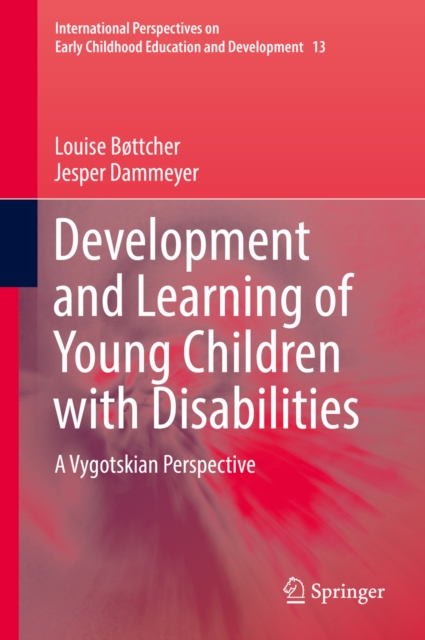
Development and Learning of Young Children with Disabilities
This book introduces current theories and research on disability, and builds on the premise that disability has to be understood from the dialectical dynamics of biology, psychology, and culture over time.
eBook

An Eye for Possibilities in the Development of Children with Cerebral Palsy: Neurobiology and Neuropsychology in a Cultural-Historical Dynamic Understanding
Taking children with Cerebral Palsy (CP) as an example, the article seeks an understanding of
children with disabilities that connects neuropsychological theories of neural development with
the situated cognition perspective and the child as an active participant in its social practices. The
early brain lesion of CP is reconceptualised as a neurobiological constraint that exists in the
relations between the neural, cognitive and social levels. Through a multi-method study of two
children with CP, it is analysed how neurobiological constraints arise, evolve and sometimes are
resolved through local matches between the child and its social practices. The result is discussed
as support of a developmental science approach that includes processes at the social practice level
along with knowledge of biological processes.
Journal Article
Development of a standardized social service pathway for children with complex cerebral palsy
From a cultural-historical perspective, the impairments of a child with a condition like cerebral palsy (CP) have biological origins, but the disability evolves from the mismatch between the child and his/her social conditions for development (Vygotsky, 1993). One example of this dialectical production of disability can be seen in the challenge of the 21st-century welfare state: How to provide economically feasible health and educational services anchored in evidence-based methods and practices. Standardized social service pathways for children with CP illustrates an attempt to address this challenge and moderate the mismatch by acting in the intersection between impairment and society. The aim of the article is to analyze challenges in the practice of connecting research and practice-based knowledge with societal practices in order to diminish the disability of the child. A multidisciplinary group assembled by the Danish National Board of Social Services engaged in a practice of developing a guideline for a social service pathway. Agendas and minutes from their series of meetings provide insight in how the work evolved through conflictual discussions. Rather than a neutral transformation of knowledge into practice, the practice revealed itself as a value-laden process in which the needs of the child and family were at times decentred and the focus shifted to how social services could be realised in complex, structured social practices. While the group managed to overcome several conflicts and agree of a social service pathway, a socio-economic analysis was unable to argue for the comprehensive social service pathway as an economic sound choice for municipal decision-makers. The conflict between the welfare ideology and economic feasibility remains unresolved and can be expected to limit the extent that impairments can be remedied and the mismatch decreased. Overcoming or diminishing the mismatch might never become economic worthwhile. As the political pendulum oscillates between welfare and economic concerns, the experience of disability will likewise diminish or expand.
Journal Article


Attentional and executive impairments in children with spastic cerebral palsy
Aim Children with cerebral palsy (CP) are reported to have learning and social problems. The aim of the present study was to examine whether children with CP have impairments in attention or executive function. Method We examined attention and executive function with standardized neuropsychological measures in a group of children with unilateral (n=15) or bilateral (n=18) spastic CP (14 females, 19 males, mean age 11y 4mo, SD 1y 1mo, range 9y 1mo–13y 7mo; Gross Motor Function Classification System level I n=22, II n=3, III n=6, and IV n=2). Performance was compared with test norms. Results Verbal cognitive functioning fell within the normal range, whereas sustained (p=0.001) and divided attention (p<0.001) were found to be impaired. Greater impairment was observed in executive function in general (p<0.001) and in inhibition (p=0.038) and shifting (p<0.001) in particular. No significant difference was found between types of CP (unilateral and bilateral). Performance of all timed tasks was slower than the test norm (p<0.00). Interpretation The finding of slower performances across tasks may indicate a general impairment in efficiency of information processing in relation to white‐matter lesions. Impairments in attention and executive functions are present in children with CP and may help to explain why these children have increased social and learning problems.
Journal Article