
Catalogue Search | MBRL


Are you sure you want to remove the book from the shelf?

{{itemTitle}}
39
result(s) for
"BLASER, MARIO"
Sort by:

IS ANOTHER COSMOPOLITICS POSSIBLE?
The concept of cosmopolitics developed by Isabelle Stengers and Bruno Latour keeps open the question of who and what might compose the common world. In this way, cosmopolitics offers a way to avoid the pitfalls of reasonable politics, a politics that, defining in advance that the differences at stake in a disagreement are between perspectives on a single reality, makes it possible to sideline some concerns by deeming them unrealistic and, therefore, unreasonable or irrelevant. Figuring the common world as its possible result, rather than as a starting point, cosmopolitics disrupts the quick recourse to ruling out concerns on the basis of their ostensible lack of reality. And yet, questions remain as to who and what can participate in the composition of the common world. Exploring these questions through ethnographical materials on a conflict around caribou in Labrador, I argue that a cosmopolitics oriented to the common world has important limitations and that another orientation might be possible as well.
Journal Article

Ontological Conflicts and the Stories of Peoples in Spite of Europe
Ontological conflicts (conflicts involving different assumptions about “what exists”) are gaining unprecedented visibility because the hegemony of modern ontological assumptions is undergoing a crisis. Such crisis provides the context and rationale for political ontology, a “project” that, emerging from the convergence of indigenous studies, science and technology studies (STS), posthumanism, and political ecology, tackles ontological conflicts as a politicoconceptual (one word) problem. Why? First, because in order to even consider ontological conflicts as a possibility, one must question some of the most profoundly established assumptions in the social sciences, for instance, the assumptions that we are all modern and that the differences that exist are between cultural perspectives on one single reality “out there.” This rules out the possibility of multiple ontologies and what is properly an ontological conflict (i.e., a conflict between different realities). Second, because ontological conflicts pose the challenge of how to account for them without reiterating (and reenacting) the ontological assumption of a reality “out there” being described. To tackle this politicoconceptual problem, I discuss the notion of an all-encompassing modernity and its effects, present the political ontology project, and offer a story of the present moment where the project makes sense.
Journal Article

Ontology and indigeneity
The first challenge faced by a project that seeks to bring concerns with ontology and indigeneity into a conversation is to sort out the various (and possibly divergent) projects that are being mobilized when the former term is used, not the least because what do we mean by ontology impinges upon how we can conceive indigeneity. In this article I play a counterpoint between two ‘ontological’ projects: one in geography, that foregrounds a reality conceived as an always-emergent assemblage of human and non-humans and troubles the politics that such assemblages imply. The other in ethnographic theory, that foregrounds that we are not only dealing with a shifting ontology, a (re)animated world, but also with multiple ontologies, a multiplicity of worlds animated in different ways. Thus, if the heterogeneity of always emerging assemblages troubles the political, the very heterogeneity of these heterogeneous assemblages troubles it even more. What kinds of politics and what kinds of knowledges does this troubling demand? I advance the notion of political ontology as a possible venue to explore this question.
Journal Article
Ontological Conflicts and the Stories of Peoples in Spite of Europe
Ontological conflicts (conflicts involving different assumptions about \"what exists\") are gaining unprecedented visibility because the hegemony of modern ontological assumptions is undergoing a crisis. Such crisis provides the context and rationale for political ontology, a \"project\" that, emerging from the convergence of indigenous studies, science and technology studies (STS), posthumanism, and political ecology, tackles ontological conflicts as a politicoconceptual (one word) problem. Why? First, because in order to even consider ontological conflicts as a possibility, one must question some of the most profoundly established assumptions in the social sciences, for instance, the assumptions that we are all modern and that the differences that exist are between cultural perspectives on one single reality \"out there.\" This rules out the possibility of multiple ontologies and what is properly an ontological conflict (i.e., a conflict between different realities). Second, because ontological conflicts pose the challenge of how to account for them without reiterating (and reenacting) the ontological assumption of a reality \"out there\" being described. To tackle this politicoconceptual problem, I discuss the notion of an all-encompassing modernity and its effects, present the political ontology project, and offer a story of the present moment where the project makes sense.
Journal Article

The Threat of the Yrmo: The Political Ontology of a Sustainable Hunting Program
Various misunderstandings and conflicts associated with attempts to integrate Indigenous Knowledges (IK) into development and conservation agendas have been analyzed from both political economy and political ecology frameworks. With their own particular inflections, and in addition to their focus on issues of power, both frameworks tend to see what occurs in these settings as involving different epistemologies, meaning that misunderstandings and conflicts occur between different and complexly interested perspectives on, or ways of knowing, the world. Analyzing the conflicts surrounding the creation of a hunting program that enrolled the participation of the Yshiro people of Paraguay, in this article I develop a different kind of analysis, one inspired by an emerging framework that I tentatively call \"political ontology.\" I argue that, from this perspective, these kinds of conflicts emerge as being about the continuous enactment, stabilization, and protection of different and asymmetrically connected ontologies.
Journal Article

The Uncommons: An Introduction
This article introduces the term uncommons as a conceptual response to questions that emerged in the context of conflicts around the scale and scope of diverse \"commons\" that are under threat by extractivism. It introduces the articles for this special issue, which were the result of an invitation to think with the concept of uncommons for a variety of situations. It is concluded that these articles provide a strong grounding to think of uncommons as constitutive of the commons, and that \"uncommoning\" might be crucial for giving shape to solid commons. Dans cet article, le terme « incommun » est présenté comme une réponse conceptuelle à des questions soulevées dans un contexte de conflits entourant l'échelle et l'étendue de plusieurs « communs » menacés par l'extractivisme. Il présente les articles de ce numéro spécial, soumis en réponse à l'invitation à réfléchir sur le concept des « incommuns » dans des situations variées. Il conclut que ces articles constituent un fort ancrage suggérant que les incommuns sont constitutifs des communs et que le « faire incommun » pourrait être crucial dans la constitution de communs solides.
Journal Article
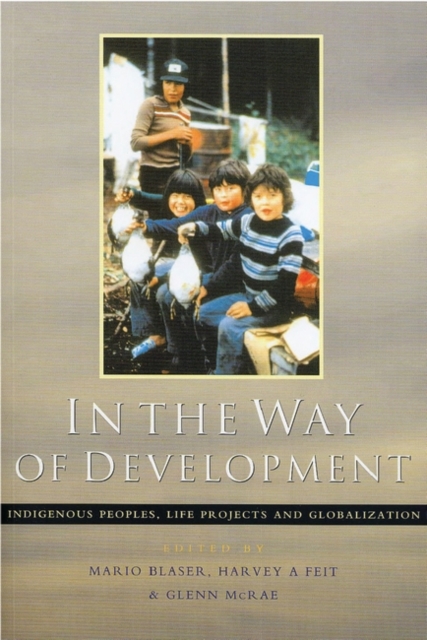
In the way of development : indigenous peoples, life projects and globalization
Indigenous peoples today are enmeshed in the expanding modern economy, subject to the pressures of both market and government. This book takes indigenous peoples as actors, not victims, as its starting point in analysing this interaction. It assembles a rich diversity of statements, case studies and wider thematic explorations, primarily from North America, and particularly the Cree, the Haudenausaunee (Iroquois) and Chippewa-Ojibwe peoples who straddle the US/Canadian border, but also from South America and the former Soviet Union. It explores the complex relationships between indigenous peoples, civil society, and the environment. It shows how the boundaries between indigenous peoples' organizations, civil society, the state, markets, development and the environment are ambiguous and constantly changing. These complexities create both opportunities and threats for local agency. People resist or react to the pressures of market and state, while sustaining 'life projects' of their own, embodying their own local history, visions and strategies.
eBook
Introduction aux incommuns
This article introduces the term uncommons as a conceptual response to questions that emerged in the context of conflicts around the scale and scope of diverse \"commons\" that are under threat by extractivism. It introduces the articles of this special issue, which were the result of an invitation to think with the concept of uncommons for a variety of situations. It is concluded that these articles provide a strong grounding to think of uncommons as constitutive of the commons, and that \"uncommoning\" might be crucial for giving shape to solid commons. : Dans cet article, le terme « incommun » est présenté comme une réponse conceptuelle à des questions soulevées dans un contexte de conflits entourant l'échelle et l'étendue de plusieurs « communs » menacés par l'extractivisme. Il présente les articles de ce numéro spécial, soumis en réponse à l'invitation à réfléchir sur le concept des « incommuns » dans des situations variées. Il conclut que ces articles constituent un fort ancrage suggérant que les incommuns sont constitutifs des communs et que le « faire incommun » pourrait être crucial dans la constitution de communs solides.
Journal Article

The 'Lettered City\ and the Insurrection of Subjugated Knowledges in Latin America
This article explores how the knowledge practices of some academic-intellectuals are shifting in such a way as to signal a radical departure from the \"traditional\" role that academic-intellectuals have had in Latin America. This re-direction is part of a much larger process, namely, the gradual rejection of the modern project by increasingly larger sectors of the Latin American population, and their ongoing efforts to bring about \"worlds and knowledges otherwise.\" In effect, some of the social movements and patterns of mobilization that have become highly visible in Latin America at the turn of the 21st century are probing the modern project—including established knowledge practices of academic-intellectuals—according to expectations, logics and standards other than the ones that have dominated for the last two centuries or more. In particular, the article suggests how these avenues, once opened by social movements, local intellectuals and other sites of knowledge production regarding the intellectual-political project in Latin America, have productively contaminated the dominant regime of power/knowledge (the \"lettered city\") that has been in place since colonial times. A focus on three cases where this contamination is currently taking place points to possible directions in which a reconfiguration of the dominant regime of power/knowledge might proceed. These developments include the relative equalization of diverse knowledge practices through the proliferation of sites of encounter between them, but also a disposition to allow for the contamination of academic-intellectuals' knowledge practices by the insurrectional movements' non-modern knowledge practices.
Journal Article
