
Catalogue Search | MBRL


Are you sure you want to remove the book from the shelf?

{{itemTitle}}
35
result(s) for
"BRESSON, Florent"
Sort by:
Comparing Poverty Variations: A Robustness Assessment of the MDGs’ Achievements with Respect to Poverty Alleviation
Had poverty been halved between 1990 and 2015? In the present paper, we show how well-known stochastic dominance tools can be used to check the robustness of claims regarding monetary poverty variations and then, using data from PovcalNet, provide a new picture of achievements with respect to poverty alleviation during the Millennium Development Goals' era. Using a sample of 90 developing countries, we notably observe that of the 58 countries whose pace of poverty reduction was consistent with a 50 percent decrease in the headcount index over a 25-year period, 51 countries showed distribution changes that were in line with a more general conclusion that poverty would have been halved, whatever the poverty index we use, over the same period. Our results at the global level for the period 2002-2012 also show that the same conclusion robustly holds.
Paper
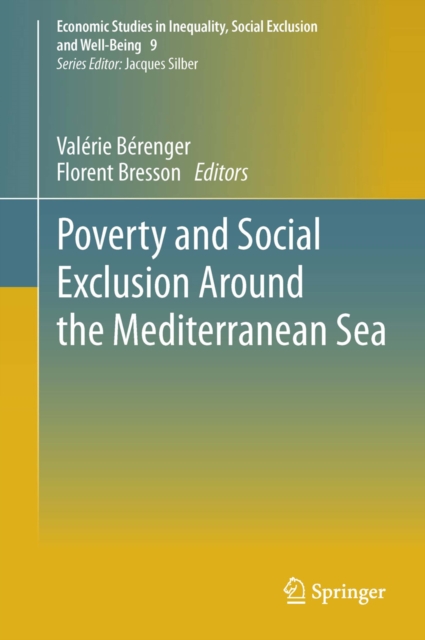
Poverty and Social Exclusion around the Mediterranean Sea
The \"Arab Spring\" events unfolding in southern Mediterranean countries show that multiple deprivations may be powerful drivers of political instability. This book probes the effects of poverty and exclusion, both long-term and in light of current upheaval.
eBook

Intertemporal pro-poorness
A long-lasting scientific and policy debate queries the impact of growth on distribution. A specific branch of the micro-oriented literature, known as 'pro-poor growth', seeks in particular to understand the impact of growth on poverty. Much of that literature supposes that the distributional impact should be measured in an anonymous fashion. The income dynamics and mobility impacts of growth are thus ignored. The paper extends this framework in two important manners. First, the paper uses an 'intertemporal pro-poorness' formulation that accounts separately for anonymous and mobility growth impacts. Second, the paper's treatment of mobility encompasses both the benefit of \"mobility as equalizer\" and the variability cost of poverty transiency. Several decompositions are proposed to measure the importance of each of these impacts of growth on the pro-poorness of distributional changes. The framework is applied to panel data on 23 European countries drawn from the 'European Union Statistics on Income and Living Conditions' survey.
Journal Article

A general class of inequality elasticities of poverty
Many authors have recently emphasized the crucial role of income inequalities in the design of efficient policies aimed at reducing poverty. However, the link between variations in the degree of inequality and variations in poverty is not well documented. The literature, for instance, does not provide any satisfying tool for predicting how a small relative variation in the Gini index may be associated with a variation in the headcount index. In the present paper, we define a family of Lorenz curve transformations that can directly be interpreted in terms of relative variations of known inequality measures. Then, we extend Kakwani’s (Rev Income Wealth 39(2):121–139,
1993
) methodology for the calculation of inequality elasticities of poverty. Improvements are threefold with respect to Kakwani’s work. First, our formulas are not confined to the sole Gini index. Secondly, they embrace the uncertainty and the complexity of the mechanical link between inequality and poverty. Third, using some flexible functional form, one can easily perform an accurate estimation of the point inequality elasticities of poverty corresponding to observed variations of a given income distribution. We also propose a simple measure that may be helpful to assess how “pro-poor” are inequality variations by comparing the observed elasticities with the set of theoretical elasticities that could be obtained from the initial income distribution.
Journal Article
Intertemporal poverty comparisons
The paper deals with poverty orderings when multidimensional attributes exhibit some degree of comparability. The paper focuses on an important special case of this, that is, comparisons of poverty that make use of incomes at different time periods. The ordering criteria extend the power of earlier multidimensional dominance tests by making (reasonable) assumptions on the relative marginal contributions of each time dimension to poverty. Inter alia, this involves drawing on natural symmetry and asymmetry assumptions as well as on the mean/variability framework commonly used in the risk literature. The resulting procedures make it possible to check for the robustness of poverty comparisons to choices of intertemporal aggregation procedures and to areas of intertemporal poverty frontiers. The results are illustrated using a rich sample of 23 European countries over 2006-2009.
Journal Article
Variations sans mesure : le cas de l'extrême pauvreté mondiale durant les OMD
Stochastic dominance techniques can be used to compare poverty variations or assess relative poverty changes. As in the case of poverty orderings, this can be done without reference to a specific poverty index or a specific value for the poverty line. With the help of these tools, the study shows that, during the period 2002-2012, global poverty decreased by at least 50%, whatever the way this global poverty is measured.
Paper
Relative Bipolarization Orderings
This paper first reviews the different dominance criteria that have been proposed in the literature in order to obtain robust bipolarization orderings. We notably contrast dominance criteria related to indices based solely on the distribution of distances from the median, and dominance criteria for the wider set of indices where these distances may not be given the same weight depending on whether they refer to the bottom or the top half of the distribution. In order to increase the set of tools for bipolarization orderings and increase the ordering power of dominance tests without having to impose this neglect of the relative position of each observed income with respect to the median, we also propose sequential dominance criteria that makes it possible for increased distances below (or above) the median to be compensated by reduced distances above (or below) the median, but not vice-versa
Paper
Poverty has Declined, but What about the Burden of Non-Extreme Poverty? Generalized Dominance Criteria for Convex Subsets within the Poverty Domain
Abstract
This paper deals with poverty decompositions into subgroups defined with respect to intervals of income and the robustness of comparisons of the absolute contribution of such groups to poverty. For instance, world poverty estimates by the World Bank often distinguish between the extreme poor whose incomes are lower than $1.25 a day (in PPP terms) and the other poor with incomes between $1.25 and $2.5 a day. Existing dominance conditions can tell whether overall poverty and extreme poverty have declined in a robust manner when comparing countries at two points of time, but they cannot say anything for the contribution of the non-extreme poor to overall poverty. In the present paper we propose stochastic generalized dominance criteria to perform robust poverty ordering when the focus is placed on some interval of the poverty domain. Using generated data based on grouped data from World Bank’s PovcalNet tool, the paper finally investigates whether the robust decline of extreme poverty around the world during the last decades was also accompanied by a decline of the contribution of non-extreme poverty.
Book Chapter
Poverty: Looking for the Real Elasticities
After decades of intensive research on the statistical size distribution of income and despite its empirical weaknesses, the lognormal distribution still enjoys an important popularity in the applied literature dedicated to poverty and inequality. In the present study, we emphasize the drawbacks of this choice for the calculation of the elasticities of poverty. Using last version of WIID database, we estimate the growth and inequality elasticities of poverty using 1,842 income distributions under fifteen rival distribution assumptions. Our results confirm that the lognormal distribution is not appropriate for the analysis of poverty. Most of the time, it implies an overestimation of the elasticities and bias our estimation of the relative impact of growth and redistribution on poverty alleviation.
Paper
Un cadre général pour le calcul des élasticités inégalités de la pauvreté
Many authors have recently emphasized the crucial role of income inequalities in the design of efficient policies aimed at reducing poverty. However, the link between variations of the degree of inequality and variations of poverty are not well documented. The literature, for instance, does not provide any satisfying tool for predicting how a small relative variation of the Gini index can be associated to a variation of the headcount index. In the present paper, we define a family of Lorenz curve transformations that can directly be interpreted in terms of relative variations of known inequality measures. Then, we extend pcitet{kakwani-93} methodology for the calculation of inequality elasticities of poverty. Improvements are threefold with respect to pcitet{kakwani-93} works. First, our formulas do not confine to the sole Gini index. Secondly, they embrace the uncertainty and the complexity of the mechanical link between inequality and poverty. Third, using some flexible functional form, one can easily perform an accurate estimation of the point inequality elasticities of poverty corresponding to observed variations of a given income distribution. Finally, we propose a simple measure that may be helpful to assess how ``pro-poor'' are inequality variations by comparing the observed elasticities with the set of theoretical elasticities that could be obtained from the initial income distribution.
Paper